


Page 68 - Journal of Special Operations Medicine - Winter 2015
P. 68
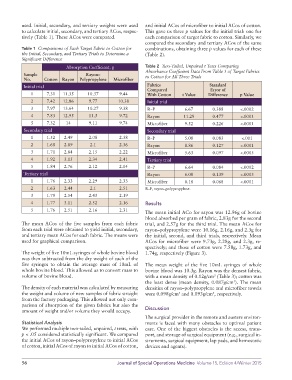
used. Initial, secondary, and tertiary weights were used   and initial ACos of microfiber to initial ACos of cotton.
          to calculate initial, secondary, and tertiary ACos, respec-  This gave us three p values for the initial trial: one for
          tively (Table 1). These ACos were compared.        each comparison of target fabric to cotton. Similarly, we
                                                             compared the secondary and tertiary ACos of the same
          Table 1  Comparisons of Each Target Fabric to Cotton for   combinations, obtaining three p values for each of these
          the Initial, Secondary, and Tertiary Trials to Determine a   (Table 2).
          Significant Difference

                            Absorption Coefficient, g        Table 2  Two-Tailed, Unpaired t Tests Comparing
                                                             Absorbance Coefficient Data From Table 1 of Target Fabrics
           Sample                   Rayon–                   to Cotton for All Three Trials
           No.     Cotton  Rayon  Polypropylene  Microfiber
           Initial trial                                      Fabrics                   Standard
                                                              Compared                  Error of
              1     7.31   11.35     10.37        9.44        With Cotton   t Value    Difference   p Value
              2     7.42   12.86      9.77        10.38       Initial trial
              3     7.97   13.64     10.27        9.38        R–P            6.67        0.388      <.0002
              4     7.83   12.95      11.3        9.72        Rayon          11.29       0.477      <.0001
              5     7.32    14        9.11        9.74        Microfiber     9.52        0.226      <.0001
           Secondary trial                                    Secondary trial
              1     1.52   2.49       2.08        2.38        R–P            5.08        0.083       <.001
              2     1.68   2.89       2.1         2.36        Rayon          8.86        0.127      <.0001
              3     1.71   2.84       2.15        2.22        Microfiber     5.63        0.097      <.0005
              4     1.92   3.15       2.34        2.41        Tertiary trial
              5     1.84   2.76       2.12        2.04        R–P            6.64        0.084      <.0002
           Tertiary trial                                     Rayon          6.08        0.139      <.0003
              1     1.76   2.33       2.29        2.33        Microfiber     8.18        0.068      <.0001
              2     1.63   2.44       2.1         2.51       R–P, rayon–polypropylene.
              3     1.79   2.54       2.43        2.19
              4     1.77   3.11       2.52        2.16       Results
              5     1.76   2.51       2.16        2.31       The mean initial ACo for rayon was 12.96g of bovine
                                                             blood absorbed per gram of fabric, 2.83g for the second
          The mean ACos of the five samples from each fabric   trial, and 2.57g for the third trial. The mean ACos for
          from each trial were obtained to yield initial, secondary,   rayon–polypropylene were 10.16g, 2.16g, and 2.3g for
          and tertiary mean ACos for each fabric. The means were   the initial, second, and third trials, respectively. Mean
          used for graphical comparison.                     ACos for microfiber were 9.73g, 2.28g, and 2.3g, re-
                                                             spectively; and those of cotton were 7.58g, 1.73g, and
          The weight of five 10mL syringes of whole bovine blood   1.74g, respectively (Figure 3).
          was then subtracted from the dry weight of each of the
          five  syringes  to  obtain  the  average  mass  of  10mL  of   The mean weight of the five 10mL syringes of whole
          whole bovine blood. This allowed us to convert mass to   bovine blood was 10.3g. Rayon was the densest fabric,
          volume of bovine blood.                            with a mean density of 0.12g/cm  (Table 3); cotton was
                                                                                         3
                                                             the least dense (mean density, 0.087g/cm ). The mean
                                                                                                 3
          The density of each material was calculated by measuring   densities of rayon–polypropylene and microfiber towels
          the weight and volume of new samples of fabric straight   were 0.098g/cm  and 0.093g/cm , respectively.
                                                                           3
                                                                                         3
          from the factory packaging. This allowed not only com-
          parison of absorption of the given fabrics but also the
          amount of weight and/or volume they would occupy.  Discussion
                                                             The surgical provider in the remote and austere environ-
          Statistical Analysis                               ments is faced with many obstacles to optimal patient
          We performed multiple two-tailed, unpaired, t tests, with   care. One of the biggest obstacles is the access, trans-
          p < .05 considered statistically significant. We compared   port, and storage of surgical equipment (e.g., surgical in-
          the initial ACos of rayon–polypropylene to initial ACos   struments, surgical equipment, lap pads, and  hemostatic
          of cotton, initial ACos of rayon to initial ACos of  cotton,   devices and agents).


          56                                     Journal of Special Operations Medicine  Volume 15, Edition 4/Winter 2015

