


Page 46 - Journal of Special Operations Medicine - Winter 2015
P. 46
smaller diameter forearms than on the calves (CAT, p The Occlusion Pressures used in the comparisons in
= .004; RMT-P, p = .07). With the SWATT, an elastic Table 2 were those of each tourniquet. An alternative
tourniquet whose pressure increases with increasing for the 3.8cm-wide designs would be to use the RMT-P
wraps, the change from Occlusion to Completion was Occlusion Pressures (the lowest Occlusion Pressures of
greater on the smaller diameter forearms than on the the 3.8cm-wide designs). All of the CAT, SOFTT-W, and
calves (p = .03). RMT-P applications that failed to maintain Occlusion
had 120-second Pressures greater than their respective
120Second Pressure RMT-P Occlusion Pressures.
The 120-second Pressures are shown in Figure 6A. The
120-second Pressures are lower than the Completion TighteningSystem Use
Pressures for each tourniquet. Tightening-system use at Completion is shown in Table 3.
Fewer windlass turns were required for CAT applications
The pressure decreases from Completion to 120-sec- than SOFTT-W applications. No SOFTT-W applications
onds are shown in Figure 6B. Since the tourniquet re- required fewer than two turns at Completion, but 10
cipients were directed to remain relaxed throughout the CAT applications required only one turn at Completion.
tourniquet applications, the observed pressure decreases Calf applications required more windlass turns and more
are not likely to be a result of changes in recipient mus- ladder-teeth use than did forearm applications with each
cle tension. The 120-second pressure decreases were tourniquet. The number of SWATT wraps, however, was
highest for the two windlass-tightened tourniquets but less on the larger-diameter calves than on the forearms.
were substantial for all three nonelastic strap designs
(combined median, 49mmHg; minimum–maximum: Ease of Application
7–153mmHg). The 120-second pressure decreases under Ease-of-application data are shown in Table 4. The
the elastic strap SWATT were small (median, 5mmHg; SOFTT-W was the least easy to use. The main reason for
minimum–maximum, 1–14mmHg). The number of the higher application-difficulty rating with the SOFTT-
120-second Pressures below the Occlusion Pressures are W was applier difficulty securing the windlass in the
shown in Table 2 for each tourniquet. windlass securing triangle (Figure 1B).
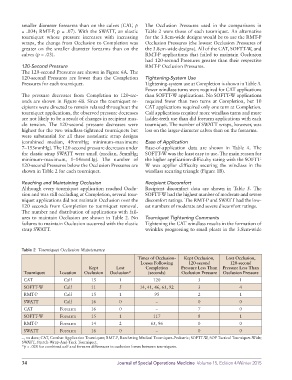
Reaching and Maintaining Occlusion Recipient Discomfort
Although every tourniquet application reached Occlu- Recipient discomfort data are shown in Table 5. The
sion and was still occluding at Completion, several tour- SOFTT-W had the highest number of moderate and severe
niquet applications did not maintain Occlusion over the discomfort ratings. The RMT-P and SWATT had the low-
120 seconds from Completion to tourniquet removal. est numbers of moderate and severe discomfort ratings.
The number and distribution of applications with fail-
ures to maintain Occlusion are shown in Table 2. No Tourniquet Tightening Comments
failures to maintain Occlusion occurred with the elastic Tightening the CAT windlass results in the formation of
strap SWATT. wrinkles progressing to small pleats in the 3.8cm-wide
Table 2 Tourniquet Occlusion Maintenance
Times of Occlusion- Kept Occlusion, Lost Occlusion,
Losses Following 120-second 120-second
Kept Lost Completion Pressure Less Than Pressure Less Than
Tourniquet Location Occlusion Occlusion* (seconds) Occlusion Pressure Occlusion Pressure
CAT Calf 15 1 120 3 1
SOFTT-W Calf 11 5 14, 41, 46, 61, 92 3 4
RMT-P Calf 15 1 95 2 1
SWATT Calf 16 0 – 0 0
CAT Forearm 16 0 – 7 0
SOFTT-W Forearm 15 1 117 8 1
RMT-P Forearm 14 2 65, 96 0 0
SWATT Forearm 16 0 – 0 0
–, no data; CAT, Combat Application Tourniquet; RMT-P, Ratcheting Medical Tourniquet–Pediatric; SOFTT-W, SOF Tactical Tourniquet-Wide;
SWATT, Stretch-Wrap-And-Tuck Tourniquet.
*p = .028 for combined calf and forearm differences in occlusion losses between tourniquets.
34 Journal of Special Operations Medicine Volume 15, Edition 4/Winter 2015

