


Page 43 - Journal of Special Operations Medicine - Winter 2015
P. 43
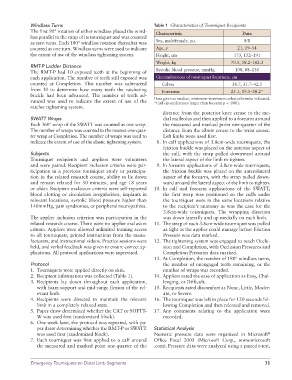
Windlass Turns Table 1 Characteristics of Tourniquet Recipients
The first 90° rotation of either windlass placed the wind- Characteristic Data
lass parallel to the strap of its tourniquet and was counted
as zero turns. Each 180° windlass rotation thereafter was Sex, male/female, no. 8/8
counted as one turn. Windlass turns were used to indicate Age, y 21, 19–54
the extent of use of the windlass tightening system. Height, cm 173, 152–191
Weight, kg 70.5, 58.2–102.3
RMTP Ladder Distance
The RMT-P had 10 exposed teeth at the beginning of Systolic blood pressure, mmHg 108, 88–130
each application. The number of teeth still exposed was Circumferences of tourniquet locations, cm
counted at Completion. This number was subtracted Calves 38.7, 31.7–42.5
from 10 to determine how many teeth the ratcheting Forearms 25.1, 19.5–30.2*
buckle had been advanced. The number of teeth ad-
vanced was used to indicate the extent of use of the Data given as median, minimum–maximum unless otherwise indicated.
*Calf circumferences larger than forearm p < .0001.
ratchet tightening system.
distance from the posterior knee crease to the me-
SWATT Wraps dial malleolus and then applied to a forearm around
Each 360° wrap of the SWATT was counted as one wrap. the measured and marked point one-quarter of the
The number of wraps was counted to the nearest one-quar- distance from the elbow crease to the wrist crease.
ter wrap at Completion. The number of wraps was used to Left limbs were used first.
indicate the extent of use of the elastic tightening system. 8. In calf applications of 3.8cm-wide tourniquets, the
friction buckle was placed on the anterior aspect of
Subjects the calf, with the strap pulled downward around
Tourniquet recipients and appliers were volunteers the lateral aspect of the limb to tighten.
and were paired. Recipient inclusion criteria were par- 9. In forearm applications of 3.8cm-wide tourniquets,
ticipation in a previous tourniquet study or participa- the friction buckle was placed on the anterolateral
tion in the related research course, ability to lie down aspect of the forearm, with the strap pulled down-
and remain relaxed for 50 minutes, and age 18 years ward around the lateral aspect of the limb to tighten.
or older. Recipient exclusion criteria were self-reported 10. In calf and forearm applications of the SWATT,
blood clotting or circulation irregularities, implants in the first wrap was positioned so the cuffs under
relevant locations, systolic blood pressure higher than the tourniquet were in the same locations relative
140mmHg, pain syndromes, or peripheral neuropathies. to the recipient’s anatomy as was the case for the
3.8cm-wide tourniquets. The wrapping direction
The applier inclusion criterion was participation in the was down laterally and up medially on each limb.
related research course. There were no applier exclusion 11. The strap of each 3.8cm-wide tourniquet was pulled
criteria. Appliers were allowed unlimited training access as tight as the applier could manage before Friction
to all tourniquets, printed instructions from the manu- Pressure was data marked.
facturers, and instructional videos. Practice sessions were 12. The tightening system was engaged to reach Occlu-
held, and verbal feedback was given to ensure correct ap- sion and Completion, with Occlusion Pressures and
plications. All protocol applications were supervised. Completion Pressures data marked.
13. At Completion, the number of 180° windlass turns,
Protocol the number of unengaged teeth remaining, or the
1. Tourniquets were applied directly on skin. number of wraps was recorded.
2. Recipient information was collected (Table 1). 14. Appliers rated the ease of application as Easy, Chal-
3. Recipients lay down throughout each application, lenging, or Difficult.
with foam support and mid-range flexion of the rel- 15. Recipients rated discomfort as None, Little, Moder-
evant limb. ate, or Severe.
4. Recipients were directed to maintain the relevant 16. The tourniquet was left in place for 120 seconds fol-
limb in a completely relaxed state. lowing Completion and then released and removed.
5. Paper draw determined whether the CAT or SOFTT- 17. Any comments relating to the application were
W was used first (randomized block). recorded.
6. One week later, the protocol was repeated, with pa-
per draw determining whether the RMT-P or SWATT Statistical Analysis
was used first (randomized block). Numeric pressure data were organized in Microsoft
®
7. Each tourniquet was first applied to a calf around Office Excel 2003 (Microsoft Corp., www.microsoft
the measured and marked point one-quarter of the .com). Pressure data were analyzed using a paired t-test,
Emergency Tourniquets on Distal Limb Segments 31

