


Page 48 - Journal of Special Operations Medicine - Winter 2015
P. 48
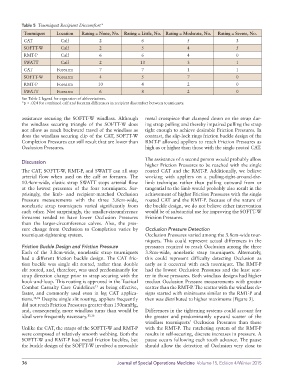
Table 5  Tourniquet Recipient Discomfort*
           Tourniquet   Location   Rating = None, No.  Rating = Little, No.  Rating = Moderate, No.  Rating = Severe, No.
           CAT            Calf            2                6                  5                    3
           SOFTT-W        Calf            2                5                  4                    5
           RMT-P          Calf            6                6                  4                    0
           SWATT          Calf            2                10                 3                    1
           CAT           Forearm          7                7                  1                    1
           SOFTT-W       Forearm          4                5                  7                    0
           RMT-P         Forearm          10               4                  2                    0
           SWATT         Forearm          6                8                  2                    0
          See Table 2 legend for expansion of abbreviations.
          *p = .024 for combined calf and forearm differences in recipient discomfort between tourniquets.


            assistance securing the SOFTT-W windlass. Although   metal crosspiece that clamped down on the strap dur-
          the windlass securing triangle of the SOFTT-W does   ing strap pulling and thereby impaired pulling the strap
          not allow as much backward travel of the windlass as   tight enough to achieve desirable Friction Pressures. In
          does the windlass securing clip of the CAT, SOFTT-W   contrast, the slip-lock rings friction buckle design of the
          Completion Pressures can still result that are lower than   RMT-P allowed appliers to reach Friction Pressures as
          Occlusion Pressures.                               high as or higher than those with the single routed CAT.

                                                             The assistance of a second person would probably allow
          Discussion
                                                             higher Friction Pressures to be reached with the single
          The CAT, SOFTT-W, RMT-P, and SWATT can all stop    routed CAT and the RMT-P. Additionally, we believe
          arterial  flow  when  used  on  the  calf  or  forearm.  The   working with appliers on a pulling-tight-around-the-
          10.4cm-wide, elastic strap SWATT stops arterial flow   limb  technique  rather  than  pulling  outward  from  or
          at  the  lowest  pressures  of  the  four  tourniquets.  Sur-  tangential to the limb would probably also result in the
          prisingly, the limb- and recipient-matched Occlusion   achievement of higher Friction Pressures with the single
          Pressure measurements with the three 3.8cm-wide,   routed CAT and the RMT-P. Because of the nature of
          nonelastic strap tourniquets varied significantly from   the buckle design, we do not believe either intervention
          each other. Not surprisingly, the smaller-circumference   would be of substantial use for improving the SOFTT-W
          forearms tended to have lower Occlusion Pressures   Friction Pressures.
          than the larger-circumference calves. Also, the pres-
          sure change from Occlusion to Completion varies by   Occlusion Pressure Detection
            tourniquet-tightening system.                    Occlusion Pressures varied among the 3.8cm-wide tour-
                                                             niquets.  This  could  represent  actual  differences  in  the
          Friction Buckle Design and Friction Pressure       pressures required to reach Occlusion among the three
          Each of the 3.8cm-wide, nonelastic strap tourniquets   3.8cm-wide, nonelastic strap tourniquets. Alternately,
          had a different friction buckle design. The CAT fric-  this  could  represent  difficulty detecting  Occlusion  as
          tion buckle was single slit routed, rather than double   early as it occurred with each tourniquet. The RMT-P
          slit routed, and, therefore, was used predominantly for   had the lowest Occlusion Pressures and the least scat-
          strap direction change prior to strap securing with the   ter in those pressures. Both windlass designs had higher
          hook-and-loop. This routing is approved in the Tactical   median Occlusion Pressure measurements with greater
          Combat Casualty Care Guidelines  as being effective,   scatter than the RMT-P. The scatter with the windlass de-
                                        13
          faster, and commonly used even in leg CAT applica-  signs started with minimums similar to the RMT-P and
          tions. 12,16  Despite single slit routing, appliers frequently   then was distributed to higher maximums (Figure 3).
          did not reach Friction Pressures greater than 150mmHg,
          and, consequently, more windlass turns than would be   Differences in the tightening systems could account for
          ideal were frequently necessary. 15,16             the greater and predominantly upward scatter of the
                                                             windlass tourniquets’ Occlusion Pressures than those
          Unlike the CAT, the straps of the SOFTT-W and RMT-P   with the RMT-P. The ratcheting system of the RMT-P
          were composed of relatively smooth webbing. Both the   results in self-securing, discrete increases in pressure. A
          SOFTT-W and RMT-P had metal friction buckles, but   pause occurs following each tooth advance. The pause
          the buckle design of the SOFTT-W involved a moveable   should allow the detection of Occlusion very close to


          36                                     Journal of Special Operations Medicine  Volume 15, Edition 4/Winter 2015

