


Page 44 - Journal of Special Operations Medicine - Winter 2015
P. 44
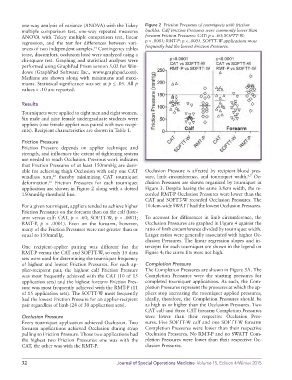
one-way analysis of variance (ANOVA) with the Tukey   Figure 2  Friction Pressures of tourniquets with friction
          multiple comparison test, one-way repeated measures   buckles. Calf Friction Pressures were commonly lower than
          ANOVA with Tukey multiple comparison test, linear   forearm Friction Pressures: CAT: p = .60; SOFTT-W:
          regression, and the test for differences between vari-  p = .0001; RMT-P: p < .0001. SOFTT-W applications most
          ances of two independent samples.  Contingency tables   frequently had the lowest Friction Pressures.
                                        14
          (ease, discomfort, occlusion loss) were analyzed using a
          chi-square test. Graphing and statistical analyses were
          performed using GraphPad Prism version 5.02 for Win-
          dows  (GraphPad  Software  Inc.,  www.graphpad.com).
          Medians are shown along with minimums and maxi-
          mums. Statistical significance was set at p ≤ .05. All p
          values < .10 are reported.


          Results
          Tourniquets were applied to eight men and eight women.
          Six male and nine female undergraduate students were
          appliers (one female applier was paired with two recipi-
          ents). Recipient characteristics are shown in Table 1.

          Friction Pressure
          Friction Pressure depends on applier technique and
          strength, and influences the extent of tightening system
          use needed to reach Occlusion. Previous work indicates
          that Friction Pressures of at least 150mmHg are desir-
          able for achieving thigh Occlusion with only one CAT   Occlusion Pressure is affected by recipient blood pres-
                                                                                                       6,7
          windlass turn,  thereby minimizing CAT tourniquet   sure, limb circumference, and tourniquet width.  Oc-
                       15
          deformation.  Friction Pressures for each tourniquet   clusion Pressures are shown organized by tourniquet in
                     16
          application are shown in Figure 2 along with a dotted   Figure 3. Despite having the same 3.8cm width, the re-
          150mmHg-threshold line.                            corded RMT-P Occlusion Pressures were lower than the
                                                             CAT and SOFTT-W recorded Occlusion Pressures. The
          For a given tourniquet, appliers tended to achieve higher   10.4cm-wide SWATT had the lowest Occlusion Pressures.
          Friction Pressures on the forearm than on the calf (fore-
          arm  versus  calf:  CAT,  p  =  .60;  SOFTT-W,  p  =  .0001;   To account for differences in limb circumference, the
          RMT-P,  p < .0001). Even on the forearm, however,   Occlusion Pressures are graphed in Figure 4 against the
          many of the Friction Pressures were not greater than or   ratio of limb circumference divided by tourniquet width.
          equal to 150mmHg.                                  Larger ratios were generally associated with higher Oc-
                                                             clusion Pressures. The linear regression slopes and in-
          One recipient-applier pairing was different for the   tercepts for each tourniquet are shown in the legend on
          RMT-P versus the CAT and SOFTT-W, so only 15 data   Figure 4; the curve fits were not high.
          sets were used for determining the tourniquet frequency
          of highest and lowest Friction Pressures. For each ap-  Completion Pressure
          plier-recipient pair, the highest calf Friction Pressure   The Completion Pressures are shown in Figure 5A. The
          was most frequently achieved with the CAT (10 of 15   Completion Pressures were the starting pressures for
            application sets) and the highest forearm Friction Pres-  completed tourniquet applications. As such, the Com-
          sure was most frequently achieved with the RMT-P (11   pletion Pressures represent the pressures at which the ap-
          of 15 application sets). The SOFTT-W most frequently   pliers stop increasing the tourniquet applied pressures;
          had the lowest Friction Pressure for an applier-recipient   ideally, therefore, the Completion Pressures should be
          pair regardless of limb (24 of 30 application sets).  as high as or higher than the Occlusion Pressures. Two
                                                             CAT calf and three CAT forearm Completion  Pressures
          Occlusion Pressure                                 were lower than their respective Occlusion Pres-
          Every tourniquet application achieved Occlusion. Two   sures. Five SOFTT-W calf and one SOFTT-W  forearm
          forearm applications achieved Occlusion during strap     Completion Pressures were lower than their respective
          pulling to Friction Pressure. Those two applications had   Occlusion Pressures. No RMT-P and no SWATT Com-
          the highest two Friction Pressures: one was with the   pletion Pressures were lower than their respective Oc-
          CAT, the other was with the RMT-P.                 clusion Pressures.


          32                                     Journal of Special Operations Medicine  Volume 15, Edition 4/Winter 2015

