


Page 41 - Journal of Special Operations Medicine - Winter 2015
P. 41
Medical Solutions Inc., www.tacmedsolutions.com) was   4.0 cm-diameter metal rings with a rough, friction-
              purchased.                                         enhancing coating to secure the correctly routed strap
                                                                 around the limb. Throughout tightening by advancing
              Tourniquets                                        the ratcheting buckle along the teeth of the ladder, the
              The four tourniquets of different widths and tighten-  RMT-P  ratcheting  buckle  is  self-securing  by  ladder-
              ing systems were the 3.8cm-wide windlass CAT and   tooth engagement of its internal pawl.
              SOFTT-W; the 3.8cm-wide  ratchet  RMT-P; and the
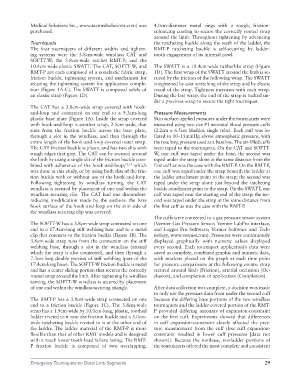
              10.4cm-wide elastic SWATT. The CAT, SOFTT-W, and   The SWATT is a 10.4cm-wide rubberlike strap (Figure
              RMT-P are each composed of a nonelastic fabric strap,   1D). The first wrap of the SWATT around the limb is se-
              friction buckle, tightening system, and mechanism for   cured by the friction of the following wrap. The SWATT
              securing the tightening system for application comple-  is tightened by user stretching of the strap and by elastic
              tion (Figure 1A-C). The SWATT is composed solely of   recoil of the strap. Tightness increases with each wrap.
              an elastic strap (Figure 1D).                      During the last wrap, the end of the strap is tucked un-
                                                                 der a previous wrap to secure the tight tourniquet.
              The CAT has a 3.8cm-wide strap covered with hook-
              and-loop and connected on one end to a 9.3cm-long   Pressure Measurements
              plastic base plate (Figure 1A). Inside the strap covered   Skin surface-applied pressures under the tourniquets were
              with hook-and-loop is another strap, 2.5cm wide, that   measured using two size #1 neonatal blood pressure cuffs
              runs  from  the  friction  buckle  across  the  base  plate,   (2.2cm × 6.5cm bladder, single tube). Each cuff was in-
              through a slot in the windlass, and then through the   flated to 10–15mmHg above atmospheric pressure, with
              entire length of the hook-and-loop covered outer strap.   the resulting pressure used as a baseline. The air-filled cuffs
              The CAT friction buckle is plastic and has two slits with   were taped to the tourniquets. On the CAT and SOFTT-
              rough edges that grip. The CAT can be secured around   W, one cuff was taped under the base; the second was
              the limb by using a single slit of the friction buckle com-  taped under the strap alone at the same distance from the
              bined with adherence of the hook-and-loop, 12,13  which   first cuff as was the case with the RMT-P. On the RMT-P,
              was done in this study, or by using both slits of the fric-  one cuff was taped under the strap beneath the ladder at
              tion buckle with or without use of the hook-and-loop.   the ladder attachment point to the strap; the second was
              Following  tightening  by  windlass  turning,  the  CAT   taped under the strap alone just beyond the ratcheting
              windlass is secured by placement of one end within the   buckle attachment point to the strap. On the SWATT, one
              windlass securing clip. The CAT had one discomfort-  cuff was taped near the starting end of the strap; the sec-
              reducing modification made by the authors: the bare   ond was taped under the strap at the same distance from
              hook surface of the hook-and-loop on the skin side of   the first cuff as was the case with the RMT-P.
              the windlass securing clip was covered.
                                                                 The cuffs were connected to a gas pressure sensor system
              The SOFTT-W has a 3.8cm-wide strap connected on one   (Vernier Gas Pressure Sensor, Vernier LabPro interface,
              end to a 17.4cm-long stiff webbing base and to a metal   and Logger Pro Software; Vernier Software and Tech-
              clip that connects to the friction buckle (Figure 1B). The   nology, www.vernier.com). Pressures were continuously
              3.8cm-wide strap runs from the connection on the stiff   displayed graphically with numeric values displayed
              webbing base, through a slot in the windlass (around   every second. Each tourniquet application’s data were
              which the strap is also connected), and then through a   saved as complete, combined graphic and numeric data,
              7.3cm-long double portion of stiff webbing (part of the   with markers placed on the graph at each time point
              17.4cm-long base). The SOFTT-W friction buckle is metal   for pressure comparisons at the following events: strap
              and has a center sliding portion that secures the correctly   secured around limb (Friction), arterial occlusion (Oc-
              routed strap around the limb. After tightening by windlass   clusion), and completion of application (Completion).
              turning, the SOFTT-W windlass is secured by placement
              of one end within the windlass-securing triangle.  After data collection was complete, a decision was made
                                                                 to only use the pressure data from under the second cuff
              The RMT-P has a 3.8cm-wide strap connected on one   because the differing base portions of the two windlass
              end to a friction buckle (Figure 1C). The 3.8cm-wide   tourniquets and the ladder-covered portion of the RMT-
              strap has a 1.9cm-wide by 10.0cm-long, plastic, toothed   P provided differing amounts of expansion-constraint
              ladder riveted to it near the friction buckle and a 3.0cm-  on the first cuff. Experiments showed that differences
              wide ratcheting buckle riveted to it at the other end of   in cuff expansion-constraint clearly affected the pres-
              the ladder. The ladder material of the RMT-P is more   sure measurement from the cuff (less cuff expansion-
              flexible than that of other RMT models and is designed   constraint  resulted  in  lower  cuff  pressures  [data  not
              with a much lower tooth-load failure rating. The RMT-  shown]). Because the nonbase, nonladder portions of
              P friction buckle is composed of two   overlapping,   the tourniquets offered the most complete and  consistent


              Emergency Tourniquets on Distal Limb Segments                                                   29

