


Page 36 - Journal of Special Operations Medicine - Winter 2015
P. 36
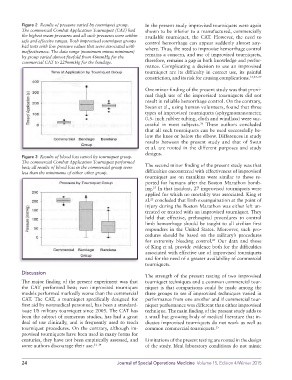
Figure 2  Results of pressure varied by tourniquet group.    In the present study improvised tourniquets were again
          The commercial Combat Application Tourniquet (CAT) had   shown to be inferior to a manufactured, commercially
          the highest mean pressures and all such pressures were within   available  tourniquet, the  CAT. However, the  need  to
          safe and effective ranges. Both improvised tourniquet groups   control hemorrhage can appear suddenly almost any-
          had tests with low pressure values that were associated with   where. Thus, the need to improvise hemorrhage control
          ineffectiveness. The data range (maximum minus minimum)
          by group varied almost fivefold from 46mmHg for the   remains a concern, and use of improvised tourniquets,
          commercial CAT to 229mmHg for the bandage.         therefore, remains a gap in both knowledge and perfor-
                                                             mance. Complicating  a decision to use  an improvised
                                                             tourniquet are its difficulty in correct use, its painful
                                                             constriction, and its risk for causing complications. 15,35–37

                                                             One minor finding of the present study was that proxi-
                                                             mal thigh use of the improvised tourniquets did not
                                                             result in reliable hemorrhage control. On the contrary,
                                                             Swan et al., using human volunteers, found that three
                                                             types of improvised tourniquets (sphygmomanometer,
                                                             0.5- inch rubber tubing, cloth and windlass) were suc-
                                                             cessful in most subjects.  These authors concluded
                                                                                    36
                                                             that all such tourniquets can be used successfully be-
                                                             low the knee or below the elbow. Differences in study
                                                             results between the present study and that of Swan
                                                             et al. are rooted in the different purposes and study
                                                             designs.
          Figure 3  Results of blood loss varied by tourniquet group.
          The commercial Combat Application Tourniquet performed
          best; all results of blood loss in the commercial group were   The second minor finding of the present study was that
          less than the minimums of either other group.      difficulties encountered with effectiveness of improvised
                                                             tourniquet use on manikins were similar to those re-
                                                             ported for humans after the Boston Marathon bomb-
                                                             ing.  In that incident, 27 improvised tourniquets were
                                                                25
                                                             applied for which no mortality was associated. King et
                                                             al.  concluded that limb exsanguination at the point of
                                                               25
                                                             injury during the Boston Marathon was either left un-
                                                             treated or treated with an improvised tourniquet. They
                                                             held that effective, prehospital procedures to control
                                                             limb hemorrhage should be taught to all civilian first
                                                             responders in the United States. Moreover, such pro-
                                                             cedures  should  be  based  on  the  military’s  procedures
                                                             for  extremity  bleeding control.  Our  data  and those
                                                                                         25
                                                             of King et al. provide evidence both for the difficulties
                                                             associated with effective use of improvised tourniquets
                                                             and for the need of a greater availability of commercial
                                                             tourniquets.

          Discussion
                                                             The strength of the present testing of two improvised
          The major finding of the present experiment was that   tourniquet techniques and a common commercial tour-
          the CAT performed best; two improvised tourniquet   niquet  is  that  comparisons  could  be  made  among  the
          models performed markedly worse than the commercial   three groups to see if improvised techniques varied in
          CAT. The CAT, a tourniquet specifically designed for   performance from one another and if commercial tour-
          first aid by nonmedical personnel, has been a standard-  niquet performance was different than either improvised
          issue US military tourniquet since 2005. The CAT has   technique. The main finding of the present study adds to
          been the subject of numerous studies, has had a great   a small but growing body of medical literature that in-
          deal  of use  clinically, and  is frequently  used  to  teach   dicates improvised tourniquets do not work as well as
          tourniquet  procedures.  On  the  contrary,  although  im-  common commercial tourniquets. 25
          provised tourniquets have been used in many forms for
          centuries, they have not been empirically assessed, and   Limitations of the present testing are rooted in the design
          some authors discourage their use. 31–34           of the study. Ideal laboratory conditions do not mimic


          24                                     Journal of Special Operations Medicine  Volume 15, Edition 4/Winter 2015

