


Page 47 - Journal of Special Operations Medicine - Winter 2015
P. 47
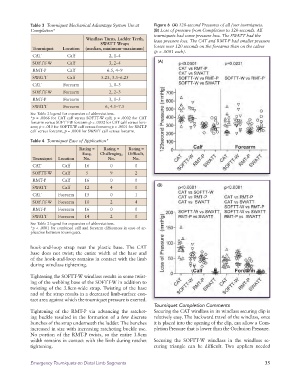
Table 3  Tourniquet Mechanical Advantage System Use at   Figure 6  (A) 120-second Pressures of all four tourniquets.
              Completion*                                        (B) Loss of pressure from Completion to 120-seconds. All
                                                                 tourniquets had some pressure loss. The SWATT had the
                                    Windlass Turns, Ladder Teeth,   least pressure loss. The CAT and RMT-P had smaller pressure
                                           SWATT Wraps
              Tourniquet   Location  (median, minimum–maximum)   losses over 120 seconds on the forearms than on the calves
                                                                 (p < .0001 each).
              CAT            Calf             2, 1–4
              SOFTT-W        Calf             3, 2–4              (A)
              RMT-P          Calf            6.5, 4–9
              SWATT          Calf          5.25, 3.5–6.25
              CAT          Forearm            1, 0–3
              SOFTT-W      Forearm            2, 2–3
              RMT-P        Forearm            3, 0–5
              SWATT        Forearm          6, 4.5–7.5
              See Table 2 legend for expansion of abbreviations.
              *p = .0066 for CAT calf versus SOFTT-W calf; p = .0002 for CAT
              forearm versus SOFTT-W forearm; p = .0032 for CAT calf versus fore-
              arm; p = .015 for SOFTT-W calf versus forearm; p < .0001 for RMT-P
              calf versus forearm; p = .0008 for SWATT calf versus forearm.

              Table 4  Tourniquet Ease of Application*
                                  Rating =   Rating =   Rating =
                                   Easy,    Challenging,   Difficult,
              Tourniquet  Location  No.       No.       No.
              CAT          Calf     16         0         0
              SOFTT-W      Calf     5          9         2
              RMT-P        Calf     16         0         0
                                                                  (B)
              SWATT        Calf     12         4         0
              CAT        Forearm    15         0         1
              SOFTT-W    Forearm    10         2         4
              RMT-P      Forearm    16         0         0
              SWATT      Forearm    14         2         0
              See Table 2 legend for expansion of abbreviations.
              *p < .0001 for combined calf and forearm differences in ease of ap-
              plication between tourniquets.


              hook-and-loop  strap  near  the  plastic  base.  The  CAT
              base does not twist; the entire width of the base and
              of the hook-and-loop remains in contact with the limb
              during windlass tightening.

              Tightening the SOFTT-W windlass results in some twist-
              ing of the webbing base of the SOFTT-W in addition to
              twisting of the 3.8cm-wide strap. Twisting of the base
              and of the strap results in a decreased limb-surface con-
              tact area against which the tourniquet pressure is exerted.
                                                                 Tourniquet Completion Comments
              Tightening of the RMT-P via advancing the ratchet-  Securing the CAT windlass in its windlass securing clip is
              ing buckle resulted in the formation of a few discrete   relatively easy. The backward travel of the windlass, once
              bunches of the strap underneath the ladder. The bunches   it is placed into the opening of the clip, can allow a Com-
              increased in size with increasing ratcheting buckle use.   pletion Pressure that is lower than the Occlusion Pressure.
              No portion of the RMT-P twists, so the entire 3.8cm
              width remains in contact with the limb during ratchet   Securing the SOFTT-W windlass in the windlass se-
              tightening.                                        curing triangle can be difficult. Two appliers needed


              Emergency Tourniquets on Distal Limb Segments                                                   35

