


Page 37 - Journal of Special Operations Medicine - Winter 2014
P. 37
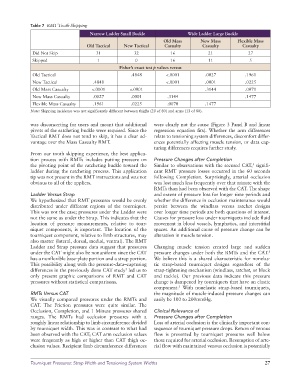
Table 7  RMT Tooth Skipping
                                      Narrow Ladder Small Buckle               Wide Ladder Large Buckle
                                                                     Old Mass       New Mass       Flexible Mass
                                     Old Tactical   New Tactical     Casualty        Casualty        Casualty
              Did Not Skip               31             32             16              21               27
              Skipped                    1               0             16              11               5
                                                  Fisher’s exact test p values versus
              Old Tactical                             .4848          <.0001          .0027           .1961
              New Tactical             .4848                          <.0001          .0001           .0225
              Old Mass Casualty        <.0001          <.0001                         .3144           .0070
              New Mass Casualty        .0027           .0001          .3144                           .1477
              Flexible Mass Casualty   .1961           .0225          .0070           .1477
              Note: Skipping incidence was not significantly different between thighs (20 of 80) and arms (13 of 80).

              was disconcerting for users and meant that additional   were clearly not the cause (Figure 3 Panel B and linear
              pivots of the ratcheting buckle were required. Since the   regression equation fits). Whether the arm differences
              Tactical RMT does not tend to skip, it has a clear ad-  relate to tensioning system differences, discomfort differ-
              vantage over the Mass Casualty RMT.                ences potentially affecting muscle tension, or data cap-
                                                                 turing differences requires further study.
              From our tooth skipping experience, the best applica-
              tion  process  with  RMTs  includes  putting  pressure  on   Pressure Changes after Completion
              the pivoting point of the ratcheting buckle toward the   Similar to observations with the secured CAT,  signifi-
                                                                                                         5
              ladder  during  the ratcheting  process.  This  application   cant RMT pressure losses occurred in the 60 seconds
              tip was not present in the RMT instructions and was not   following Completion. Surprisingly, arterial occlusion
              obvious to all of the appliers.                    was lost much less frequently over that minute with the
                                                                 RMTs than had been observed with the CAT. The shape
              Ladder Versus Strap                                and extent of pressure loss for longer time periods and
              We hypothesized that RMT pressures would be evenly   whether the difference in occlusion maintenance would
              distributed under different regions of the tourniquet.   persist between the windlass versus ratchet designs
              This was not the case; pressures under the Ladder were   over longer time periods are both questions of interest.
              not the same as under the Strap. This indicates that the   Causes for pressure loss under tourniquets include fluid
              location  of  pressure  measurements,  relative  to  tour-  movement in blood vessels, lymphatics, and interstitial
              niquet components, is important. The location of the   spaces. An additional cause of pressure change can be
              tourniquet component, relative to limb structures, may   alteration in muscle tension.
              also matter (lateral, dorsal, medial, ventral). The RMT
              Ladder and Strap pressure data suggest that pressures   Changing muscle tension created large and sudden
              under the CAT might also be nonuniform since the CAT   pressure changes under both the RMTs and the  CAT.
                                                                                                                5
              has a nonflexible base-plate portion and a strap portion.   We believe this is a shared characteristic for nonelas-
              This possibility along with the pressure-data–capturing   tic  strap-based  tourniquet  designs  regardless  of the
              differences in the previously done CAT study  led us to   strap-tightening mechanism (windlass, ratchet, or block
                                                     5
              only present graphic comparisons of RMT and CAT    and tackle). Our previous data indicate this pressure
              pressures without statistical comparisons.         change is dampened by tourniquets that have an elastic
                                                                   component.  With nonelastic strap-based tourniquets,
                                                                           5
              RMTs Versus CAT                                    the magnitude of muscle-induced pressure changes can

              We visually compared pressures under the RMTs and   easily be 100 to 200mmHg.
              CAT. The Friction pressures were quite similar. The
              Occlusion, Completion, and 1 Minute pressures shared   Clinical Relevance of
              ranges. The RMTs had occlusion pressures with a    Pressure Changes after Completion
              roughly linear relationship to limb circumference divided   Loss of arterial occlusion is the clinically important con-
              by tourniquet width. This was in contrast to what had   sequence of tourniquet pressure drops. Return of venous
              been observed with the CAT; CAT arm occlusion values   flow is prevented by tourniquet pressures well below
              were frequently as high or higher than  CAT thigh oc-  those required for arterial occlusion. Resumption of arte-
              clusion values. Recipient limb circumference differences   rial flow with maintained venous occlusion is potentially


              Tourniquet Pressures: Strap Width and Tensioning System Widths                                  27

