


Page 35 - Journal of Special Operations Medicine - Winter 2014
P. 35
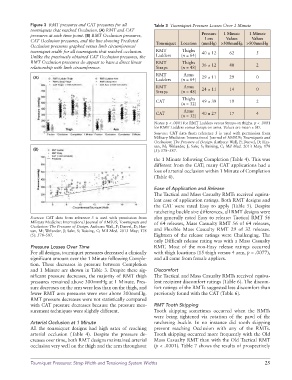
Figure 3  RMT pressures and CAT pressures for all   Table 3  Tourniquet Pressure Losses Over 1 Minute
              tourniquets that reached Occlusion. (A) RMT and CAT
              pressures at each time point. (B) RMT Occlusion pressures,            Pressure    1 Minute   1 Minute
                                                                                              Values
                                                                                                         Values
                                                                                      Loss
              CAT Occlusion pressures, and the line showing Predicted   Tourniquet  Location  (mmHg)  >300mmHg  >500mmHg
              Occlusion pressures graphed versus limb circumference/
              tourniquet width for all tourniquets that reached occlusion.   RMT   Thighs   40 ± 12  62    5
              Unlike the previously obtained CAT Occlusion pressures, the   Ladders  (n = 64)
              RMT Occlusion pressures do appear to have a direct linear   RMT   Thighs   36 ± 12  40       2
              relationship with limb circumference.              Straps     (n = 48)
                                                                 RMT         Arms
               (A)                                               Ladders    (n = 64)  29 ± 11   29         0
                                                                 RMT         Arms    24 ± 11    14         0
                                                                 Straps     (n = 48)
                                                                            Thighs
                                                                 CAT                49 ± 39     19         2
                                                                            (n = 32)
                                                                             Arms
                                                                 CAT                40 ± 27     17         4
                                                                            (n = 32)
                                                                 Notes: p < .0001 for RMT Ladders versus Straps on thighs. p < .0001
                                                                 for RMT Ladders versus Straps on arms. Values are mean ± SD.
                                                                 Sources:  CAT data from reference 5 is used with permission from
                                                                 Military Medicine: International Journal of AMSUS; Tourniquets and
                                                                 Occlusion: The Pressure of Design. Authors: Wall, P; Duevel, D; Has-
                                                                 san, M; Welander, J; Sahr, S; Buising, C; Mil Med. 2013 May; 178
               (B)                                               (5): 578–587.
                                                                 the 1 Minute following Completion (Table 4). This was
                                                                 different from the CAT; many CAT applications had a
                                                                 loss of arterial occlusion within 1 Minute of Completion
                                                                 (Table 4).

                                                                 Ease of Application and Release
                                                                 The Tactical and Mass Casualty RMTs received equiva-
                                                                 lent ease of application ratings. Both RMT designs and
                                                                 the CAT were rated Easy to apply (Table 5). Despite
                                                                 ratcheting buckle size differences, all RMT designs were
              Sources: CAT data from reference 5 is used with permission from   also generally rated Easy to release: Tactical RMT 56
              Military Medicine: International Journal of AMSUS; Tourniquets and   of 64 releases, Mass Casualty RMT 56 of 64 releases,
              Occlusion: The Pressure of Design. Authors: Wall, P; Duevel, D; Has-
              san, M; Welander, J; Sahr, S; Buising, C; Mil Med. 2013 May; 178   and Flexible Mass Casualty RMT 29 of 32 releases.
              (5): 578–587.                                      Eighteen of the release  ratings were Challenging.  The
                                                                 only Difficult release rating was with a Mass Casualty
              Pressure Losses Over Time                          RMT. Most of the non-Easy release ratings occurred
              For all designs, tourniquet pressures decreased a clinically   with thigh locations (15 thigh versus 4 arm, p = .0077),
              significant amount over the 1 Minute  following Comple-  and all came from female appliers.
              tion.  These decreases  in  pressure between  Completion
              and 1 Minute are shown in Table 3. Despite these sig-  Discomfort
              nificant pressure decreases, the majority of RMT thigh   The Tactical and Mass Casualty RMTs received equiva-
              pressures remained above 300mmHg at 1 Minute. Pres-  lent recipient discomfort ratings (Table 6). The discom-
              sure decreases on the arm were less than on the thigh, and   fort ratings of the RMTs suggested less discomfort than
              fewer RMT arm pressures were ever above 300mmHg.   previously found with the CAT (Table 6).
              RMT pressure decreases were not statistically compared
              with CAT pressure decreases because the pressure mea-  RMT Tooth Skipping
              surement techniques were slightly different.       Tooth skipping sometimes occurred when the RMTs
                                                                 were being tightened via rotation of the pawl of the
              Arterial Occlusion at 1 Minute                     ratcheting buckle. In no instance did tooth skipping
              All the tourniquet designs had high rates of reaching     prevent reaching Occlusion with any of the RMTs.
                arterial occlusion (Table 4). Despite the pressure de-  Tooth skipping occurred more frequently with the Old
              creases over time, both RMT designs maintained arterial   Mass Casualty RMT than with the Old Tactical RMT
              occlusion very well on the thigh and the arm throughout   (p < .0001). Table 7 shows the results of prospectively


              Tourniquet Pressures: Strap Width and Tensioning System Widths                                  25

