


Page 32 - Journal of Special Operations Medicine - Winter 2014
P. 32
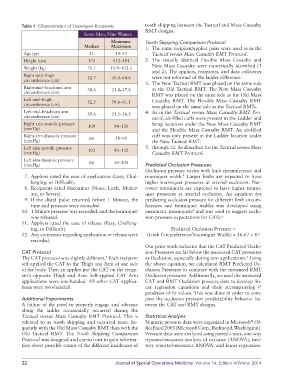
Table 1  Characteristics of Tourniquet Recipients  tooth skipping between the Tactical and Mass Casualty
                                                             RMT designs.
                                    Seven Men, Nine Women
                                               Minimum-      Tooth Skipping Comparison Protocol
                                    Median     Maximum       1.  The same recipient/applier pairs were used as in the
           Age (yr)                   21         19–53          Tactical versus Mass Casualty RMT Protocol.
           Height (cm)               175        152–191      2.  The visually identical Flexible Mass Casualty and
                                                                New Mass Casualty were numerically identified (1
           Weight (kg)               71.1      45.9–102.3
                                                                and 2). The appliers, recipients, and data collectors
           Right mid–thigh           52.7      40.0–64.8        were not informed of the ladder difference.
           circumference (cm)
                                                             3.  The New Tactical RMT was placed on the same side
           Right mid–brachium arm    30.6      21.8–37.8        as the Old Tactical RMT. The New Mass Casualty
           circumference (cm)
                                                                RMT was placed on the same side as the Old Mass
           Left mid–thigh            52.5      39.6–61.1        Casualty RMT. The Flexible Mass Casualty RMT
           circumference (cm)                                   was placed on the same side as the Tactical RMTs.
           Left mid–brachium arm     29.6      21.5–36.5     4.  As in the Tactical versus Mass Casualty RMT Pro-
           circumference (cm)                                   tocol, air-filled cuffs were present in the Ladder and
           Right arm systolic pressure   100    94–130          Strap locations under the New Mass Casualty RMT
           (mmHg)                                               and the Flexible Mass Casualty RMT. An air-filled
           Right arm diastolic pressure   66     58–90          cuff was only present in the Ladder location under
           (mmHg)                                               the New Tactical RMT.
           Left arm systolic pressure   102     90–132       5.  through 12. As described for the Tactical versus Mass
           (mmHg)                                               Casualty RMT Protocol.
           Left arm diastolic pressure   66     56–100
           (mmHg)                                            Predicted Occlusion Pressures
                                                             Occlusion pressure varies with limb circumference and
            7.  Appliers rated the ease of application (Easy, Chal-  tourniquet width.  Larger  limbs are expected  to have
                                                                             4
              lenging, or Difficult).                        higher tourniquet pressures at arterial occlusion. Nar-
            8.  Recipients rated discomfort (None, Little, Moder-  rower tourniquets are expected to have higher tourni-
              ate, or Severe).                               quet pressures  at arterial occlusion. An equation  for
            9.  If the distal pulse returned before 1 Minute, the   predicting occlusion pressure for different limb circum-
              time and pressure were recorded.               ferences and tourniquet widths was developed using
          10.  1 Minute pressure was recorded, and the tourniquet   pneumatic tourniquets  and was used to suggest occlu-
                                                                                 4
              was released.                                  sion pressure expectations for CATs. 6
          11.  Appliers rated the ease of release (Easy, Challeng-
              ing, or Difficult).                                       Predicted Occlusion Pressure =
          12.  Any comments regarding application or release were   (Limb Circumference/Tourniquet Width) × 16.67 + 67
              recorded.
                                                             Our prior work indicates that the CAT Predicted Occlu-
          CAT Protocol                                       sion Pressures are far below the measured CAT pressures
          The CAT protocol was slightly different.  Each recipient   at Occlusion, especially during arm  applications.  Using
                                             5
                                                                                                       5
          self-applied the CAT to the Thigh and Arm of one side   the above equation, we calculated RMT Predicted Oc-
          of the body. Then an applier put the CAT on the recipi-  clusion Pressures to compare with the  measured RMT
          ent’s opposite Thigh and Arm. Self-applied CAT Arm   Occlusion pressures. Additionally, we used the measured
          applications were one-handed. All other CAT applica-  CAT and RMT Occlusion pressure data to develop lin-
          tions were two-handed.                             ear regression equations and their   accompanying  r
                                                                                                            2
                                                             goodness-of-fit values. This was done in order to com-
          Additional Experiments                             pare the occlusion pressure predictability behavior be-
          A failure of the pawl to properly engage and advance   tween the CAT and RMT designs.
          along  the  ladder  occasionally  occurred  during  the
            Tactical versus Mass Casualty RMT Protocol. This is   Statistical Analysis
          referred to as tooth skipping and occurred more fre-  Numeric pressure data were organized in Microsoft  Of-
                                                                                                         ®
          quently with the Old Mass Casualty RMT than with the   fice Excel 2003 (Microsoft Corp., Redmond, Washington).
          Old Tactical RMT. The  Tooth Skipping Comparison   Pressure data were analyzed using paired t-tests, one-way
          Protocol was designed and carried out to gain informa-  repeated-measures analysis of variance (ANOVA), two-
          tion about possible causes of the different incidences of   way repeated-measures ANOVA, and linear regression.


          22                                     Journal of Special Operations Medicine  Volume 14, Edition 4/Winter 2014

