


Page 34 - Journal of Special Operations Medicine - Winter 2014
P. 34
the arm ranged from 0.11 to 0.54. These r  values indi-    Minute; Ladder pressures were higher than Strap pres-
                                               2
          cate a weak relationship between Friction pressure and   sures 87 out of 96 times. Exceptions occurred with the
          ratchet buckle travel needed for Completion.       Old Tactical (1 occurrence), Old Mass Casualty (2 occur-
                                                             rences), and New Mass Casualty RMTs (6 occurrences).
          Despite the narrower ladder on the Tactical RMT, pres-
          sures  measured  under  the  comparable  locations were   With the Flexible Mass Casualty RMT, Ladder and
          not significantly different for the two RMT designs at   Strap pressures at Occlusion, Completion, and 1 Minute
          each time point (Figure 1). In fact, Tactical RMT pres-  were also different from each other. This difference also
          sures were often lower than Mass Casualty pressures at   increased at greater pressures. However, the  frequency
          Occlusion, Completion, and 1 Minute (Figure 1).    with which the Ladder pressure was higher than Strap
                                                             pressure changed to 15 out of 32 applications. This
          Since the comparable location Tactical and Mass Ca-  change in ratio is statistically different from what was
          sualty RMT pressures were not statistically different,   seen before (p = .0004 versus Old and New Mass Ca-
          hereafter,  Tactical  and  Mass  Casualty  RMT  pressures   sualty RMT ratio and p = .0319 versus only New Mass
          were combined for comparable locations. Regarding   Casualty RMT ratio). The change in relationship indi-
          limb locations, thigh pressure values were higher than   cates that users cannot assume that measurements under
          arm pressure values and were never combined.       any single portion of a strap-based tourniquet are the
                                                             highest pressures under that tourniquet.
          Ladder and Strap Differences
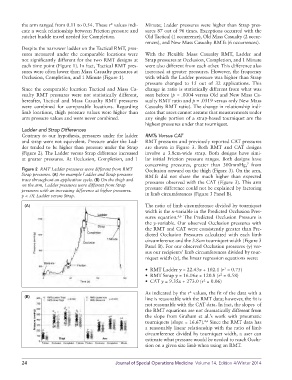
          Contrary to our hypothesis, pressures under the ladder   RMTs Versus CAT
          and strap were not equivalent. Pressure under the Lad-  RMT pressures and previously reported CAT pressures
          der tended to be higher than pressure under the Strap   are shown in Figure 3. Both RMT and CAT designs
          (Figure 2). The Ladder versus Strap difference increased   involve a 3.8cm-wide strap. Both designs have simi-
          at greater pressures. At Occlusion, Completion, and 1   lar initial Friction pressure  ranges. Both designs  have
                                                             concerning pressures, greater than 300mmHg,  from
                                                                                                       7
          Figure 2  RMT Ladder pressures were different from RMT     Occlusion onward on the thigh (Figure 3). On the arm,
          Strap pressures. (A) An example Ladder and Strap pressure   RMTs did not share the much higher than expected
          trace throughout an application cycle. (B) On the thigh and   pressures observed with the CAT (Figure 3). This arm
          on the arm, Ladder pressures were different from Strap
          pressures with an increasing difference at higher pressures.    pressure difference could not be explained by factoring
          p < .01 Ladder versus Strap.                       in limb circumferences (Figure 3 Panel B).
           (A)                                               The ratio of limb circumference divided by tourniquet
                                                             width is the x-variable in the Predicted Occlusion Pres-
                                                             sures equation.  The Predicted Occlusion Pressure is
                                                                          4,6
                                                             the y-variable. Our observed Occlusion pressures with
                                                             the RMT and CAT were consistently greater than Pre-
                                                             dicted Occlusion Pressures calculated with each limb
                                                             circumference and the 3.8cm tourniquet width (Figure 3
                                                             Panel B). For our observed Occlusion pressures (y) ver-
                                                             sus our recipients’ limb circumferences divided by tour-
                                                             niquet width (x), the linear regression equations were:

                                                             •  RMT Ladder y = 22.43x + 102.1 (r  = 0.75)
                                                                                              2
                                                             •  RMT Strap y = 16.06x + 120.8 (r  = 0.58)
                                                                                            2
                                                             •  CAT y = 9.35x + 273.0 (r  = 0.06)
                                                                                     2
                                                             As indicated by the r  values, the fit of the data with a
                                                                               2
           (B)                                               line is reasonable with the RMT data; however, the fit is
                                                             not reasonable with the CAT data. In fact, the slopes  of
                                                             the RMT equations are not dramatically different from
                                                             the slope from Graham et al.’s work with pneumatic
                                                             tourniquets (slope = 16.67).  Since the RMT data has
                                                                                     4,6
                                                             a reasonably linear relationship with the ratio of limb
                                                             circumference divided by tourniquet width, a user can
                                                             estimate what pressure would be needed to reach Occlu-
                                                             sion on a given size limb when using an RMT.


          24                                     Journal of Special Operations Medicine  Volume 14, Edition 4/Winter 2014

