


Page 140 - Journal of Special Operations Medicine - Winter 2014
P. 140
Diagnosis                                          Disclaimer
          Diagnostic testing is based on the time frame of the ill-  The views expressed in this publication are those of the
          ness and should be considered in patients who develop   author and do not reflect the official policy or position
          acute fever and arthralgia. In the first 8 days of the ill-  of the Department of the Army, Department of Defense,
          ness, RT-PCR and IgM testing is recommended. Sero-  or the US Government.
          conversion of IgM to IgG is seen in positive cases in
          convalescent samples drawn 10 to 14 days following the
          acute sample. Virus isolation is performed in a Biosafety   Disclosure
          Level (BSL) 3 lab. Additional information regarding test-  The author has nothing to disclose.
          ing in the United States can be found at http://www.cdc.
          gov/chikungunya/. Testing is also performed at multiple
          other locations worldwide as noted on the Pan Ameri-  Bibliography
          can Health Organization website at www.paho.org.   http://www.cdc.gov/chikungunya/hc/index.html.
                                                             http://www.paho.org/hq/index.php?option=com_topics&vie
                                                                 w=article&id=343&Itemid=40931.
          Treatment and Vaccination                          Morens DM, Fauci AS. Chikungunya at the door: déjà vu all
          There is currently no vaccination for chikungunya, nor   over again? N Engl J Med. 2014;371:885–887.
          are there any specific therapies for those infected. Treat-  Staples JE, Fischer MF. Chikungunya virus in the Americas:
                                                                 what a vectorborne pathogen can do. N Engl J Med. 2014;
          ment is symptomatic in nature, with rest, judicious fluids,   371:887–889.
          and pain control with nonsteroidal anti-inflammatory
          drugs being key.


          Importance in a Deployed Setting                   COL Burnett is currently the Area-Support Group-Kuwait
                                                             Command Surgeon and is board certified in pediatrics and
          Chikungunya should be strongly considered in any pa-  pediatric infectious diseases. He has served overseas in Ko-
          tient who develops an acute fever with symmetric poly-  rea, Germany, Kosovo, Iraq, Afghanistan, Kuwait, and as the
          arthralgias. Viremic patients can further infect feeding   JSOTF-P Surgeon in the Philippines. He is a graduate of the
          mosquitoes for up to a week, spreading the disease to   University of Wisconsin-Madison and the Medical College of
          others in the immediate area. With no available vaccine,   Wisconsin.
          prevention is key by using a DEET-based repellent and
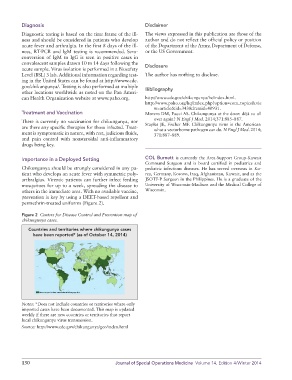
          permethrin-treated uniforms (Figure 2).

          Figure 2  Centers for Disease Control and Prevention map of
          chikungunya cases.

             Countries and territories where chikungunya cases
               have been reported* (as of October 14, 2014)


          Notes: *Does not include countries or territories where only
          imported cases have been documented. This map is updated
          weekly if there are new countries or territories that report
          local chikungunya virus transmission.
          Source: http://www.cdc.gov/chikungunya/geo/index.html


          130                                    Journal of Special Operations Medicine  Volume 14, Edition 4/Winter 2014

