


Page 141 - Journal of Special Operations Medicine - Winter 2014
P. 141
An Ongoing Series


                        Injuries and Injury Prevention During Foot Marching


                                                   Joseph J. Knapik, ScD


              ABSTRACT
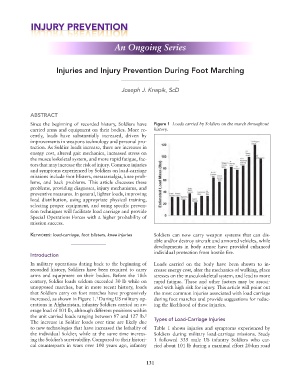
              Since the beginning of recorded history, Soldiers have   Figure 1  Loads carried by Soldiers on the march throughout
              carried arms and equipment on their bodies. More re-  history.
              cently,  loads  have  substantially  increased,  driven  by
              improvements in weapons technology and personal pro-
              tection. As Soldier loads increase, there are increases in
              energy cost, altered gait mechanics, increased stress on
              the musculoskeletal system, and more rapid fatigue, fac-
              tors that may increase the risk of injury. Common injuries
              and symptoms experienced by Soldiers on load-carriage
              missions include foot blisters, metatarsalgia, knee prob-
              lems, and back problems. This article discusses these
              problems, providing diagnoses, injury mechanisms, and
              preventive measures. In general, lighter loads, improving
              load distribution, using appropriate physical training,
              selecting proper equipment, and using specific preven-
              tion techniques will facilitate load carriage and provide
              Special Operations Forces with a higher probability of
              mission success.

              Keywords: load-carriage, foot blisters, knee injuries    Soldiers can now carry weapon systems that can dis-
                                                                 able and/or destroy aircraft and armored vehicles, while
                                                                 developments in body armor have provided enhanced
                                                                 individual protection from hostile fire.
              Introduction
              In military operations dating back to the beginning of   Loads carried on the body have been shown to in-
              recorded history, Soldiers have been required to carry   crease energy cost, alter the mechanics of walking, place
              arms and equipment on their bodies. Before the 18th   stresses on the musculoskeletal system, and lead to more
              century, Soldier loads seldom exceeded 30 lb while on   rapid fatigue. These and other factors may be associ-
              unopposed marches, but in more recent history, loads   ated with high risk for injury. This article will point out
              that Soldiers carry on foot marches have progressively   the most common injuries associated with load carriage
              increased, as shown in Figure 1.  During US military op-  during foot marches and provide suggestions for reduc-
                                         1
              erations in Afghanistan, infantry Soldiers carried an av-  ing the likelihood of these injuries.
              erage load of 101 lb, although different positions within
              the unit carried loads ranging between 87 and 127 lb.
                                                             2
              The increase in Soldier loads over time are likely due   Types of Load-Carriage Injuries
              to new technologies that have increased the lethality of   Table 1 shows injuries and symptoms  experienced  by
              the individual Soldier, while at the same time increas-  Soldiers during military load-carriage missions. Study
              ing the Soldier’s survivability. Compared to their histori-  1 followed 335 male US infantry Soldiers who car-
              cal counterparts in wars over 100 years ago, infantry   ried about 101 lb during a maximal effort 20-km road


                                                             131

