


Page 142 - Journal of Special Operations Medicine - Winter 2014
P. 142
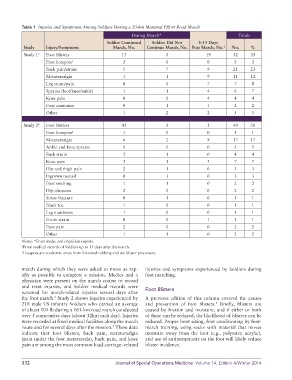
Table 1  Injuries and Symptoms Among Soldiers During a 20-km Maximal Effort Road March
                                                        During March*                              Totals
                                             Soldier Continued   Soldier Did Not   1-15 Days
           Study    Injury/Symptoms             March, No.    Continue March, No.  Post March, No. †  No.  %
           Study 1 3  Foot blisters                13                 0               19         32     35
                    Foot hotspots ‡                 3                 0                0          3      3
                    Back pain/strain                5                 7                9         21     23
                    Metatarsalgia                   1                 1                9         11     12
                    Leg strain/pain                 0                 0                7          7      8
                    Sprains (foot/knee/ankle)       1                 1                4          6      7
                    Knee pain                       0                 0                4          4      4
                    Foot contusion                  0                 1                1          2      2
                    Other                           1                 2                2          5      5


           Study 2 4  Foot blisters                43                 3                3         49     50
                    Foot hotspots ‡                 1                 0                0          1      1
                    Metatarsalgia                   6                 2                9         17     17
                    Ankle and knee sprains          5                 0                0          5      5
                    Back strain                     3                 1                0          4      4
                    Knee pain                       3                 1                3          7      7
                    Hip and thigh pain              2                 1                0          3      3
                    Ingrown toenail                 0                 3                0          3      3
                    Foot swelling                   1                 1                0          2      2
                    Hip abrasion                    2                 0                0          2      2
                    Stress fracture                 0                 1                0          1      1
                    Black toe                       1                 0                0          1      1
                    Leg numbness                    1                 0                0          1      1
                    Groin strain                    0                 0                1          1      1
                    Foot pain                       2                 0                0          2      2
                    Other                           1                 1                0          2      2
          Notes: *From medic and physician reports.
          † From medical records of Soldiers up to 15 days after the march.
          ‡ Hotspots are erythemic areas from frictional rubbing and are blister precursors.


          march during which they were asked to move as rap-  injuries and symptoms experienced by Soldiers during
          idly as possible to complete a mission. Medics and a   foot marching.
          physician were present on the march course to record
          and  treat  injuries,  and  Soldier  medical  records  were
          screened for march-related injuries several days after   Foot Blisters
          the foot march.  Study 2 shows injuries experienced by   A previous edition of this column covered the causes
                        3
          218 male US infantry Soldiers who carried an average   and prevention of  foot  blisters.  Briefly, blisters  are
                                                                                          5
          of about 104 lb during a 161-km road march conducted   caused by friction and moisture, and if either or both
          over 5 consecutive days (about 32km each day). Injuries   of these can be reduced, the likelihood of blisters can be
          were recorded at fixed medical facilities along the march   reduced. Proper boot sizing, foot conditioning by foot-
          route and for several days after the mission.  These data   march training, using socks  with material that moves
                                                4
          indicate  that  foot  blisters,  back  pain,  metatarsalgia   moisture away from the foot (e.g., polyester, acrylic),
          (pain under the foot metatarsals), back pain, and knee   and use of antiperspirants on the foot will likely reduce
          pain are among the most common load-carriage–related   blister incidence.


          132                                    Journal of Special Operations Medicine  Volume 14, Edition 4/Winter 2014

