


Page 137 - Journal of Special Operations Medicine - Winter 2014
P. 137
to  aspiration include severe trismus, coagulopathy and   of oral stimulation and pressure, thereby reducing gag
              inability of the patient to cooperate with the procedure. 6  reflex and movement.
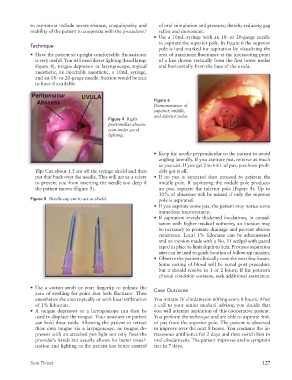
                                                                 •  Use a 10mL syringe with an 18- or 20-gauge needle
                                                                   to aspirate the superior pole. In Figure 6 the superior
              Technique
                                                                   pole is land-marked for aspiration by visualizing the
              •  Have the patient sit upright comfortably. An assistant   area of maximum fluctuance at the intersecting point
                is very useful. You will need direct lighting (head lamp;   of a line drawn vertically from the first lower molar
                Figure 4), tongue depressor or laryngoscope, topical   and horizontally from the base of the uvula.
                anesthetic, an injectable anesthetic, a 10mL syringe,
                and an 18- or 20-gauge needle. Suction would be nice
                to have if available.


                                                                 Figure 6
                                                                 Demonstration of
                                                                 superior, middle,
                                                                 and inferior poles.
                                              Figure 4  Right
                                              peritonsillar abscess
                                              seen under good
                                              lighting.


                                                                 •  Keep the needle perpendicular to the patient to avoid
                                                                   angling laterally. If you aspirate pus, remove as much
                                                                   as you can. If you get 2 to 6mL of pus, you have prob-
                Tip: Cut about 1.5 cm off the syringe shield and then   ably got it all.
                put that back over the needle. This will act as a safety   •  If no pus is aspirated then proceed to aspirate the
                to prevent you from inserting the needle too deep if   middle  pole.  If  aspirating  the  middle  pole  produces
                the patient moves (Figure 5).                      no pus, aspirate the inferior pole (Figure 4). Up to
                                                                   30% of abscesses will be missed if only the superior
              Figure 5  Needle cap cut to act as shield.           pole is aspirated.
                                                                 •  If you aspirate some pus, the patient may notice some
                                                                   immediate improvement.
                                                                 •  If  aspiration  reveals  thickened loculations, in  consul-
                                                                   tation with higher medical authority, an incision may
                                                                   be necessary to promote drainage and prevent abscess
                                                                   recurrence. Local 1% lidocaine can be administered
                                                                   and an incision made with a No. 11 scalpel with guard
                                                                   taped in place to limit depth to 1cm. Previous aspiration
                                                                   sites can be used to guide location of follow-up incision.
                                                                 •  Observe the patient clinically over the next few hours.
                                                                   Some oozing of blood will be noted post procedure
                                                                   but it should resolve in 1 or 2 hours. If the patient’s
                                                                   clinical condition worsens, seek additional assistance.

              •  Use a cotton swab or your fingertip to palpate the
                area of swelling for point that feels fluctuant. Then   Case Outcome
                anesthetize the area topically or with local infiltration   You initiate IV clindamycin 600mg every 8 hours. After
                of 1% lidocaine.                                 a call to your senior medical advisor, you decide that
              •  A tongue depressor or a laryngoscope can then be   you will attempt aspiration of this cooperative patient.
                used to displace the tongue. Your assistant or patient   You perform the technique and are able to aspirate 3mL
                can hold these tools. Allowing the patient to retract   of pus from the superior pole. The patient is observed
                their own tongue via a laryngoscope, or tongue de-  to improve over the next 8 hours. You continue the in-
                pressor with an attached pen light not only frees the   travenous antibiotics for 2 days and then switch him to
                provider’s hands but usually allows for better visual-  oral clindamycin. The patient improves and is symptom
                ization and lighting as the patient has better control   free in 7 days.


              Sore Throat                                                                                    127

