


Page 132 - Journal of Special Operations Medicine - Winter 2014
P. 132
An Ongoing Series


                                             Erythema Nodosum


                                     John A. Vigilante, MD; Jane Scribner, MD


          ABSTRACT
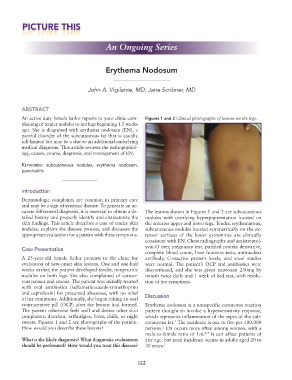
          An active duty female Sailor reports to your clinic com-  Figures 1 and 2 Clinical photographs of lesions on the legs.
          plaining of tender nodules to her legs beginning 1.5 weeks
          ago. She is diagnosed with erythema nodosum (EN), a
          painful disorder of the subcutaneous fat that is usually
          self-limited but may be a clue to an additional underlying
          medical diagnosis. This article reviews the pathophysiol-
          ogy, causes, course, diagnosis, and management of EN.

          Keywords: subcutaneous nodules, erythema nodosum,
          panniculitis


          Introduction
          Dermatologic complaints are common in primary care
          and may be a sign of systemic disease. To generate an ac-
          curate differential diagnosis, it is essential to obtain a de-  The lesions shown in Figures 1 and 2 are subcutaneous
          tailed history and properly identify and characterize the   nodules with overlying hyperpigmentation located on
          skin findings. This article describes a case of tender skin   the anterior upper and lower legs. Tender, erythematous,
          nodules, explains the disease process, and discusses the   subcutaneous nodules located symmetrically on the ex-
          appropriate evaluation for a patient with these symptoms.  tensor  surfaces  of  the  lower  extremities  are  clinically
                                                             consistent with EN. Chest radiography and antistreptol-
                                                             ysin-O titer, pregnancy test, purified protein derivative,
          Case Presentation
                                                             complete blood count, liver function tests, antinuclear
          A 23-year-old female Sailor presents to the clinic for   antibody, C-reactive protein levels, and stool studies
          evaluation of new-onset skin lesions. One and one-half   were normal. The patient’s OCP and antibiotics were
          weeks earlier, the patient developed tender, nonpruritic   discontinued,  and she was given naproxen  250mg by
          nodules on both legs. She also complained of concur-  mouth twice daily and 1 week of bed rest, with resolu-
          rent nausea and emesis. The patient was initially treated   tion of her symptoms.
          with oral antibiotics (sulfamethoxazole-trimethoprim
          and cephalexin) for presumed abscesses, with no relief
          of her symptoms. Additionally, she began taking an oral   Discussion
          contraceptive pill (OCP) after the lesions had formed.   Erythema nodosum is a nonspecific cutaneous reaction
          The patient otherwise feels well and denies other skin   pattern thought to involve a hypersensitivity response,
          complaints, diarrhea, arthralgias, fever, chills, or night   which represents inflammation of the septa of the sub-
          sweats. Figures 1 and 2 are photographs of the patient.   cutaneous fat.  The incidence is one to five per 100,000
                                                                         1
          How would you describe these lesions?              persons.  EN occurs more often among women, with a
                                                                    1
                                                             male-to-female ratio of 1:6.  It can affect patients of
                                                                                     2–4
          What is the likely diagnosis? What diagnostic evaluations   any age, but peak incidence occurs in adults aged 20 to
          should be performed? How would you treat this disease?  30 years. 1


                                                          122

