


Page 128 - Journal of Special Operations Medicine - Winter 2014
P. 128
blood has been estimated to be approximately 0.3%    for exposure should deploy with a full regimen of HIV
                                                         17
          and that after a mucous membrane exposure to be ap-  PEP to be started as soon as possible after occupational
          proximately 0.09%.  Preventing exposures to blood   exposure to HIV, but evacuation off the continent is rec-
                            18
          and body fluids is the most important strategy for pre-  ommended to complete the full 4 weeks of treatment.
          venting occupationally acquired HIV infection. Individ-  Complete blood counts and renal and hepatic func-
          ual healthcare providers and leaders in SOF units should   tion tests should be obtained at baseline and 2 weeks
          ensure strict adherence to the principles of standard pre-  after exposure (further testing may be indicated if ab-
          cautions, including consistent use of personal protective   normalities are detected). HIV testing is recommended
          equipment. 19                                      at baseline and at 6 weeks, 12 weeks, and 6 months
                                                             after exposure.  Because of the potential for toxicities
                                                                          19
          The point-of-care diagnostic kit, OraQuick Advanced   associated with PEP regimens and the need for further
          Rapid HIV-½ Ab test (NSN 6550-01-526-7431, avail-  laboratory follow-up, the SOCAFRICA policy is for all
          able through medical supply channels; OraSure Tech-  personnel undergoing HIV PEP treatment to be trans-
          nologies Inc., Bethlehem, PA, USA; www.orasure.com)   ferred off the continent to a US MTF for further evalu-
          has an extremely high sensitivity and results are avail-  ation and treatment. In addition to supplying patients
          able in about 30 minutes. If the test is negative, the pa-  with enough PEP medications for travel, it is wise to
          tient is highly likely to be HIV negative. This may be   supply them with an antiemetic, as well.
          useful to test the source of an accidental needle stick
          or blood splash, but should not be used to screen for   Snake Envenomation
          acute HIV infection (sensitivity will be much lower un-  It is no surprise that snake envenomation is one of the
          der these circumstances). For a US Servicemember with   most feared consequences of operations on the Afri-
          body-fluid exposure from a person whose HIV status   can continent. Africa is home to more than 400 snake
          is  unknown,  it is  prudent  to  begin  postexposure  pro-  species and 30 of these are known to have caused hu-
          phylaxis as soon as possible and begin the evacuation   man death.  The incidence of snakebites in Africa
                                                                       20
          procedures off the continent.                      is difficult to characterize, as reporting methods are
                                                             fragmented. Based on literature meta-analysis, the inci-
          The US Public Health Service Working Group published   dence of African snakebites is around 315,000 per year
          new HIV postexposure prophylaxis (PEP) guidelines in   with more than 700 amputations and between 7,000
          2013.  A new recommendation was for all PEP medica-  and 32,000 deaths.  The majority of snake envenom-
               19
                                                                              21
          tion regimens to contain three (or more) antiretroviral   ations occur among the rural indigenous population.
          drugs for all occupational exposures to HIV. The pre-  Current disease and nonbattle injury (DNBI) statistics
          ferred HIV PEP regimen recommended by SOCAFRICA    for the  AFRICOM area of responsibility reveal a 0%
          is: raltegravir (Isentress ; Merck & Co., Whitehouse   incidence of snake envenomations for personnel de-
                               ®
          Station, NJ, USA; www.merck.com) 400mg by mouth    ployed to the continent.
          twice daily plus tenofovir 300mg/emtricitabine 200mg
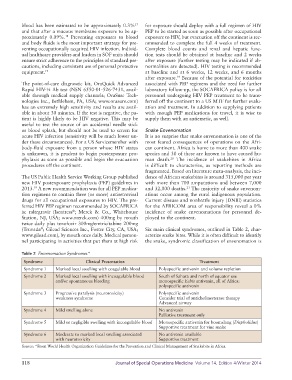
          (Truvada ; Gilead Sciences Inc., Foster City, CA, USA;   Six main clinical syndromes, outlined in Table 2, char-
                  ®
          www.gilead.com), by mouth once daily. Medical person-  acterize snake bites. While it is often difficult to identify
          nel participating in activities that put them at high risk   the snake, syndromic classification of envenomation is


          Table 2  Envenomation Syndromes*
           Syndrome                 Clinical Presentation                          Treatment
           Syndrome 1   Marked local swelling with coagulable blood  Polyspecific antivenin and volume repletion
           Syndrome 2   Marked local swelling with incoagulable blood    South of Sahara and north of equator use
                        and/or spontaneous bleeding                monospecific Echis antivenin, all of Africa:
                                                                   polyspecific antivenin
           Syndrome 3   Progressive paralysis (neurotoxicity)      Polyspecific antivenin
                        weakness syndrome                          Consider trial of anticholinesterase therapy
                                                                   Advanced airway
           Syndrome 4   Mild swelling alone                        No antivenin
                                                                   Palliative treatment only
           Syndrome 5   Mild or negligible swelling with incoagulable blood  Monospecific antivenin for boomslang (Dispholidus)
                                                                   Supportive treatment for vine snake
           Syndrome 6   Moderate to marked local swelling associated    No antivenin available
                        with neurotoxicity                         Supportive treatment
          Source: *From World Health Organization Guidelines for the Prevention and Clinical Management of Snakebite in Africa.


          118                                    Journal of Special Operations Medicine  Volume 14, Edition 4/Winter 2014

