


Page 125 - Journal of Special Operations Medicine - Winter 2014
P. 125
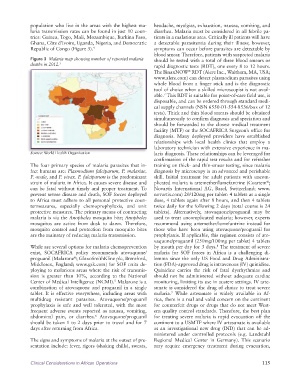
population who live in the areas with the highest ma-  headache, myalgias, exhaustion, nausea, vomiting, and
              laria transmission rates can be found in just 10 coun-  diarrhea. Malaria must be considered in all febrile pa-
              tries: Guinea, Togo, Mali, Mozambique, Burkina Faso,   tients in a malarious area. Critically ill patients will have
              Ghana, Côte d’Ivoire, Uganda, Nigeria, and Democratic   a detectable parasitemia during their illness; however,
              Republic of Congo (Figure 3). 4                    symptoms can occur before parasites are detectable by
                                                                 blood smear. Therefore, patients with suspected malaria
              Figure 3  Malaria map showing number of reported malaria   should be tested with a total of three blood smears or
              deaths in 2012. 3                                  rapid diagnostic tests (RDT), one every 8 to 12 hours.
                                                                 The BinaxNOW  RDT (Alere Inc., Waltham, MA, USA;
                                                                               ®
                                                                 www.alere.com) can detect plasmodium parasites using
                                                                 whole blood from a finger stick and is the diagnostic
                                                                 tool of choice when a skilled microscopist is not avail-
                                                                 able.  This RDT is suitable for point-of-care field use, is
                                                                     7
                                                                 disposable, and can be ordered through standard medi-
                                                                 cal supply channels (NSN 6550-01-554-8536/box of 12
                                                                 tests). Thick and thin blood smears should be obtained
                                                                 simultaneously to confirm diagnosis and speciation and
                                                                 should be forwarded to the closest medical treatment
                                                                 facility (MTF) or the SOCAFRICA Surgeon’s office for
                                                                 diagnosis. Many deployed providers have established
                                                                 relationships with local health clinics that employ a
                                                                 laboratory technician with extensive experience in ma-
              Source: World Health Organization                  laria diagnosis. These relationships can be leveraged for
                                                                 confirmation of the rapid test results and for refresher
              The four primary species of malaria parasites that in-  training on thick- and thin-smear testing, since malaria
              fect humans are: Plasmodium falciparum, P. malariae,   diagnosis by microscopy is an advanced and perishable
              P. ovale, and P. vivax. P. falciparum is the predominant   skill. Initial treatment  for adult  patients with uncom-
              strain of malaria in Africa. It causes severe disease and   plicated malaria is artemether/lumefantrine (Coartem ;
                                                                                                               ®
              can be fatal without timely and proper treatment. To   Novartis International AG, Basel, Switzerland; www.
              prevent severe disease and death, SOF forces deployed   novartis.com) 20/120mg per tablet: 4 tablets as a single
              to Africa must adhere to all personal protective coun-  dose, 4 tablets again after 8 hours, and then 4 tablets
              termeasures, especially chemoprophylaxis, and unit   twice daily for the following 2 days (total course is 24
              protective measures. The primary means of contracting   tablets). Alternatively, atovaquone/proguanil may be
              malaria is via the Anopheles mosquito bite; Anopheles   used to treat uncomplicated malaria; however, experts
              mosquitos are active from dusk to dawn. Therefore,   recommend using artemether/lumefantrine instead for
              mosquito control and protection from mosquito bites   those who have been using atovaquone/proguanil for
              are the mainstay of reducing malaria transmission.  prophylaxis. If applicable, this regimen consists of ato-
                                                                 vaquone/proguanil (250mg/100mg per tablet) 4 tablets
              While are several options for malaria chemoprevention   by mouth per day for 3 days.  The treatment of severe
                                                                                           8
              exist, SOCAFRICA policy recommends atovaquone/     malaria for SOF forces in Africa is a challenging di-
              proguanil (Malarone ; GlaxoSmithKline plc, Brentford,   lemma since the only US Food and Drug Administra-
                                ®
              Middlesex, England; www.gsk.com) for SOF units de-  tion (FDA)-approved drug is intravenous (IV) quinidine.
              ploying to malarious areas where the risk of transmis-  Quinidine  carries  the  risk  of  fatal  dysrhythmias  and
              sion is greater than 10%, according to the National   should not be administered without adequate cardiac
              Center of Medical Intelligence (NCMI).  Malarone is a   monitoring, limiting its use in austere settings. IV arte-
                                                5
              combination of  atovaquone and  proguanil in a single   sunate is considered the drug of choice to treat severe
              tablet. It is effective everywhere, including areas with   malaria.  While artesunate is widely available in Af-
                                                                        7
              multidrug resistant parasites. Atovaquone/proguanil   rica, there is a real and valid concern on the continent
              prophylaxis is safe and well tolerated, with the most   for counterfeit drugs or drugs that do not meet West-
              frequent adverse events reported as nausea, vomiting,   ern quality control standards. Therefore, the best plan
              abdominal pain, or diarrhea.  Atovaquone/proguanil   for treating severe malaria is rapid evacuation off the
                                        6
              should be taken 1 to 2 days prior to travel and for 7   continent to a USMTF where IV artesunate is available
              days after returning from Africa.                  as an investigational new drug (IND) that can be ad-
                                                                 ministered under controlled protocols (e.g. Landstuhl
              The signs and symptoms of malaria at the outset of pre-  Regional  Medical  Center  in Germany).  This  scenario
              sentation include: fever, rigors (shaking chills), sweats,   may require emergency treatment during evacuation,


              Clinical Considerations in African Operations                                                  115

