


Page 124 - Journal of Special Operations Medicine - Winter 2014
P. 124
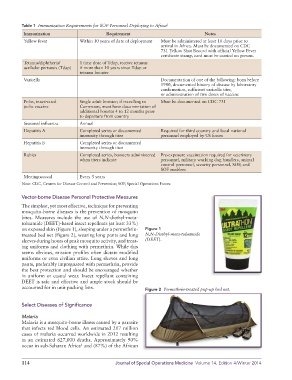
Table 1  Immunization Requirements for SOF Personnel Deploying to Africa 2
           Immunization                      Requirement                             Notes
           Yellow fever           Within 10 years of date of deployment  Must be administered at least 10 days prior to
                                                                   arrival in Africa. Must be documented on CDC
                                                                   731 Yellow Shot Record with official Yellow Fever
                                                                   certificate stamp, card must be carried on person.
           Tetanus/diphtheria/    1 time dose of Tdap, receive tetanus
           acellular pertussis (Tdap)  if more than 10 years since Tdap or
                                  tetanus booster
           Varicella                                               Documentation of one of the following: born before
                                                                   1980, documented history of disease by laboratory
                                                                   confirmation, sufficient varicella titer,
                                                                   or administration of two doses of vaccine
           Polio, inactivated     Single adult booster; if travelling to   Must be documented on CDC 731
           polio vaccine          Cameroon, must have documentation of
                                  additional booster 4 to 12 months prior
                                  to departure from country
           Seasonal influenza     Annual
           Hepatitis A            Completed series or documented   Required for third country and local national
                                  immunity through titer           personnel employed by US forces
           Hepatitis B            Completed series or documented
                                  immunity through titer
           Rabies                 Completed series, boosters administered  Pre-exposure vaccination required for veterinary
                                  when titers indicate             personnel, military working dog handlers, animal
                                                                   control personnel, security personnel, SOF, and
                                                                   SOF enablers
           Meningococcal          Every 5 years
          Note: CDC, Centers for Disease Control and Prevention; SOF, Special Operations Forces.

          Vector-borne Disease Personal Protective Measures
          The simplest, yet most effective, technique for preventing
          mosquito-borne diseases is the prevention of mosquito
          bites. Measures include the use of  N,N- diethyl-meta-
          toluamide (DEET)-based insect repellents (at least 33%)
          on exposed skin (Figure 1), sleeping under a permethrin-  Figure 1
          treated bed net (Figure 2), wearing long pants and long   N,N-Diethyl-meta-toluamide
          sleeves during hours of peak mosquito activity, and treat-  (DEET).
          ing uniforms and clothing with permethrin. While this
          seems obvious, mission profiles often dictate modified
          uniforms or even civilian attire. Long sleeves and long
          pants, preferably impregnated with permethrin, provide
          the best protection and should be encouraged whether
          in uniform or casual wear. Insect repellant containing
          DEET is safe and effective and ample stock should be
          accounted for in unit packing lists.               Figure 2  Permethrin-treated pop-up bed net.


          Select Diseases of Significance

          Malaria
          Malaria is a mosquito-borne illness caused by a parasite
          that infects red blood cells. An estimated 207 million
          cases of malaria occurred worldwide in 2012 resulting
          in an estimated 627,000 deaths. Approximately 90%
          occur in sub-Saharan Africa  and (87%) of the African
                                  3


          114                                    Journal of Special Operations Medicine  Volume 14, Edition 4/Winter 2014

