


Page 135 - Journal of Special Operations Medicine - Winter 2014
P. 135
What would you want to look for on exam?           severe pharyngitis can be caused by Epstein-Barr virus
                                                                 (mononucleosis); the presence of swollen posterior cer-
              You examine the patient. You find a 21-year-old man   vical nodes is typical for this. 1
              who is sitting upright. His voice is somewhat muffled,
              but he appears in no respiratory distress. His neck is   Peritonsillar abscess or PTC refers to an infection in-
              supple, but he has tender left anterior cervical adenopa-  volving the space between the tonsil and the pharyngeal
              thy. His heart rate, respiratory rate, and blood pressure   muscles and palate. It is thought to arise as a compli-
              are normal. He has an Spo  of 98% and a temperature   cation of a streptococcal infection. In PTC, there is an
                                     2
              of 38.0ºC. Examination of his pharynx reveals pharyn-  infection in this space with swelling, whereas PTA refers
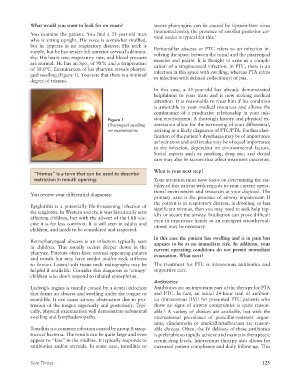
              geal swelling (Figure 1). You note that there is a minimal   to infection with defined collection(s) of pus.
              degree of trismus.
                                                                 In this case, a 21-year-old has already demonstrated
                                                                 helpfulness to your team and is now seeking medical
                                                                 attention. It is reasonable to treat him if his condition
                                                                 is amenable to your medical resources and allows the
                                                                 continuance of a productive relationship in your mis-
                                              Figure 1           sion environment. A thorough history and physical ex-
                                              Pharyngeal swelling   amination allow for the narrowing of your differential,
                                              on examination.    arriving at a likely diagnoses of PTC/PTA. Further clari-
                                                                 fication of the patient’s dysphagia may be of importance
                                                                 as hydration and oral intake may be of equal importance
                                                                 to  the infection, dependent  on environmental  factors.
                                                                 Social aspects such as smoking, drug use, and dental
                                                                 care may also be factors that affect treatment outcomes.

                                                                 What is your next step?
               “Trismus” is a term that can be used to describe
               restriction in mouth opening.                     Your attention must now focus on determining the sta-
                                                                 bility of this patient with regards to your current opera-
                                                                 tional environment and resources at your disposal. The
              You review your differential diagnoses.
                                                                 primary issue is the presence of airway impairment. If
                                                                 the patient is in respiratory distress, is drooling, or has
              Epiglottitis is a potentially life-threatening infection of   significant trismus, then you may need to seek help rap-
              the epiglottis. In Western society, it was historically seen   idly or secure the airway. Intubation can prove difficult
              affecting children, but with the advent of the HiB vac-  even in experience hands so an emergent cricothyroid-
              cine it is far less common. It is still seen in adults and   otomy may be necessary.
              children, and needs to be considered and respected.
                                                                 In this case the patient has swelling and is in pain but
              Retropharyngeal abscess is an infection typically seen   appears to be at no immediate risk. In addition, your
              in children. This usually occurs deeper down in the   current operating conditions do not permit immediate
              pharynx. Patients often have normal-appearing palates   evacuation. What next?
              and tonsils but may have stridor and/or neck stiffness
              to flexion. Lateral soft tissue neck radiographs may be   The  treatment  for  PTC  is  intravenous  antibiotics  and
              helpful if available. Consider this diagnosis in ‘croupy’   supportive care.
              children who don’t respond to inhaled epinephrine.
                                                                 Antibiotics
              Ludwig’s angina is usually caused by a dental infection   Antibiotics are an important part of the therapy for PTA
              that forms an abscess and swelling under the tongue or   and PTC. In fact, an initial 24-hour trial of antibiot-
              mandible. It can cause airway obstruction due to pro-  ics (intravenous [IV]) for presumed PTC patients who
              trusion of the tongue superiorly and posteriorly. Typi-  show no signs of airway compromise is quite reason-
              cally, physical examination will demonstrate submental   able.   A variety of choices are available, but with the
                                                                     2
              swelling and lymphadenopathy.                      international prevalence of penicillin-resistant organ-
                                                                 isms, clindamycin or ampicillin/sulbactam are reason-
              Tonsilitis is a common infection caused by group A strep-  able choices. Often, the IV delivery of these antibiotics
              tococci bacteria. The tonsils can be quite large and even   is preferable to rapidly achieve and maintain therapeutic
              appear to “kiss” in the midline. It typically responds to   serum drug levels. Intravenous therapy also allows for
              antibiotics and/or steroids. In some case, tonsillitis or   increased patient compliance and daily follow-up. This


              Sore Throat                                                                                    125

