


Page 185 - 2023 SMOG Digital
P. 185
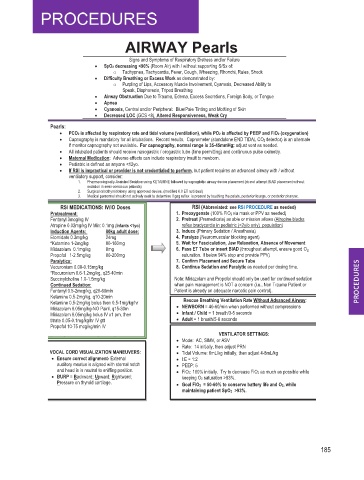
AIRWAY Pearls

                             Signs and Symptoms of Respiratory Distress and/or Failure
                        p
                      •  SpO2 decreasing <90% (Room Air) with / without supporting S/Sx of:
                          o  Tachypnea, Tachycardia, Fever, Cough, Wheezing, Rhonchi, Rales, Shock
                      •  Difficulty Breathing or Excess Work as demonstrated by:
                          o  Purpling of Lips, Accessory Muscle Involvement, Cyanosis, Decreased Ability to
                            Speak, Diaphoresis, Tripod Breathing
                      •  Airway Obstruction Due to Trauma, Edema, Excess Secretions, Foreign Body, or Tongue
                      •  Apnea
                      •  Cyanosis, Central and/or Peripheral:  Blue/Pale Tinting and Mottling of Skin
                      •  Decreased LOC (GCS <8), Altered Responsiveness, Weak Cry
            Pearls:
              •  PCO2 is affected by respiratory rate and tidal volume (ventilation), while PO2 is affected by PEEP and FiO2 (oxygenation)
              •  Capnography is mandatory for all intubations.  Record results.  Capnometer (standalone END TIDAL CO2 detector) is an alternate
                if monitor capnography not available.  For capnography, normal range is 35-45mmHg; adjust vent as needed.
              •  All intubated patients should receive nasogastric / orogastric tube (time permitting) and continuous pulse oximetry.
              •  Maternal Medication:  Adverse effects can include respiratory insult to newborn.
              •  Pediatric is defined as anyone <12yo.
              •  If RSI is impractical or provider is not credentialed to perform, but patient requires an advanced airway with / without
                ventilatory support, consider:
                  1.  Pharmacologically-Assisted Sedation using KETAMINE followed by supraglottic airway device placement (do not attempt BIAD placement without
                    sedation in semi-conscious patients)
                  2.  Surgical cricothyroidotomy using approved device. (modified 6.0 ET not ideal)
                  3.  Medical personnel should not actively seek to determine if gag reflex  is present by touching the palate, posterior lounge, or posterior pharynx.
              RSI MEDICATIONS: IV/IO Doses   RSI (Abbreviated: see RSI PROCEDURE as needed)
            Pretreatment:              1. Preoxygenate (100% FiO2 via mask or PPV as needed)
            Fentanyl 3mcg/kg IV        2. Pretreat (Premedicate) as able or mission allows (Atropine blocks
            Atropine 0.02mg/kg IV Min: 0.1mg (Infants <1yo)   reflex bradycardia in pediatric (<2y/o only)  population)
            Induction Agents:    80kg adult dose:   3. Induce (Primary Sedation / Anesthesia)
            Etomidate 0.3mg/kg   24mg   4. Paralyze (Neuromuscular blocking agent)
            *Ketamine 1-2mg/kg   80-160mg  5. Wait for Fasciculation, Jaw Relaxation, Absence of Movement
            Midazolam  0.1mg/kg   8mg  6. Pass ET Tube or insert BIAD (throughout attempt, ensure good O₂
            Propofol  1-2.5mg/kg   80-200mg  saturation. If below 94% stop and provide PPV)
            Paralytics:                7. Confirm Placement and Secure Tube
            Vecuronium 0.08-0.15mg/kg  8. Continue Sedation and Paralytic as needed per dosing time.
            *Rocuronium 0.6-1.2mg/kg, q25-40min
            Succinylcholine 1.0-1.5mg/kg  Note: Midazolam and Propofol should only be used for continued sedation
            Continued Sedation:        when pain management is NOT a concern (i.e., Non Trauma Patient or
            Fentanyl 0.5-2mcg/kg, q20-60min  Patient is already on adequate narcotic pain control).
            Ketamine 0.5-2mg/kg, q10-20min  Rescue Breathing Ventilation Rate Without Advanced Airway:
            Ketamine 0.5-2mg/kg bolus then 0.5-1mg/kg/hr
            Midazolam 0.05mg/kg-NO Painl, q15-30m   • NEWBORN = 40-60/min when performed without compressions
            Midazolam 0.05mg/kg bolus IV x1 prn, then   • Infant / Child = 1 breath/3-5 seconds
            titrate 0.05-0.1mg/kg/hr IV gtt  • Adult = 1 breath/5-6 seconds
            Propofol 10-75 mcg/kg/min IV
                                                 VENTILATOR SETTINGS:
            * P f  d   di  i  f  B l fi ld T  • Mode:  AC, SIMV, or ASV
                                       • Rate:  14 initially, then adjust PRN
            VOCAL CORD VISUALIZATION MANEUVERS:   • Tidal Volume: 6mL/kg initially, then adjust 4-8mL/kg
            • Ensure correct alignment- External  • I:E = 1:2
             auditory meatus is aligned with sternal notch  • PEEP: 5
             and head is in neutral to sniffing position.  • FiO2: 100% initially.  Try to decrease FiO2 as much as possible while
            • BURP = Backward; Upward; Rightward;  keeping O2 saturation >93%.
             Pressure on thyroid cartilage.  • Goal FiO2  = 50-60% to conserve battery life and O2, while
                                         maintaining patient SpO2  >93%.
                                                                       185

