


Page 127 - 2023 SMOG Digital
P. 127
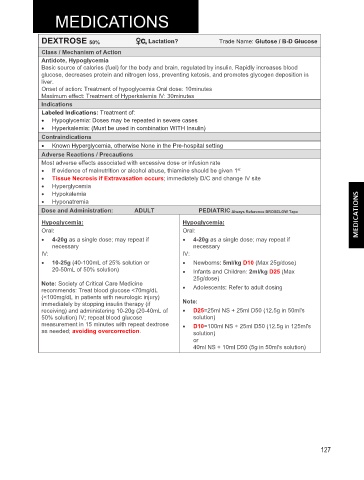
DEXTROSE 50%           Lactation?      Trade Name: Glutose / B-D Glucose
          Class / Mechanism of Action
          Antidote, Hypoglycemia
          Basic source of calories (fuel) for the body and brain, regulated by insulin. Rapidly increases blood
          glucose, decreases protein and nitrogen loss, preventing ketosis, and promotes glycogen deposition in
          liver.
          Onset of action: Treatment of hypoglycemia Oral dose: 10minutes
          Maximum effect: Treatment of Hyperkalemia IV: 30minutes
          Indications
          Labeled Indications: Treatment of:
          •  Hypoglycemia: Doses may be repeated in severe cases
          •  Hyperkalemia: (Must be used in combination WITH Insulin)
          Contraindications
          •  Known Hyperglycemia, otherwise None in the Pre-hospital setting
          Adverse Reactions / Precautions
          Most adverse effects associated with excessive dose or infusion rate
          •  If evidence of malnutrition or alcohol abuse, thiamine should be given 1 st
          •  Tissue Necrosis if Extravasation occurs; immediately D/C and change IV site
          •  Hyperglycemia
          •  Hypokalemia
          •  Hyponatremia
          Dose and Administration:    ADULT    PEDIATRIC Always Reference BROSELOW Tape
          Hypoglycemia:                  Hypoglycemia:
          Oral:                          Oral:
          •  4-20g as a single dose; may repeat if   •  4-20g as a single dose; may repeat if
            necessary                      necessary
          IV:                            IV:
          •  10-25g (40-100mL of 25% solution or   •  Newborns: 5ml/kg D10 (Max 25g/dose)
            20-50mL of 50% solution)     •  Infants and Children: 2ml/kg D25 (Max
                                           25g/dose)
          Note: Society of Critical Care Medicine
          recommends: Treat blood glucose <70mg/dL   •  Adolescents: Refer to adult dosing
          (<100mg/dL in patients with neurologic injury)
          immediately by stopping insulin therapy (if   Note:
          receiving) and administering 10-20g (20-40mL of   •  D25=25ml NS + 25ml D50 (12.5g in 50ml's
          50% solution) IV; repeat blood glucose   solution)
          measurement in 15 minutes with repeat dextrose   •  D10=100ml NS + 25ml D50 (12.5g in 125ml's
          as needed; avoiding overcorrection.    solution)
                                           or
                                           40ml NS + 10ml D50 (5g in 50ml's solution)


                                                                       127

