


Page 123 - 2023 SMOG Digital
P. 123
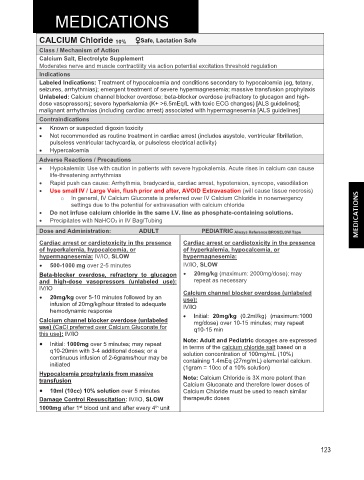
CALCIUM Chloride 10%   Safe, Lactation Safe
          Class / Mechanism of Action
          Calcium Salt, Electrolyte Supplement
          Moderates nerve and muscle contractility via action potential excitation threshold regulation
          Indications
          Labeled Indications: Treatment of hypocalcemia and conditions secondary to hypocalcemia (eg, tetany,
          seizures, arrhythmias); emergent treatment of severe hypermagnesemia; massive transfusion prophylaxis
          Unlabeled: Calcium channel blocker overdose; beta-blocker overdose (refractory to glucagon and high-
          dose vasopressors); severe hyperkalemia (K+ >6.5mEq/L with toxic ECG changes) [ALS guidelines];
          malignant arrhythmias (including cardiac arrest) associated with hypermagnesemia [ALS guidelines]
          Contraindications
          •  Known or suspected digoxin toxicity
          •  Not recommended as routine treatment in cardiac arrest (includes asystole, ventricular fibrillation,
            pulseless ventricular tachycardia, or pulseless electrical activity)
          •  Hypercalcemia
          Adverse Reactions / Precautions
          •  Hypokalemia: Use with caution in patients with severe hypokalemia. Acute rises in calcium can cause
            life-threatening arrhythmias
          •  Rapid push can cause: Arrhythmia, bradycardia, cardiac arrest, hypotension, syncope, vasodilation
          •  Use small IV / Large Vein, flush prior and after, AVOID Extravasation (will cause tissue necrosis)
              o  In general, IV Calcium Gluconate is preferred over IV Calcium Chloride in nonemergency
                settings due to the potential for extravasation with calcium chloride
          •  Do not infuse calcium chloride in the same I.V. line as phosphate-containing solutions.
          •  Precipitates with NaHCO3 in IV Bag/Tubing
          Dose and Administration:    ADULT    PEDIATRIC Always Reference BROSELOW Tape
          Cardiac arrest or cardiotoxicity in the presence   Cardiac arrest or cardiotoxicity in the presence
          of hyperkalemia, hypocalcemia, or   of hyperkalemia, hypocalcemia, or
          hypermagnesemia: IV/IO, SLOW   hypermagnesemia:
          •  500-1000 mg over 2-5 minutes  IV/IO, SLOW
          Beta-blocker  overdose,  refractory  to  glucagon  •  20mg/kg (maximum: 2000mg/dose); may
          and  high-dose  vasopressors  (unlabeled  use):   repeat as necessary
          IV/IO
          •  20mg/kg over 5-10 minutes followed by an   Calcium channel blocker overdose (unlabeled
                                         use):
            infusion of 20mg/kg/hour titrated to adequate   IV/IO
            hemodynamic response
          Calcium channel blocker overdose (unlabeled   •  Initial:  20mg/kg  (0.2ml/kg)  (maximum:1000
                                           mg/dose) over 10-15 minutes; may repeat
          use) (CaCl preferred over Calcium Gluconate for   q10-15 min
          this use): IV/IO
          •  Initial: 1000mg over 5 minutes; may repeat   Note: Adult and Pediatric dosages are expressed
                                         in terms of the calcium chloride salt based on a
            q10-20min with 3-4 additional doses; or a   solution concentration of 100mg/mL (10%)
            continuous infusion of 2-6grams/hour may be   containing 1.4mEq (27mg/mL) elemental calcium.
            initiated                    (1gram = 10cc of a 10% solution)
          Hypocalcemia prophylaxis from massive
          transfusion                    Note: Calcium Chloride is 3X more potent than
                                         Calcium Gluconate and therefore lower doses of
          •  10ml (10cc) 10% solution over 5 minutes   Calcium Chloride must be used to reach similar
          Damage Control Resuscitation: IV/IO, SLOW   therapeutic doses
          1000mg after 1 st  blood unit and after every 4 th  unit
                                                                       123

