


Page 129 - 2023 SMOG Digital
P. 129
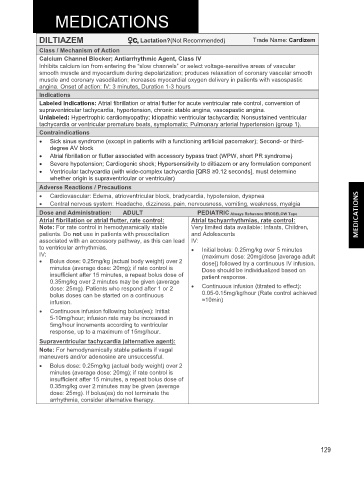
DILTIAZEM             Lactation?(Not Recommended)   Trade Name: Cardizem
          Class / Mechanism of Action
          Calcium Channel Blocker; Antiarrhythmic Agent, Class IV
          Inhibits calcium ion from entering the “slow channels” or select voltage-sensitive areas of vascular
          smooth muscle and myocardium during depolarization; produces relaxation of coronary vascular smooth
          muscle and coronary vasodilation; increases myocardial oxygen delivery in patients with vasospastic
          angina. Onset of action: IV: 3 minutes, Duration 1-3 hours
          Indications
          Labeled Indications: Atrial fibrillation or atrial flutter for acute ventricular rate control, conversion of
          supraventricular tachycardia, hypertension, chronic stable angina, vasospastic angina.
          Unlabeled: Hypertrophic cardiomyopathy; Idiopathic ventricular tachycardia; Nonsustained ventricular
          tachycardia or ventricular premature beats, symptomatic; Pulmonary arterial hypertension (group 1).
          Contraindications
          •  Sick sinus syndrome (except in patients with a functioning artificial pacemaker); Second- or third-
            degree AV block
          •  Atrial fibrillation or flutter associated with accessory bypass tract (WPW, short PR syndrome)
          •  Severe hypotension; Cardiogenic shock; Hypersensitivity to diltiazem or any formulation component
          •  Ventricular tachycardia (with wide-complex tachycardia [QRS ≥0.12 seconds], must determine
            whether origin is supraventricular or ventricular)
          Adverse Reactions / Precautions
          •  Cardiovascular: Edema, atrioventricular block, bradycardia, hypotension, dyspnea
          •  Central nervous system: Headache, dizziness, pain, nervousness, vomiting, weakness, myalgia
          Dose and Administration:       ADULT    PEDIATRIC Always Reference BROSELOW Tape
          Atrial fibrillation or atrial flutter, rate control:   Atrial tachyarrhythmias, rate control:
          Note: For rate control in hemodynamically stable   Very limited data available: Infants, Children,
          patients. Do not use in patients with preexcitation   and Adolescents
          associated with an accessory pathway, as this can lead  IV:
          to ventricular arrhythmias.      •  Initial bolus: 0.25mg/kg over 5 minutes
          IV:                                (maximum dose: 20mg/dose [average adult
          •  Bolus dose: 0.25mg/kg (actual body weight) over 2   dose]) followed by a continuous IV infusion.
            minutes (average dose: 20mg); if rate control is   Dose should be individualized based on
            insufficient after 15 minutes, a repeat bolus dose of   patient response.
            0.35mg/kg over 2 minutes may be given (average
            dose: 25mg). Patients who respond after 1 or 2   •  Continuous infusion (titrated to effect):
            bolus doses can be started on a continuous   0.05-0.15mg/kg/hour (Rate control achieved
            infusion.                        ≈10min)
          •  Continuous infusion following bolus(es): Initial:
            5-10mg/hour; infusion rate may be increased in
            5mg/hour increments according to ventricular
            response, up to a maximum of 15mg/hour.
          Supraventricular tachycardia (alternative agent):
          Note: For hemodynamically stable patients if vagal
          maneuvers and/or adenosine are unsuccessful.
          •  Bolus dose: 0.25mg/kg (actual body weight) over 2
            minutes (average dose: 20mg); if rate control is
            insufficient after 15 minutes, a repeat bolus dose of
            0.35mg/kg over 2 minutes may be given (average
            dose: 25mg). If bolus(es) do not terminate the
            arrhythmia, consider alternative therapy.


                                                                       129

