


Page 123 - JSOM Fall 2025
P. 123
However, prehospital interventions remain limited, and in   Methods
          cases where NCTH is the underlying cause, even rapid resus-
          citation efforts may be ineffective without concurrent hemor-  Search Strategy
          rhage control. According to Eastridge et al., 79% of potentially   Medical Subject Headings (MeSH) terms were used with the
          preventable prehospital deaths among U.S. combat fatalities   search string: (“Abdominal Aortic and Junctional Tourniquet”
                                                      6
          were due to uncontrolled torso and junctional bleeding.  This   OR  AAJT OR  AAJT-S OR  “external haemorrhage control
          stark statistic highlights a fundamental gap in trauma man-  devices”  OR  “external  haemorrhage  control  devices”  OR
          agement; while extremity hemorrhage can be controlled, torso   EHCD) AND (hemor* OR haemor* OR effect* OR occlusion
          and internal bleeding remain overwhelming causes of death   OR REBOA OR resuscitat* OR prehospital OR “chest com-
          before definitive surgical care can be administered.  pression*” OR application OR “intermittent hemostasis” OR
                                                             “safe duration” OR utility). A literature search was performed
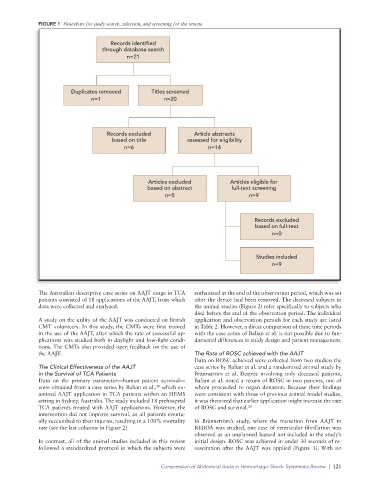
                                                             on 3 September 2024 (Figure 1). Access to the biomedical da-
          To address this challenge, new methods of prehospital hem-
          orrhage control are being explored, including the abdominal   tabases was granted by the University of Turku, Finland.
          aortic and junctional tourniquet (AAJT, windlass version FDA
          cleared in 2013). The AAJT is an external hemorrhage con-  Inclusion and Exclusion Criteria
          trol device (EHCD) that resembles a belt-like tourniquet with   Results were limited to English-language publications in peer-
          an air bladder that, when inflated, compresses the abdominal   reviewed  journals  published  between  2019  and 2024.  Only
          aorta and stops circulation below the aortic bifurcation.  The   medical journal articles were considered for inclusion. Publica-
                                                      9
          only product commercially available today is a more advanced   tions in which a hemorrhage was treated with the abdominal
          version, the abdominal aortic and junctional tourniquet –   application of the AAJT were considered for inclusion. Pub-
          stabilized  (AAJT-S,  FDA  cleared  in  2023),  which  features  a   lications regarding non-hemorrhagic injuries were excluded.
          ratchet buckle tensioning mechanism instead of the traditional   Healthy volunteer and animal studies were considered for in-
          windlass rod; the ratchet makes it easier to apply and reduces   clusion alongside human patient studies.
                                                10
          the risk of pressure loss if the operator loses grip.  This review
          refers to the device as AAJT regardless of more recent studies   Selection Process and Quality Assessment
          using the updated model.                           Studies on hemorrhage, TCA, and combined open-book pel-
                                                             vic fractures with major iliac vascular injuries were included.
                                                             One animal study that examined electrically induced ventric-
          Most research on the  AAJT has been conducted in animal
          studies, demonstrating clear physiological benefits in resusci-  ular fibrillation as the mechanism of injury was excluded. An
          tation efforts. 11–13  However, its practical application presents   imaging study of external compression of hemorrhage, which
          challenges. The device exerts significant pressure over a large   focused on the localization of the lower abdominal arteries,
          area, raising concerns about severe organ damage and isch-  was also discarded.
          emic injury if applied for extended periods. 14,15  The evidence
          of the effectiveness of the AAJT in human patients is limited. 16  After the titles and abstracts were independently screened and
                                                             duplicates removed, the remaining full papers were reviewed
                                                             to assess how the results matched the inclusion criteria. The
          Another intervention to control abdominal hemorrhage, the
          resuscitative  endovascular  balloon  occlusion  of  the  aorta   patient outcome measures included in the analysis were mor-
          (REBOA), was used to treat patients with hemorrhagic shock   tality, rate of ROSC achieved, and benefit, including rate of
          both in and outside the hospital until its controversial results   successful  application and the time of application. The  sys-
          in recent clinical trials. A recent randomized controlled trial   tematic literature review identified nine publications from 21
          of REBOA integration to hemorrhage care protocol revealed   records (Figure 1). Level of evidence was evaluated with the
          increased mortality when compared with standard care alone,   Oxford Centre for Evidence-Based Medicine tool, and the risk
          partly  due to  delays  in  intervention  and prolonged  time  to   of bias was interpreted with the Cochrane Risk of Bias Tool
                                   17
          definitive surgical management.  Other similar studies have   (RoB 1.0).
          reported high rates of late mortality in initially surviving pa-
          tients, raising concerns about the long-term complications   Results
          associated with REBOA’s prehospital use, even with partial
          aortic occlusion. 18.19                            Nine publications on the AAJT were identified for this review
                                                             (Table 1). One studied the difficulty of using the  AAJT, as
                                                             tested on British combat medic technician (CMT) operators.
          Given the ambiguous effects of the AAJT and the mixed out-
          comes of REBOA’s prehospital use, there is an urgent need to   One was a descriptive case series on the use of AAJT in an Aus-
          evaluate the effectiveness of the AAJT in human trauma pa-  tralian Helicopter Emergency Medical Services (HEMS) unit
          tients. This review aimed to determine the effect of the AAJT   for TCA. Seven publications were animal model studies. The
          on survival rates among patients with hemorrhagic shock,   level of evidence was IV or V for all included studies. Attrition
          based on the most recent literature.  The analysis was con-  bias was high in all studies. Reporting bias was high in six of
          ducted by reviewing studies published from 2019 to 2024.   the included studies (Appendix A).
          The primary parameter was the reported survival of patients
          with hemorrhagic shock treated with the AAJT. The secondary   The seven animal case studies focused mainly on physiological
          parameter was return of spontaneous circulation (ROSC) in   and hemodynamic changes associated with AAJT use and its
          TCA following hemorrhagic shock, given its correlation with   resuscitative effects. Three of the studies investigated hemody-
          survival in both human and animal studies. In addition, stud-  namic effects by comparing REBOA and AAJT. One of these
          ies assessing the utility of the AAJT, specifically the successful   included different resuscitative fluids in its analysis, while the
          application rate and time to aortic occlusion, were included   other two studies concentrated on installing REBOA in an an-
          to determine AAJT’s feasibility in urgent emergency settings.  imal model with the AAJT.

          120  |  JSOM   Volume 25, Edition 3 / Fall 2025

