


Page 120 - JSOM Fall 2025
P. 120
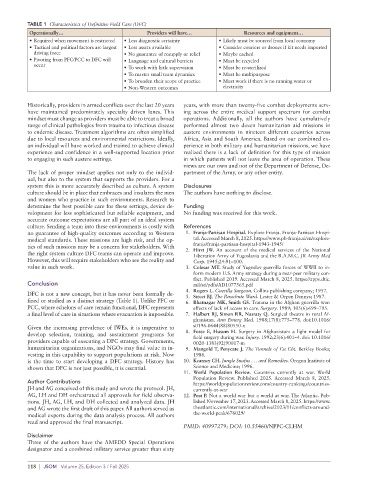
BOX 1  List of Nations in Conflict                 FIGURE 2  Small surgical team (four members) setting up an
              Afghanistan               Mauritania               operating table in an irregular warfare environment.
              Algeria                   Mexico
              Bangladesh                Morocco
              Benin                     Mozambique
              Burkina Faso              Myanmar
              Cameroon                  Niger
              Central Africa Repuablic  Nigeria
              Chad                      Pakistan
              China                     Palestine
              Colombia                  Philippines
              Democratic Republic of the Congo Russia
              Ecuador                   Somalia
              Ethiopia                  South Sudan
              Ghana                     Sudan
              Haiti                     Syria
              India                     Tanzania
              Iraq                      Togo
              Israel                    Tunisia
              Ivory Coast               Uganda
              Libya                     Ukraine
              Mali                      Yemen
              Source: World Population Review, Accessed Feb 12, 2025.

              landscape. Healthcare providers are viewed as force multipli-
              ers through their ability to help heal the opposition’s forces
              and/or boost morale. Historical protections under the Geneva
              Convention for health care providers is non-existent.

              The patients are subject to care in an austere environment—
              care that is often delayed or limited, and therefore, must be
              able to “fail well”. The delays may lead to increased risk for
              medical complications. Power will be unreliable, communica-
              tions frequently disrupted, and language barriers insurmount-
              able, among other setbacks. Cautery, lighting, instrumentation,
              and staff education will all be uncertain. Follow-up rarely ex-
              ists. Diagnostic modalities are limited. Treatment algorithms   team need to be experts in their own field with overlapping
              are shortened, and complications are harder to manage. Out-  knowledge and skills for other team members’ roles.  Team
              comes are likely to be inferior to a modern Western medical   members need to exhibit leadership in their content area and
              facility (Figure 2).                               submission to the leadership of their fellow teammates’ exper-
                                                                 tise. Integrity and trust among team members is essential.
              Risk to the provider and risk to the patient will lead to risk to
              the organization. Any time patients are perceived as receiving   The provider must understand and have a mindset that accepts
              or actually receive sub-standard care, commands and politi-  that the trappings of war will become more visible. Guns, gre-
              cians become vulnerable. Thus, DFC as a primary plan will   nades, and armed soldiers presenting within clinics and oper-
              require discussion before acceptance, as the cost to the patient,   ating rooms are the norm. There is no clearing one’s weapon
              provider and organization is substantial. Nonetheless, as his-  on the way to the dining or medical facility—neutrality is not
              tory demonstrates, DFC does occur.                 appreciated. While the surgical element is not itself engaged
                                                                 in combat, it is clear they are force multipliers for the group
              The adage, “a plan poorly executed is better than no plan,”   they support, and providers entering this environment must
              summarizes the risk associated with DFC. This risk needs to   understand this context.
              empower governments, politicians, and commanders alike to
              strive to develop casualty plans beyond a proposed evacuation   Providers must understand that evidence-based medicine is vir-
              system that many know will fail.                   tually non-existent in these environments. Best practice is rarely
                                                                 established for isolated, austere, resource restricted locations.
              Mindset                                            When antiseptic soaps are missing, clean water is rationed,
                                                                 patients arrive hours after wounding with gross contamina-
              Only after understanding the operational considerations and   tion, postoperative patients sleep on the floor and insects roam
              risk tolerance, can the mindset of DFC be fully appreciated.   freely across operative fields, the provider will never replicate
              Each individual and parent organization must obtain and   Western outcomes. A provider must be comfortable in this con-
              maintain the right mindset and soft skills to function effec-  text and not carry an unnecessary weight of concern. The risk
              tively in small surgical teams.                    of “morale injury” must be countered with the “permission” to
                                                                 do one’s best under such extreme conditions. A greater latitude
              There are many soft skills required to work effectively in an   for the surgical element’s judgement must be granted. High lev-
              IWE. These teams historically are composed of 1–5 individu-  els of grit, resilience and perseverance in such environments are
              als. A small footprint decreases visibility, allows for improved   crucial. Monday morning quarterbacking from a Western view
              mobility, and reduces resource requirements. Individuals on a   will never be appreciated or helpful.

                                                                              Definitive Field Care: Modern Application  |  117

