


Page 119 - JSOM Fall 2025
P. 119
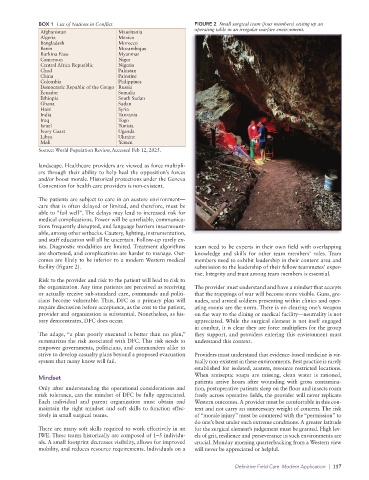
occurred during World War II when the Yugoslavian Partisans   While tactical and political considerations are human vari-
          resisted Nazi occupation.                          ables, other operational considerations that force a DFC strat-
                                                             egy are out of human control—weather and disease. In their
          Nazi dominance required creative methods for delivering   final campaign in 1944, Merrill’s Marauders paid dearly with
          healthcare to both the resistance and civilian population. Static   980 soldiers evacuated for illness and 955 evacuated for in-
          locations were often in hard-to-reach geographic locations   jury.  Burmese jungle roads became impassable with the rainy
                                                                10
          requiring patients to be carried for miles across rugged and   season deluge, and movement was equally difficult for both
          treacherous terrain.  Geographic features were taken advan-  the Allied and the Axis armies. Mosquito and waterborne ill-
                         1
          tage of, including gorges and caves, to provide cover and con-  nesses were rampant. Merrill’s Marauders had a very limited
          cealment for medical operations. At times, underground wards   evacuation plan. The Office of Strategic Services (OSS) had
          were constructed, often dug by hand, near a water feature.   no practical means of evacuation, and the local Kachin fight-
          Utmost secrecy was maintained regarding all these locations,   ers were never getting evacuated (Lew Kolodny, MD, Personal
          as the Nazis specifically targeted healthcare facilities, killing   Communication, December 1996). DFC was their only option.
          both workers and patients alike.  Despite tactically proficient
                                   2,3
          fieldcraft being utilized, the always advancing enemy forced   These operational conditions are seen regularly by humani-
          the operating theaters, post-operative recovery wards, and   tarians working with oppressed people groups. In Afghani-
          convalescing patients to relocate often. Surgical care in this   stan during the Soviet invasion, a small civilian surgical team
          environment was challenging at best. 4,5           utilized disguise and frequent movement on bicycles to avoid
                                                             detection by Soviet forces.  The team never stayed longer than
                                                                                 8
          Following WWII, the implementation  of DFC was also uti-  eight hours in a location and thus postoperative recovery and
          lized by several non-governmental organizations (NGOs) in   follow up were limited. Despite the challenges, outcomes were
          Afghanistan during the Soviet invasion from 1979–1989.    surprisingly good, demonstrating that surgical care, even with
                                                        6–8
          While there are many more examples of definitive care   less than optimal conditions, saves lives.
          throughout history, there is one important shared aspect of
          healthcare delivery—definitive care was always provided at   With appropriate planning, implementation of DFC may make
          the time of the initial surgeon-patient interaction because this   attaining care within the Golden Hour more likely. Rather than
          interaction was often the first, last, and only interaction.  delaying definitive surgical care or damage control surgery as
                                                             described in PCC/PFC, the DFC pathway is implemented as
                                                             soon as it is deemed reasonable. What small amount of liter-
          Operational Considerations
                                                             ature there is available describing DFC-like conditions, sug-
          Restriction of movement is the the driving force behind the   gests that suboptimal conditions for surgery are less evil than
          use of a DFC strategy. While there are numerous reasons for   delaying a critical surgery. The DFC plan accepts some risks
          restrictions of movement, without movement, normal evacua-  inherent to the environment while mitigating others.
          tion chains cannot be utilized. The tactical and political envi-
          ronment are the two main considerations driving restriction   Risk Tolerance
          of movement. As war is a continuation of politics, there will
          always be a population of people that are not politically con-  During DFC, the accepted risk tolerance will be higher than
          venient, or maybe even politically detrimental, to evacuate. A   PFC/PCC. As of the writing of this manuscript, there are over
          medical element supporting such a population by definition   forty conflicts globally.  It has been said that the world is at
                                                                               11
          are in a DFC strategy.                             war, though it is not yet a “world war.”  The majority of these
                                                                                           12
                                                             conflicts are due to terrorist insurgencies, ethnic conflicts, and
          For example, the Viet Cong were restricted to using the Cu Chi   civil wars, the combination of which has led to an increase in
          tunnels. There was no evacuation plan to a higher level of care   irregular war environments (IWE). Many of these conflicts are
                9
          for these casualties. The providers sent were the DFC. Even   in the most remote and poverty-stricken areas of the world,
          within Operation Enduring Freedom, Operations Freedom   compounding the difficulty of providing medical support to
          Sentinel, and Operation Iraqi Freedom, there are examples   the combat elements, as well as to the civilians who are often
          were local forces partnering with the United States were not   directly attacked as terror targets (Box 1). Additionally, many
          able to be evacuated to higher levels of care, let alone evacu-  of the actors in these IWEs are ideologues and not subject to
          ated for Role 5 care in the United States, as this would have   and refuse to abide by Geneva conventions.
          been impractical. In this situation, the U.S. provided some level
          of care, and if and when able, casualties moved to definitive   In order to provide care in many of these conflict zones, dis-
          care locally or “on the economy.”                  creet humanitarian or government entities are needed. The in-
                                                             dividuals in these elements, and their patients, face different
          In the case of an intervening country supporting a resistance   risks and mitigation strategies. These risks include disease as
          element, echelons of care are likely different for intervening   well as battle and non-battle injuries. The increased risk also
          force  casualties  than for  their  local  partners.  Additionally,   applies to facilities, infrastructure, tactical commands, and
          wounding patterns may drive a partial DFC strategy in which   politicians engaged in the conflict. Accepting these risks is a
          all patients with extremity injuries are managed locally, but   necessary part of implementing and understanding DFC as a
          those with penetrating abdominal trauma are evacuated when   primary strategy. Despite these increased risks, it is being ac-
          possible. When there is no hope for any evacuation, there is   tively carried out in parts of the world today.
          likely to be a significant shift in decision making; for example,
          the role for direct amputation versus limb salvage, or the de-  Providers in these locations are subject to the same risks as
          cision to resuscitate a patient with a significant burn or trau-  the resistance forces. Neutrality is not an option in IWEs
          matic brain injury (TBI) versus expectant management.  where ideologues and dictators often dominate the political

          116  |  JSOM   Volume 25, Edition 3 / Fall 2025

