


Page 114 - JSOM Fall 2025
P. 114
highlights the following regions of the world as being particu-  with exposure risk to hydatid disease might not exhibit pa-
              larly noteworthy, especially areas “coinciding with sheep hus-  thology until years later.
              bandry”: Russia, central Asia, China, Tibet, Mongolia, Turkey,
              Lebanon, Syria, Egypt, Sudan, Kenya, and Australia.  Spain and   A 2004 case report in Military Medicine described hydatid dis-
                                                     4
                                                                                                      7
              Uruguay are listed in the 20th edition of Control of Commu-  ease of the spleen in a 20-year-old Iranian soldier.  The authors
              nicable Diseases, in the chapter on echinococcosis.  Khalili et   speculate that the patient had likely contracted the infection
                                                     1
              al. report that hydatid disease is “highly prevalent in Iran,”    during his youth, as the soldier was raised in a pastoral setting
                                                             5
              while Botezatu et al. point out that the disease also occurs in   with exposure to both dogs and cattle.
              eastern Europe, the Balkans, and New Zealand.  According to
                                                  3
              the World Health Organization (WHO), some South American   In 2008 Kronmann et al. reported a case of hydatid disease in
              slaughterhouses yield a cystic echinococcosis rate of 20%–95%   a 23-year-old U.S. Marine who had deployed to Afghanistan.
                                                                                                                8
              of animals slaughtered.  Small pockets of locally transmitted   Onset of symptoms began 7 months after his return to the
                                2
              hydatid disease exist within the United States, namely, in Cali-  U.S. His chief complaint was right upper quadrant abdominal
              fornia, Utah, New Mexico, Alaska, and Arizona. 4   pain. Despite the eventual discovery of multiple cysts (the larg-
                                                                 est measuring 6.5×6.3cm) within both peritoneal and thoracic
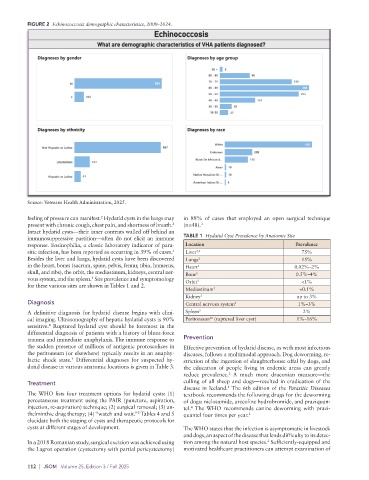
              The United States Veterans Health Administration—with the   spaces, the patient denied any constitutional symptoms. Initial
              assistance of the Science and Health Initiative to Combat Infec-  lab work revealed an unremarkable complete metabolic panel,
              tious and Emerging Life-Threatening Diseases (SHIELD) Vector   a white cell count of 8,500/mm , and 16% eosinophils. Treat-
                                                                                         3
              Borne, Environmental, and Zoonotic Disease Workgroup—has   ment was multimodal and included administration of alben-
              made data available on the incidence of echinococcosis in U.S.   dazole, a percutaneous procedure, described in the Treatment
              Veterans for this article. As shown in Figure 1, they report a to-  section of this article, and surgical removal.
              tal of 1,059 cases in their system from the years 2000 to 2024.
              In Figure 2 we see that the majority of these cases occurred in   A 2022 case report described a Vietnam War veteran in his
              males (90.5% [958 patients]), with the highest incidence occur-  seventies who presented with a nonproductive cough.  Upon
                                                                                                           9
              ring in patients aged 60–69 years (27.2% [288 patients]).  imaging of the chest, a 2.8cm hydatid cyst was revealed in
                                                                 the left lower lobe. The patient stated that he had “patrolled
                                                                 farmlands among animals” in Vietnam, leading the authors to
              In the 1958 U.S. Army Medical Department’s Preventive Med-  speculate that this was the source of infection. The cyst was
              icine in World War II text,  the authors noted 2,036 reported   successfully removed via surgical resection.
                                  6
              cestode (tapeworm) infections in Soldiers from the years 1942
              to 1945. Out of these reported cases, 22 were attributed to   Clinical Presentation
              infection with hydatid disease. Given the prolonged develop-
              ment timing of cystic echinococcosis, it is likely that some of   A mature hydatid cyst contains millions  of protoscolices and
                                                                                                4
              these cases were contracted by American Soldiers prior to the   can take months to years to reach a maximum size of up to
                                                                                       1
              war. Besides discouraging the keeping of indigenous dogs as   15cm (larger in some cases).  Most liver cysts (60%) are as-
              pets in deployed areas, the authors also point out that Soldiers   ymptomatic,  though abdominal pain, nausea, vomiting and a
                                                                          4
              FIGURE 1  Echinococcosis disease frequency across time and geography, U.S. Veterans, 2000–2024.


              Source: Veterans Health Administration, 2025.

                                                                                                Hydatid Disease  |  111

