


Page 42 - JSOM Summer 2025
P. 42
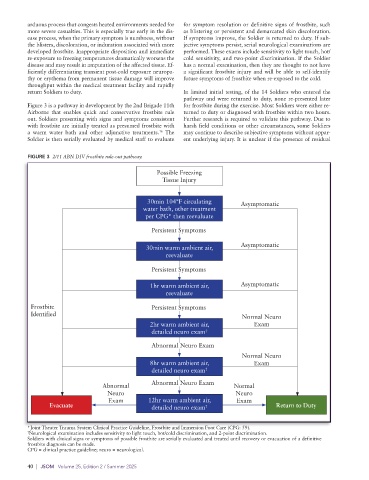
arduous process that congests heated environments needed for   for symptom resolution or definitive signs of frostbite, such
          more severe casualties. This is especially true early in the dis-  as blistering or persistent and demarcated skin discoloration.
          ease process, when the primary symptom is numbness, without   If symptoms improve, the Soldier is returned to duty. If sub-
          the blisters, discoloration, or induration associated with more   jective symptoms persist, serial neurological examinations are
          developed frostbite. Inappropriate disposition and immediate   performed. These exams include sensitivity to light touch, hot/
          re-exposure to freezing temperatures dramatically worsens the   cold sensitivity, and two-point discrimination. If the Soldier
          disease and may result in amputation of the affected tissue. Ef-  has a normal examination, then they are thought to not have
          ficiently differentiating transient post-cold exposure neuropa-  a significant frostbite injury and will be able to self-identify
          thy or erythema from permanent tissue damage will improve   future symptoms of frostbite when re-exposed to the cold.
          throughput within the medical treatment facility and rapidly
          return Soldiers to duty.                           In limited initial testing, of the 14 Soldiers who entered the
                                                             pathway and were returned to duty, none re-presented later
          Figure 3 is a pathway in development by the 2nd Brigade 11th   for frostbite during the exercise. Most Soldiers were either re-
          Airborne that enables quick and conservative frostbite rule   turned to duty or diagnosed with frostbite within two hours.
          out. Soldiers presenting with signs and symptoms consistent   Further research is required to validate this pathway. Due to
          with frostbite are initially treated as presumed frostbite with   harsh field conditions or other circumstances, some Soldiers
          a warm water bath and other adjunctive treatments.   The   may continue to describe subjective symptoms without appar-
                                                     16
          Soldier is then serially evaluated by medical staff to evaluate   ent underlying injury. It is unclear if the presence of residual

          FIGURE 3  2/11 ABN DIV frostbite rule-out pathway.

                                                    Possible Freezing
                                                      Tissue Injury


                                                 30min 104°F circulating        Asymptomatic
                                                water bath, other treatment
                                                 per CPG* then reevaluate

                                                   Persistent Symptoms


                                                 30min warm ambient air,        Asymptomatic
                                                       reevaluate

                                                   Persistent Symptoms


                                                  1hr warm ambient air,         Asymptomatic
                                                       reevaluate

           Frostbite                               Persistent Symptoms
           Identified                                                           Normal Neuro
                                                  2hr warm ambient air,             Exam
                                                   detailed neuro exam †

                                                   Abnormal Neuro Exam
                                                                                Normal Neuro
                                                  8hr warm ambient air,             Exam
                                                   detailed neuro exam †

                                   Abnormal        Abnormal Neuro Exam       Normal
                                    Neuro                                     Neuro
                                    Exam         12hr warm ambient air,       Exam
                 Evacuate                          detailed neuro exam †                   Return to Duty


          *Joint Theater Trauma System Clinical Practice Guideline, Frostbite and Immersion Foot Care (CPG: 59).
          † Neurological examination includes sensitivity to light touch, hot/cold discrimination, and 2-point discrimination.
          Soldiers with clinical signs or symptoms of possible frostbite are serially evaluated and treated until recovery or evacuation of a definitive
          frostbite diagnosis can be made.
          CPG = clinical practice guideline; neuro = neurological.

          40  |  JSOM   Volume 25, Edition 2 / Summer 2025

