


Page 40 - JSOM Summer 2025
P. 40
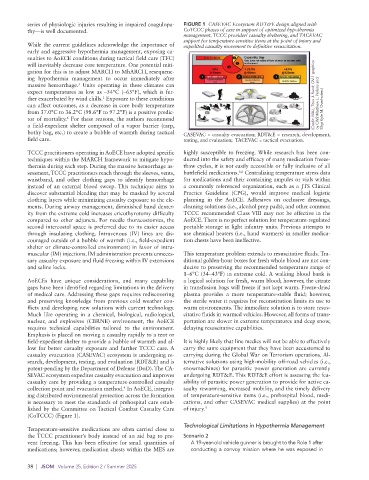
series of physiologic injuries resulting in impaired coagulopa-  FIGURE 1  CASEVAC Ecosystem RDT&E design aligned with
          thy—is well documented.                            CoTCCC phases of care in support of optimized hypothermia
                                                             management, TCCC provider/ casualty sheltering, and TACEVAC
                                                             support for temperature-sensitive items at the point of injury and
          While the current guidelines acknowledge the importance of   expedited casualty movement to definitive resuscitation.
          early and aggressive hypothermia management, exposing ca-
          sualties to AoECE conditions during tactical field care (TFC)
          will inevitably decrease core temperature. One potential miti-
          gation for this is to adjust MARCH to MhARCH, resequenc-
          ing hypothermia management to occur immediately after
          massive hemorrhage.  Units operating in these climates can
                           3
          expect temperatures as low as –54°C (–65°F), which is fur-                                    (Credit: MAJ, Titus J. Rund; OV-1 graphics
          ther exacerbated by wind chills.  Exposure to these conditions
                                   1
          can affect outcomes, as a decrease in core body temperature                                    by CW2 Matthew L. Perkins and
          from 37.0°C to 36.2°C (98.6°F to 97.2°F) is a positive predic-                                  SSgt Kyle M. Overholser.)
          tor of mortality.  For these reasons, the authors recommend
                       4
          a field-expedient shelter composed of a vapor barrier (tarp,
          bothy bag, etc.) to create a bubble of warmth during tactical   CASEVAC = casualty evacuation; RDT&E = research, development,
          field care.                                        testing, and evaluation;  TACEVAC = tactical evacuation.
          TCCC practitioners operating in AoECE have adopted specific   highly susceptible to freezing. While research has been con-
          techniques within the MARCH framework to mitigate hypo-  ducted into the safety and efficacy of many medication freeze-
          thermia during each step. During the massive hemorrhage as-  thaw cycles, it is not easily accessible or fully inclusive of all
          sessment, TCCC practitioners reach through the sleeves, vents,   battlefield medications.  Centralizing temperature stress data
                                                                               5,6
          waistband, and other clothing gaps to identify hemorrhage   for medications and their containing ampules or vials within
          instead of an external blood sweep. This technique aims to   a commonly referenced organization, such as a JTS Clinical
          discover substantial bleeding that may be masked by several   Practice Guideline (CPG), would improve medical logistic
          clothing layers while minimizing casualty exposure to the ele-  planning in the  AoECE.  Adhesives on occlusive dressings,
          ments. During airway management, diminished hand dexter-  cleaning solutions (i.e., alcohol prep pads), and other common
          ity from the extreme cold increases cricothyrotomy difficulty   TCCC recommended Class VIII may not be effective in the
          compared to other adjuncts. For needle thoracostomies, the   AoECE. There is no perfect solution for temperature-regulated
          second intercostal space is preferred due to its easier access   portable storage in light infantry units. Previous attempts to
          through insulating clothing. Intravenous (IV) lines are dis-  use chemical heaters (i.e., hand warmers) in smaller medica-
          couraged outside of a bubble of warmth (i.e., field-expedient   tion chests have been ineffective.
          shelter or climate-controlled environment) in favor of intra-
          muscular (IM) injections. IM administration prevents unneces-  This temperature problem extends to resuscitative fluids. Tra-
          sary casualty exposure and fluid freezing within IV extensions   ditional golden-hour boxes for fresh whole blood are not con-
          and saline locks.                                  ducive to preserving the recommended temperature range of
                                                             1–6°C (34–43°F) in extreme cold. A walking blood bank is
          AoECEs  have  unique  considerations,  and  many  capability   a logical solution for fresh, warm blood; however, the citrate
          gaps have been identified regarding limitations in the delivery   in transfusion bags will freeze if not kept warm. Freeze-dried
          of medical care. Addressing these gaps requires rediscovering   plasma provides a more temperature-stable  fluid; however,
          and preserving knowledge from previous cold weather con-  the sterile water it requires for reconstitution limits its use to
          flicts and developing new solutions with current technology.   warm environments. The immediate solution is to store resus-
          Much  like  operating  in a  chemical,  biological, radiological,   citative fluids in warmed vehicles. However, all forms of trans-
          nuclear, and explosives (CBRNE) environment, the  AoECE   portation are slower in extreme temperatures and deep snow,
          requires technical capabilities tailored to the environment.   delaying resuscitative capabilities.
          Emphasis is placed on moving a casualty rapidly to a tent or
          field-expedient shelter to provide a bubble of warmth and al-  It is highly likely that line medics will not be able to effectively
          low for better casualty exposure and further TCCC care. A   carry the same equipment that they have been accustomed to
          casualty evacuation (CASEVAC) ecosystem is undergoing re-  carrying during the Global War on Terrorism operations. Al-
          search, development, testing, and evaluation (RDT&E) and is   ternative solutions using high-mobility off-road vehicles (i.e.,
          patent-pending by the Department of Defense (DoD). The CA-  snowmachines) for parasitic power generation are currently
          SEVAC ecosystem expedites casualty evacuation and improves   undergoing RDT&E. This RDT&E effort is assessing the fea-
          casualty care by providing a temperature-controlled casualty   sibility of parasitic power generation to provide for active ca-
          collection point and evacuation method.  In AoECE, integrat-  sualty rewarming, increased mobility, and the timely delivery
                                         4
          ing distributed environmental protection across the formation   of temperature-sensitive items (i.e., prehospital blood, medi-
          is necessary to meet the standards of prehospital care estab-  cations, and other CASEVAC medical supplies) at the point
          lished by the Committee on Tactical Combat Casualty Care   of injury. 3
          (CoTCCC) (Figure 1).
                                                             Technological Limitations in Hypothermia Management
          Temperature-sensitive medications are often carried close to
          the TCCC practitioner’s body instead of an aid bag to pre-  Scenario 2
          vent freezing. This has been effective for small quantities of   A 19-year-old vehicle gunner is brought to the Role 1 after
          medications; however, medication chests within the MES are   conducting a convoy mission where he was exposed in

          38  |  JSOM   Volume 25, Edition 2 / Summer 2025

