


Page 37 - JSOM Summer 2025
P. 37
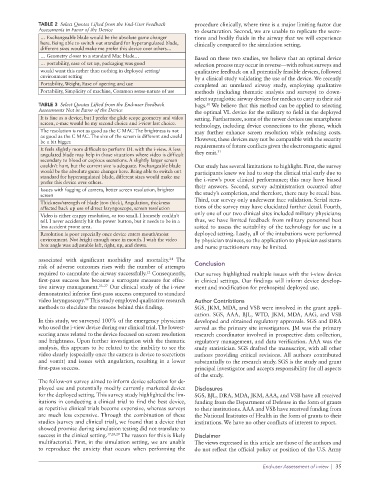
TABLE 2  Select Quotes Lifted from the End-User Feedback   procedure clinically, where time is a major limiting factor due
              Assessments in Favor of the Device                 to desaturation. Second, we are unable to replicate the secre-
              … Exchangeable blade would be the absolute game changer   tions and bodily fluids in the airway that we will experience
              here. Being able to switch out standard for hyperangulated blade,   clinically compared to the simulation setting.
              different sizes would make me prefer this device over others…
              … Geometry closer to a standard Mac blade…         Based on these two studies, we believe that an optimal device
              … portability, ease of set up, packaging was good  selection process may occur in reverse—with robust surveys and
              would want this rather than nothing in deployed setting/  qualitative feedback on all potentially feasible devices, followed
              environment setting                                by a clinical study validating the use of the device. We recently
              Portability, Weight, Ease of opening and use       completed an unrelated airway study, employing qualitative
              Portability, Simplicity of machine, Common sense-nature of use  methods (including thematic analysis and surveys) to down-
                                                                 select supraglottic airway devices for medics to carry in their aid
              TABLE 3  Select Quotes Lifted from the End-user Feedback   bags.  We believe that this method can be applied to selecting
                                                                     30
              Assessments Not in Favor of the Device             the optimal VL device for the military to field in the deployed
              It is fine as a device, but I prefer the glide scope geometry and video   setting. Furthermore, some of the newer devices use smartphone
              screen, c-mac would be my second choice and i-view last choice.  technology, including device connections to the phone, which
              The resolution is not as good as the C MAC The brightness is not   may further enhance screen resolution while reducing costs.
              as good as the C MAC. The size of the screen is different and could   However, these devices may not be compatible with the security
              be a bit bigger.                                   requirements of future conflicts given the electromagnetic signal
              It feels slightly more difficult to perform DL with the i-view. A less   31
              angulated blade may help in those situations where video is difficult   they emit.
              secondary to blood or copious secretions. A slightly larger screen
              couldn’t hurt, but the current size is adequate. Exchangeable blade   Our study has several limitations to highlight. First, the survey
              would be the absolute game changer here. Being able to switch out   participants knew we had to stop the clinical trial early due to
              standard for hyperangulated blade, different sizes would make me   the i-view’s poor clinical performance; this may have biased
              prefer this device over others.                    their answers. Second, survey administration occurred after
              Issues with fogging of camera, better screen resolution, brighter   the study’s completion, and therefore, there may be recall bias.
              screen                                             Third, our survey only underwent face validation. Serial itera-
              Thickness/strength of blade (too thick), Angulation, thickness
              affected back up use of direct laryngoscope, screen resolution  tions of the survey may have elucidated further detail. Fourth,
              Video is either crappy resolution, or too small. I honestly couldn’t   only one of our two clinical sites included military physicians;
              tell. I never accidently hit the power button, but it needs to be in a   thus, we have limited feedback from military personnel best
              less accident prone area.                          suited to assess the suitability of the technology for use in a
              Resolution is poor especially once device enters mouth/moist   deployed setting. Lastly, all of the intubations were performed
              environment. Not bright enough once in mouth. I wish the video   by physician trainees, so the application to physician assistants
              box angle was adjustable left, right, up, and down.  and nurse practitioners may be limited.

              associated with significant morbidity and mortality.  The
                                                        21
              risk of adverse outcomes rises with the number of attempts   Conclusion
              required to cannulate the airway successfully.  Consequently,   Our survey highlighted multiple issues with the i-view device
                                                 22
              first-pass success has become a surrogate measure for effec-  in clinical settings. Our findings will inform device develop-
              tive airway management. 23–27  Our clinical study of the i-view   ment and modification for prehospital deployed use.
              demonstrated inferior first-pass success compared to standard
              video laryngoscopy.  This study employed qualitative research   Author Contribtions
                             18
              methods to elucidate the reasons behind this finding.  SGS, JKM, MDA, and VSB were involved in the grant appli-
                                                                 cation.  SGS, AAA,  BJL, WTD,  JKM,  MDA, AAG,  and VSB
              In this study, we surveyed 100% of the emergency physicians   developed and obtained regulatory approvals. SGS and DRA
              who used the i-view device during our clinical trial. The lowest-   served as the primary site investigators. JM was the primary
              scoring areas related to the device focused on screen resolution   research coordinator involved in prospective data collection,
              and brightness. Upon further investigation with the thematic   regulatory management, and data verification. AAA was the
              analysis, this appears to be related to the inability to see the   study statistician. SGS drafted the manuscript, with all other
              video clearly (especially once the camera is device to secretions   authors providing critical revisions. All authors contributed
              and vomit) and issues with angulation, resulting in a lower   substantially to the research study. SGS is the study and grant
              first-pass success.                                principal investigator and accepts responsibility for all aspects
                                                                 of the study.
              The follow-on survey aimed to inform device selection for de-
              ployed use and potentially modify currently marketed device   Disclosures
              for the deployed setting. This survey study highlighted the lim-  SGS, BJL, DRA, MDA, JKM, AAA, and VSB have all received
              itations in conducting a clinical trial to find the best device,   funding from the Department of Defense in the form of grants
              as repetitive clinical trials become expensive, whereas surveys   to their institutions. AAA and VSB have received funding from
              are much less expensive. Through the combination of these   the National Institutes of Health in the form of grants to their
              studies (survey and clinical trial), we found that a device that   institutions. We have no other conflicts of interest to report.
              showed promise during simulation testing did not translate to
              success in the clinical setting. 17,28,29  The reason for this is likely   Disclaimer
              multifactorial. First, in the simulation setting, we are unable   The views expressed in this article are those of the authors and
              to reproduce the anxiety that occurs when performing the   do not reflect the official policy or position of the U.S. Army

                                                                                       End-user Assessment of i-view  |  35

