


Page 41 - JSOM Summer 2025
P. 41
the gunner’s hatch in –40°C (–40°F) temperatures. He is   indefinitely as long as reliable power is available. The device
                litter-bound, unresponsive to verbal stimuli, and his core   is often used in conjunction with a five-gallon bucket to im-
                temperature is 31.7°C (89.2°F). A hypothermia wrap is con-  merse the frozen extremity in the heated circulating  water
                structed with his sleep system and an HPMK, and warmed   bath. Bleach may be used at 0.5–2ppm (mg/L) to mitigate bac-
                                                                                                               14
                IV crystalloids are provided. Ambient temperatures in the   terial growth during prolonged periods of preheated water.
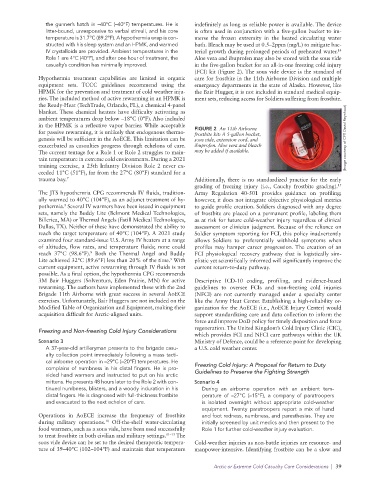
                Role 1 are 4°C (40°F), and after one hour of treatment, the   Aloe vera and ibuprofen may also be stored with the sous vide
                casualty’s condition has minimally improved.     in the five-gallon bucket for an all-in-one freezing cold injury
                                                                 (FCI) kit (Figure 2). The sous vide device is the standard of
              Hypothermia treatment capabilities are limited in organic   care for frostbite in the 11th Airborne Division and multiple
              equipment sets.  TCCC guidelines recommend using the   emergency departments in the state of Alaska. However, like
              HPMK for the prevention and treatment of cold weather inju-  the Bair Hugger, it is not included in standard medical equip-
              ries. The included method of active rewarming in an HPMK is   ment sets, reducing access for Soldiers suffering from frostbite.
              the Ready-Heat (TechTrade, Orlando, FL), a chemical 4-panel
              blanket. These chemical heaters have difficulty activating as
              ambient temperatures drop below –18°C (0°F). Also included
              in the HPMK is a reflective vapor barrier. While acceptable
              for passive rewarming, it is unlikely that endogenous thermo-  FIGURE 2  An 11th Airborne
                                                                 frostbite kit: A 5-gallon bucket,
              genesis will be sufficient in the AoECE. This limitation can be   sous vide, extension cord, and    (Image courtesy of CPT David Reynhout)
              exacerbated as casualties progress through echelons of care.   ibuprofen. Aloe vera and bleach
              The current tentage for a Role 1 or Role 2 struggles to main-  may be added if available.
              tain temperature in extreme cold environments. During a 2021
              training exercise, a 25th Infantry Division Role 2 never ex-
              ceeded 11°C (51°F), far from the 27°C (80°F) standard for a
              trauma bay. 7                                      Additionally,  there  is  no  standardized  practice  for  the  early
                                                                 grading of freezing injury (i.e., Cauchy frostbite grading).
                                                                                                               15
              The JTS hypothermia CPG recommends IV fluids, tradition-  Army Regulation 40-501 provides guidance on profiling;
              ally warmed to 40°C (104°F), as an adjunct treatment of hy-  however, it does not integrate objective physiological metrics
              pothermia.  Several IV warmers have been issued in equipment   to guide profile creation. Soldiers diagnosed with any degree
                      8
              sets, namely the Buddy Lite (Belmont Medical Technologies,   of frostbite are placed on a permanent profile, labeling them
              Billerica, MA) or Thermal Angels (Estill Medical Technologies,   as at risk for future cold-weather injury regardless of clinical
              Dallas, TX). Neither of these have demonstrated the ability to   assessment or clinician judgment. Because of the reliance on
              reach the target temperature of 40°C (104°F). A 2021 study   Soldier symptom reporting for FCI, this policy inadvertently
              examined four standard-issue U.S. Army IV heaters at a range   allows Soldiers to preferentially withhold symptoms when
              of altitudes, flow rates, and temperature fluids; none could   profiles may hamper career progression. The creation of an
                               9
              reach 37°C (98.6°F).  Both the  Thermal  Angel and Buddy   FCI physiological recovery pathway that is logistically sim-
                                                         9
              Lite achieved 32°C (89.6°F) less than 20% of the time.  With   plistic yet scientifically informed will significantly improve the
              current equipment, active rewarming through IV fluids is not   current return-to-duty pathway.
              possible. As a final option, the hypothermia CPG recommends
              3M Bair Huggers (Solventum, Eden Prairie, MN) for active   Descriptive ICD-10 coding, profiling, and evidence-based
              rewarming. The authors have implemented these with the 2nd   guidelines  to oversee  FCIs  and  non-freezing  cold injuries
              Brigade 11th Airborne with great success in several AoECE   (NFCI) are not currently  managed under a specialty center
              exercises. Unfortunately, Bair Huggers are not included on the   like the Army Heat Center. Establishing a high-reliability or-
              Modified Table of Organization and Equipment, making their   ganization for the AoECE (i.e., AoECE Injury Center) would
              acquisition difficult for Arctic-aligned units.    support standardizing care and data collection to inform the
                                                                 force and improve DoD policy for timely disposition and force
                                                                 regeneration. The United Kingdom’s Cold Injury Clinic (CIC),
              Freezing and Non-freezing Cold Injury Considerations
                                                                 which provides FCI and NFCI care pathways within the UK
              Scenario 3                                         Ministry of Defence, could be a reference point for developing
                A 37-year-old artilleryman presents to the brigade casu-  a U.S. cold weather center.
                alty collection point immediately following a mass tacti-
                cal airborne operation in –29°C (–20°F) temperatures. He   Freezing Cold Injury: A Proposal for Return to Duty
                complains of numbness in his distal fingers. He is pro-  Guidelines to Preserve the Fighting Strength
                vided hand warmers and instructed to put on his arctic
                mittens. He presents 48 hours later to the Role 2 with con-  Scenario 4
                tinued numbness, blisters, and a woody induration in his   During an airborne operation with an ambient tem-
                distal fingers. He is diagnosed with full-thickness frostbite   perature of –27°C (–15°F), a company of paratroopers
                and evacuated to the next echelon of care.         is isolated overnight without appropriate cold-weather
                                                                   equipment. Twenty paratroopers report a mix of hand
              Operations  in  AoECE  increase  the  frequency  of frostbite   and foot redness, numbness, and paresthesias. They are
              during military operations.  Off-the-shelf water-circulating   initially screened by unit medics and then present to the
                                   10
              food warmers, such as a sous vide, have been used successfully   Role 1 for further cold-weather injury evaluation.
              to treat frostbite in both civilian and military settings. 11–13  The
              sous vide device can be set to the desired therapeutic tempera-  Cold-weather injuries as non-battle injuries are resource- and
              ture of 39–40°C (102–104°F) and maintain that temperature   manpower-intensive. Identifying frostbite can be a slow and

                                                                       Arctic or Extreme Cold Casualty Care Considerations  |  39

