


Page 46 - JSOM Summer 2025
P. 46
1.  Provider—Will the step cause harm to the provider? For   Additional Metrics of the TSAT-B
            example, will the step excessively expose the provider’s wet
            hands to the elements, causing frostbite?        Additional information is gathered on the TSAT-B during testing,
          2.  Casualty—Will the step cause additional harm to the ca-  including the timing of each step. Individual step times can be
            sualty? For example, will exposing the casualty’s chest to   added together to get a total sub-task time. For example, during
            perform a needle decompression cause frostbite or rapidly   a blood sweep, the provider finds a hemorrhage. They then stop
            decrease the casualty’s core body temperature?   to apply a tourniquet. Having stopped the bleed, they resume
          3.  Procedure—Can the step be performed with the current   the blood sweep. Adding the two separate instances of the blood
            uniform, gear, and medical supplies? For example, can an   sweep equals the total time it takes to do a sweep. Additionally,
            intravenous line be flushed if the saline flush is frozen?  individual step times can be added to equal the time a specific
                                                             portion of the casualty was exposed during the procedure.
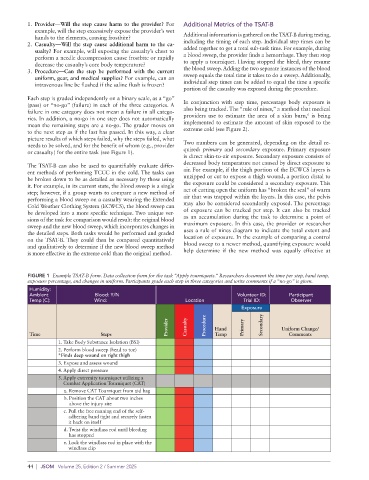
          Each step is graded independently on a binary scale, as a “go”
          (pass) or “no-go” (failure) in each of the three categories. A   In conjunction with step time, percentage body exposure is
          failure in one category does not mean a failure in all catego-  also being tracked. The “rule of nines,” a method that medical
                                                                                                     6
          ries. In addition, a no-go in one step does not automatically   providers use to estimate the area of a skin burn,  is being
          mean the remaining steps are a no-go. The grader moves on   implemented to estimate the amount of skin exposed to the
          to the next step as if the last has passed. In this way, a clear   extreme cold (see Figure 2).
          picture results of which steps failed, why the steps failed, what
          needs to be solved, and for the benefit of whom (e.g., provider   Two numbers can be generated, depending on the detail re-
          or casualty) for the entire task (see Figure 1).   quired:  primary and  secondary exposure. Primary exposure
                                                             is direct skin-to-air exposure. Secondary exposure consists of
                                                             decreased body temperature not caused by direct exposure to
          The TSAT-B can also be used to quantifiably evaluate differ-
          ent methods of performing TCCC in the cold. The tasks can   air. For example, if the thigh portion of the ECWCS layers is
          be broken down to be as detailed as necessary by those using   unzipped or cut to expose a thigh wound, a portion distal to
          it. For example, in its current state, the blood sweep is a single   the exposure could be considered a secondary exposure. This
          step; however, if a group wants to compare a new method of   act of cutting open the uniform has “broken the seal” of warm
          performing a blood sweep on a casualty wearing the Extended   air that was trapped within the layers. In this case, the pelvis
          Cold Weather Clothing System (ECWCS), the blood sweep can   may also be considered secondarily exposed. The percentage
          be developed into a more specific technique. Two unique ver-  of exposure can be tracked per step. It can also be tracked
          sions of the task for comparison would result: the original blood   as an accumulation during the task to determine a point of
          sweep and the new blood sweep, which incorporates changes in   maximum exposure. In this case, the provider or researcher
          the detailed steps. Both tasks would be performed and graded   uses a rule of nines diagram to indicate the total extent and
          on the TSAT-B. They could then be compared quantitatively   location of exposure. In the example of comparing a control
          and qualitatively to determine if the new blood sweep method   blood sweep to a newer method, quantifying exposure would
          is more effective in the extreme cold than the original method.  help determine if the new method was equally effective at


          FIGURE 1  Example TSAT-B form. Data collection form for the task “Apply tourniquets.” Researchers document the time per step, hand temp,
          exposure percentage, and changes in uniform. Participants grade each step in three categories and write comments if a “no-go” is given.
           Humidity:
           Ambient              Blood: Y/N                                     Volunteer ID:    Participant
           Temp (C):            Wind:                         Location           Trial ID:      Observer
                                                                                Exposure

                                                        Provider  Casualty  Procedure  Hand   Primary  Secondary  Uniform Change/

           Time                   Steps                                Temp                    Comments
                    1. Take Body Substance Isolation (BSI)
                    2. Perform blood sweep (head to toe)
                    *Finds deep wound on right thigh
                    3. Expose and assess wound
                    4. Apply direct pressure
                    5.  Apply extremity tourniquet utilizing a
                      Combat Application Tourniquet (CAT)
                      a. Remove CAT Tourniquet from aid bag
                      b.  Position the CAT about two inches
                        above the injury site
                      c.  Pull the free running end of the self-
                       adhering band tight and securely fasten
                       it back on itself
                      d.  Twist the windlass rod until bleeding
                        has stopped
                      e.  Lock the windlass rod in place with the
                       windlass clip

          44  |  JSOM   Volume 25, Edition 2 / Summer 2025

