


Page 50 - JSOM Summer 2025
P. 50
sleep disorder (TSD) and DNB is characterized by the uncon-  conducted by a Veterans Affairs (VA) psychologist, and were
          scious motor activity of the patient during sleep. 14,15  This activ-  observed having episodes  of frequent DNBs by their sleep
          ity interferes with the patient’s ability to obtain quality sleep,   partners. DNB events were defined as noticeable symptoms,
          results in daytime fatigue, and also presents a clear and present   including screaming, thrashing, combative behavior, and ac-
          danger to the sleep partner. 15                    cidental trauma to the sleep partner. A physical assessment
                                                             was completed for masticatory muscle trigger points, exces-
          Numerous publications have discussed the prevalence, symp-  sive dental wear, temporomandibular joint pain, and nocturnal
          toms, and effects of PTSD and PTSD / traumatic brain injury   headaches. An intraoral neuroprosthesis device was individu-
                                          16
          (TBI) on mission readiness in Big Army  units, but there is   ally fabricated, a constructed soft mandibular splint from ther-
          scant documentation on how these conditions affect the be-  moplastic material as described in Moeller et al., and Giddon
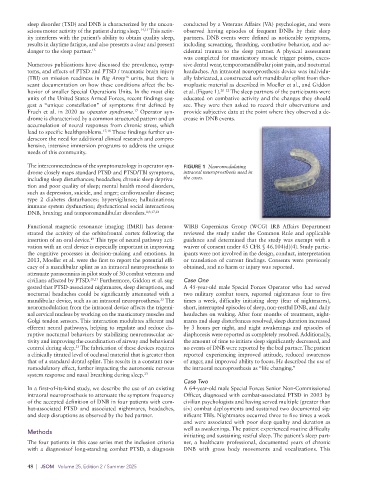
          havior of smaller Special Operations Units. In the most elite   et al. (Figure 1). 20–22  The sleep partners of the participants were
          units of the United States Armed Forces, recent findings sug-  educated on combative activity and the changes they should
          gest a “unique constellation” of symptoms first  defined by   see. They were then asked to record their observations and
                                             17
          Frueh et al. in 2020 as operator syndrome.  Operator syn-  provide subjective data at the point where they observed a de-
          drome is characterized by a common structured pattern and an   crease in DNB events.
          accumulation of neural responses from chronic stress, which
          lead to specific healthproblems. 17,18  These findings further un-
          derscore the need for additional clinical research and compre-
          hensive, intensive immersion programs to address the unique
          needs of this community.

          The interconnectedness of the symptomatology in operator syn-  FIGURE 1  Neuromodulating
          drome closely maps standard PTSD and PTSD/TBI symptoms,   intraoral neuroprosthesis used in
          including sleep disturbances; headaches; chronic sleep depriva-  the cases.
          tion and poor quality of sleep; mental health mood disorders,
          such as depression, suicide, and anger; cardiovascular disease;
          type 2 diabetes disturbances; hypervigilance; hallucinations;
          immune system dysfunction; dysfunctional social interactions;
          DNB, bruxing; and temporomandibular disorders. 8,9,17,18

          Functional magnetic resonance imaging (fMRI) has demon-  WIRB  Copernicus  Group  (WCG)  IRB  Affairs  Department
          strated the activity of the orbitofrontal cortex following the   reviewed the study under the Common Rule and applicable
                               19
          insertion of an oral device.  This type of neural pathway acti-  guidance and determined that the study was exempt with a
          vation with an oral device is especially important in improving   waiver of consent under 45 CFR § 46.104(d)(4). Study partic-
          the cognitive processes in decision-making and emotions. In   ipants were not involved in the design, conduct, interpretation
          2013, Moeller et al. were the first to report the potential effi-  or translation of current findings. Consents were previously
          cacy of a mandibular splint as an intraoral neuroprosthesis to   obtained, and no harm or injury was reported.
          attenuate parasomnias in pilot study of 30 combat veterans and
          civilians affected by PTSD. 20,21  Furthermore, Giddon et al. sug-  Case One
          gested that PTSD-associated nightmares, sleep disruptions, and   A 45-year-old male Special Forces Operator who had served
          nocturnal headaches could be significantly attenuated with a   two military combat tours, reported nightmares four to five
          mandibular device, such as an intraoral neuroprosthesis.  The   times a week, difficulty initiating sleep (fear of nightmares),
                                                     22
          neuromodulation from the intraoral device affects the trigemi-  short, interrupted episodes of sleep, non-restful DNB, and daily
          nal cervical nucleus by working on the masticatory muscles and   headaches on waking. After four months of treatment, night-
          Golgi tendon sensors. This interaction modulates afferent and   mares and sleep disturbances resolved, sleep duration increased
          efferent neural pathways, helping to regulate and reduce dis-  by 3 hours per night, and night awakenings and episodes of
          ruptive nocturnal behaviors by stabilizing neuromuscular ac-  diaphoresis were reported as completely resolved. Additionally,
          tivity and improving the coordination of airway and behavioral   the amount of time to initiate sleep significantly decreased, and
          control during sleep.  The fabrication of these devices requires   no events of DNB were reported by the bed partner. The patient
                          23
          a clinically titrated level of occlusal material that is greater then   reported experiencing improved attitude, reduced awareness
          that of a standard dental splint. This results in a constant neu-  of anger, and improved ability to focus. He described the use of
          romodulatory effect, further impacting the autonomic nervous   the intraoral neuroprosthesis as “life changing.”
          system response and nasal breathing during sleep. 23
                                                             Case Two
          In a first-of-its-kind study, we describe the use of an existing   A 64-year-old male Special Forces Senior Non-Commissioned
          intraoral neuroprosthesis to attenuate the symptom frequency   Officer, diagnosed with combat-associated PTSD in 2003 by
          of the accepted definition of DNB in four patients with com-  civilian psychologists and having served multiple (greater than
          bat-associated PTSD and associated nightmares, headaches,   six) combat deployments and sustained two documented sig-
          and sleep disruptions as observed by the bed partner.  nificant TBIs. Nightmares occurred three to five times a week
                                                             and were associated with poor sleep quality and duration as
                                                             well as awakenings. The patient experienced routine difficulty
          Methods
                                                             initiating and sustaining restful sleep. The patient’s sleep part-
          The four patients in this case series met the inclusion criteria   ner, a healthcare professional, documented years of chronic
          with a diagnosisof long-standing combat PTSD, a diagnosis   DNB with gross body movements and vocalizations.  This

          48  |  JSOM   Volume 25, Edition 2 / Summer 2025

