


Page 39 - JSOM Winter 2024
P. 39
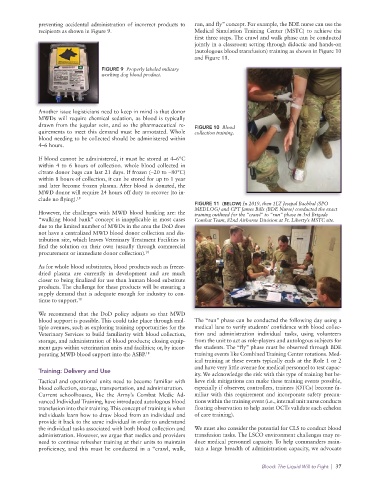
preventing accidental administration of incorrect products to   run, and fly” concept. For example, the BDE nurse can use the
              recipients as shown in Figure 9.                   Medical Simulation Training Center (MSTC) to achieve the
                                                                 first three steps. The crawl and walk phase can be conducted
                                                                 jointly in a classroom setting through didactic and hands-on
                                                                 (autologous blood transfusion) training as shown in Figure 10
                                                                 and Figure 11.

                                  FIGURE 9  Properly labeled military
                                  working dog blood product.


              Another issue logisticians need to keep in mind is that donor
              MWDs will require chemical sedation, as blood is typically
              drawn from the jugular vein, and so the pharmaceutical re-  FIGURE 10  Blood
              quirements to meet this demand must be annotated. Whole   collection training.
              blood needing to be collected should be administered within
              4–6 hours.

              If blood cannot be administered, it must be stored at 4–6°C
              within 4 to 6 hours of collection. whole blood collected in
              citrate donor bags can last 21 days. If frozen (–20 to –80°C)
              within 8 hours of collection, it can be stored for up to 1 year
              and later become frozen plasma. After blood is donated, the
              MWD donor will require 24 hours off duty to recover (to in-
              clude no flying). 18
                                                                 FIGURE 11  (BELOW) In 2019, then 1LT Jesspal Bachhal (SPO
                                                                 MEDLOG) and CPT James Bills (BDE Nurse) conducted the exact
              However, the challenges with MWD blood banking are: the   training outlined for the “crawl” to “run” phase in 3rd Brigade
              “walking blood bank” concept is inapplicable in most cases   Combat Team, 82nd Airborne Division at Ft. Liberty’s MSTC site.
              due to the limited number of MWDs in the area the DoD does
              not have a centralized MWD blood donor collection and dis-
              tribution site, which leaves Veterinary Treatment Facilities to
              find the solution on their own (usually through commercial
              procurement or immediate donor collection). 18

              As for whole blood substitutes, blood products such as freeze-
              dried plasma are currently  in development and are much
              closer to being finalized for use than human blood substitute
              products. The challenge for these products will be ensuring a
              supply demand that is adequate enough for industry to con-
              tinue to support. 18

              We  recommend  that  the  DoD  policy adjusts  so  that  MWD
              blood support is possible. This could take place through mul-  The “run” phase can be conducted the following day using a
              tiple avenues, such as exploring training opportunities for the   medical lane to verify students’ confidence with blood collec-
              Veterinary Services to build familiarity with blood collection,   tion and administration individual tasks, using volunteers
              storage, and administration of blood products; closing equip-  from the unit to act as role-players and autologous subjects for
              ment gaps within veterinarian units and facilities; or, by incor-  the students. The “fly” phase must be observed through BDE
              porating MWD blood support into the ASBP. 18       training events like Combined Training Center rotations. Med-
                                                                 ical training at these events typically ends at the Role 1 or 2
                                                                 and have very little avenue for medical personnel to test capac-
              Training: Delivery and Use
                                                                 ity. We acknowledge the risk with this type of training but be-
              Tactical and operational units need to become familiar with   lieve risk mitigations can make these training events possible,
              blood collection, storage, transportation, and administration.  especially if observer, controllers, trainers (OTCs) become fa-
              Current schoolhouses, like the  Army’s Combat Medic  Ad-  miliar  with this requirement  and incorporate  safety  precau-
              vanced Individual Training, have introduced autologous blood   tions within the training event (i.e., internal unit nurse conducts
              transfusion into their training. This concept of training is when   floating observation to help assist OCTs validate each echelon
              individuals learn how to draw blood from an individual and   of care training).
              provide it back to the same individual in order to understand
              the individual tasks associated with both blood collection and   We must also consider the potential for CLS to conduct blood
              administration. However, we argue that medics and providers   transfusion tasks. The LSCO environment challenges may re-
              need to continue refresher training at their units to maintain   duce medical personnel capacity. To help commanders main-
              proficiency, and this must be conducted in a “crawl, walk,   tain a large breadth of administration capacity, we advocate

                                                                                       Blood: The Liquid Will to Fight  |  37

