


Page 43 - JSOM Winter 2024
P. 43
that JTQs can be effectively and efficiently applied to occlude   We requested and were granted HIPAA waiver M-11013. The
                                                   10
              arterial flow, 10,16–18  remain stable during transport,  and control   data was transferred under Defense Health Agency data shar-
              junctional hemorrhage. 11,14,15  A systematic review of studies in   ing agreement 23-2977.
              healthy human subjects suggested that the SJT, CRoC, and JETT
              had short application times (approximately 2 min) and high   The DoDTR
              (83%–95%), statistically similar efficacy in stopping arterial   The DoDTR, formerly the Joint  Theater  Trauma Registry
              flow. The groin and axillary applications of the AAJT had the   (JTTR), is the data repository for DoD trauma-related inju-
              highest efficacy rates (100%) and a similar time to application. 19  ries. 26,27 The DoDTR includes demographics, injury- producing
                                                                 incidents, diagnoses, treatments, and outcomes of injuries
              In healthy subjects, the primary barrier to successful applica-  from the point of injury to final disposition. The patients in-
              tion was pain, particularly with abdominal application of the   clude U.S./non-U.S. military and civilian personnel in wartime
                                                            19
              AAJT, which showed the lowest pooled efficacy rates (52%).    and peacetime  (including  humanitarian  work). Short-term
              However, in a combat setting with a critically wounded and   outcome data is available for non-U.S. casualties.
              likely unresponsive patient, pain would likely not present this
              same barrier to successful application, as sedated animal mod-  The DoDTR comprises all patients admitted to a Role 3 (fixed
                                                    20
              els have shown significantly higher efficacy rates.    facility) or forward resuscitative surgical detachment (FRSD)
                                                                 within 72 hours of presentation. Included patients must have
              Abdominal application of the AAJT significantly reduces the   an International Classification of Disease 9th Edition (ICD-9)
              amount of crystalloid fluid resuscitation required, possibly re-  injury diagnosis code for trauma (800-959.9), near-drowning/
              ducing the risk of over-resuscitation and associated compli-  drowning with associated injury (994.1), or inhalational in-
              cations.  Meanwhile, effects of the abdominal application of   jury (987.9).
                    16
              the AAJT in the setting of traumatic cardiac arrest have been
              mixed: some animal studies show improved cardiopulmonary   Analysis
              resuscitation efficacy through measured survival and return of   We performed all statistical analysis using Excel (Microsoft
              spontaneous circulation rates; others show improved hemody-  365, Redmond, WA) and JMP Statistical Discovery (SAS ver-
              namics but no survival advantage. 21,22            sion 17, Cary, NC).  We presented continuous variables as
                                                                 means and 95% confidence intervals and compared them us-
              A case series of prehospital traumatic cardiac arrest patients   ing the  t test. Non-parametric continuous and ordinal vari-
              with applied AAJT devices showed physiologic changes (such   ables are presented as medians and interquartile ranges and
              as increased end-tidal CO  and return of spontaneous circula-  compared using the Wilcoxon rank sum test. Nominal vari-
                                  2
              tion rates) but were without improved long-term outcomes. 23  ables are presented as percentages and numbers and compared
                                                                 using the chi-square or Fishers exact test, depending on the
              JTQ Efficacy in Combat                             expected cell counts. We defined serious injury to a body re-
              Limited research is available on the efficacy of JTQs in crit-  gion as an abbreviated injury scale (AIS) ≥3. 28,29  A  massive
              ically injured patients in a combat setting. 9,24  Military con-  transfusion was defined as both ≥10 units of packed red blood
              tingencies, such as chemical, biological, radiological, nuclear,   cells or whole blood within the first 24 hours. As noted in our
              and high-yield explosives warfare, require the use of special-  previous work, a sub-massive transfusion was defined as ≥3
              ized gear by medical providers. Applying gear prolongs device   units within the first 24 hours. 30
              (such as JTQ) application time significantly and, therefore,
              likely has implications for efficacy and patient survival. 25
                                                                 Results
              The body of data currently available suggests the efficacy of   There were 48,301 documented encounters within our pri-
              JTQs in controlled laboratory settings but is comprised mainly   mary dataset, of which 39 met inclusion for this analysis. The
              of individual case reports, 9,23  non-human models, 11,12,14,21  and   SAM JTQ brand was listed for 3, with the rest remaining un-
              training data. 10,25  This highlights a gap in summative analyses   specified. Of those with an available placement location, 19
              of real-world cases. A prior retrospective case review analyzed   were placed at the point of injury, 3 during transport, and 1 at
              12 cases of combat JTQ application contextualized by qual-  the battalion aid station. The most JTQs were used in 2019,
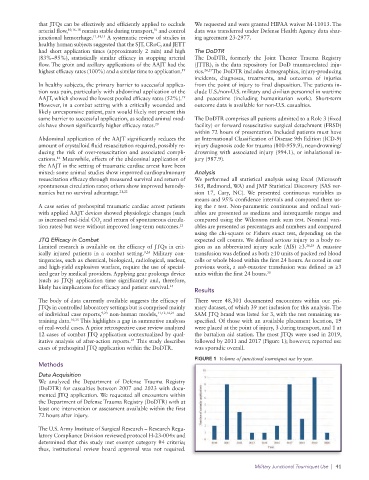
              itative analysis of after-action reports.  This study describes   followed by 2011 and 2017 (Figure 1); however, reported use
                                            24
              cases of prehospital JTQ application within the DoDTR.  was sporadic overall.
                                                                 FIGURE 1  Volume of junctional tourniquet use by year.
              Methods
              Data Acquisition
              We analyzed the Department of Defense  Trauma Registry
              (DoDTR) for casualties between 2007 and 2023 with docu-
              mented JTQ application. We requested all encounters within
              the Department of Defense Trauma Registry (DoDTR) with at
              least one intervention or assessment available within the first
              72 hours after injury.

              The U.S. Army Institute of Surgical Research – Research Regu-
              latory Compliance Division reviewed protocol H-23-004x and
              determined that this study met exempt category #4 criteria;
              thus, institutional review board approval was not required.

                                                                                    Military Junctional Tourniquet Use  |  41

