


Page 44 - JSOM Winter 2024
P. 44
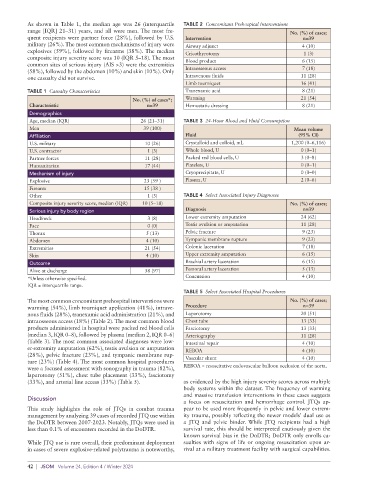
As shown in Table 1, the median age was 26 (interquartile   TABLE 2  Concomitant Prehospital Interventions
          range [IQR] 21–31) years, and all were men. The most fre-                             No. (%) of cases;
          quent recipients were partner force (28%), followed by U.S.   Intervention                n=39
          military (26%). The most common mechanisms of injury were   Airway adjunct                4 (10)
          explosives (59%), followed by firearms (38%). The median   Cricothyrotomy                 1 (3)
          composite injury severity score was 10 (IQR 5–18). The most
          common sites of serious injury (AIS >3) were the extremities   Blood product              6 (15)
          (58%), followed by the abdomen (10%) and skin (10%). Only   Intraosseous access           7 (18)
          one casualty did not survive.                       Intravenous fluids                   11 (28)
                                                              Limb tourniquet                      16 (41)
          TABLE 1  Casualty Characteristics                   Tranexamic acid                       8 (21)
                                            No. (%) of cases*;   Warming                           21 (54)
           Characteristic                        n=39         Hemostatic dressing                   8 (21)
           Demographics
           Age, median (IQR)                   26 (21–31)    TABLE 3  24-Hour Blood and Fluid Consumption
           Men                                  39 (100)                                         Mean volume
           Affiliation                                        Fluid                                (95% CI)
           U.S. military                        10 (26)       Crystalloid and colloid, mL       1,200 (0–6,116)
           U.S. contractor                       1 (3)        Whole blood, U                       0 (0–1)
           Partner forces                       11 (28)       Packed red blood cells, U            3 (0–8)
           Humanitarian                         17 (44)       Platelets, U                         0 (0–1)
           Mechanism of injury                                Cryoprecipitate, U                   0 (0–0)
           Explosive                            23 (59 )      Plasma, U                            2 (0–6)
           Firearm                              15 (38 )
           Other                                 1 (3)       TABLE 4  Select Associated Injury Diagnoses
           Composite injury severity score, median (IQR)  10 (5–18)                             No. (%) of cases;
           Serious injury by body region                      Diagnosis                             n=39
           Head/neck                             3 (8)        Lower extremity amputation           24 (62)
           Face                                  0 (0)        Testis avulsion or amputation        11 (28)
           Thorax                                5 (13)       Pelvic fracture                       9 (23)
           Abdomen                               4 (10)       Tympanic membrane rupture             9 (23)
           Extremities                          21 (54)       Colonic laceration                    7 (18)
           Skin                                  4 (10)       Upper extremity amputation            6 (15)
           Outcome                                            Brachial artery laceration            6 (15)
           Alive at discharge                   38 (97)       Femoral artery laceration             5 (13)
          *Unless otherwise specified.                        Concussion                            4 (10)
          IQR = interquartile range.
                                                             TABLE 5  Select Associated Hospital Procedures
          The most common concomitant prehospital interventions were                            No. (%) of cases;
          warming (54%), limb tourniquet application (41%), intrave-  Procedure                     n=39
          nous fluids (28%), tranexamic acid administration (21%), and   Laparotomy                20 (51)
          intraosseous access (18%) (Table 2). The most common blood   Chest tube                  13 (33)
          products administered in hospital were packed red blood cells   Fasciotomy               13 (33)
          (median 3, IQR 0–8), followed by plasma (median 2, IQR 0–6)   Arteriography              11 (28)
          (Table 3). The most common associated diagnoses were low-  Intestinal repair              4 (10)
          er-extremity amputation (62%), testis avulsion or amputation   REBOA                      4 (10)
          (28%), pelvic fracture (23%), and tympanic membrane rup-
          ture (23%) (Table 4). The most common hospital procedures   Vascular shunt                4 (10)
          were a focused assessment with sonography in trauma (82%),   REBOA = resuscitative endovascular balloon occlusion of the aorta.
          laparotomy (51%), chest tube placement (33%), fasciotomy
          (33%), and arterial line access (33%) (Table 5).   as evidenced by the high injury severity scores across multiple
                                                             body systems within the dataset. The frequency of warming
                                                             and massive transfusion interventions in these cases suggests
          Discussion
                                                             a focus on resuscitation and hemorrhage control. JTQs ap-
          This study highlights the role of JTQs in combat trauma   pear to be used more frequently in pelvic and lower extrem-
          management by analyzing 39 cases of recorded JTQ use within   ity trauma, possibly reflecting the newer models’ dual use as
          the DoDTR between 2007-2023. Notably, JTQs were used in   a JTQ and pelvic binder.  While JTQ recipients had a high
          less than 0.1% of encounters recorded in the DoDTR.   survival rate, this should be interpreted cautiously given the
                                                             known survival bias in the DoDTR; DoDTR only enrolls ca-
          While JTQ use is rare overall, their predominant deployment   sualties  with  signs  of life  or  ongoing  resuscitation  upon  ar-
          in cases of severe explosive-related polytrauma is noteworthy,   rival at a military treatment facility with surgical capabilities.

          42  |  JSOM   Volume 24, Edition 4 / Winter 2024

