


Page 38 - JSOM Winter 2024
P. 38
Arctic Considerations                              practitioners need to determine the approach that best sup-
                                                             ports the mission.
          Further discussion is required to identify solutions to known
          capability gaps in arctic environments. As stated earlier, the   The Naval Medical Center San Diego’s Combat Trauma Re-
          goal of infusing warmed IV fluids/blood is to reduce negative   search Group-West is studying the validation between two
          heat balance rather than to actively warm the patient, since ev-  emergency low-titer O whole blood (LTOWB) approaches us-
          ery decrease of 1.0°C (1.8°F) in core temperature below 36°C   ing cold stored whole blood (CSWB) to meet blood demand
          (96.8°F) results in a 10% increase in red blood cell (RBC) con-  afloat. Much like ground forces, the Navy is assuming blood
          sumption in the first 24 hours of admission. Additionally, we   products will be scarce and the walking blood bank may not
          discussed how data emphasizes the need for effective hypo-  meet the demand for immediate action, as it will be extremely
          thermia prevention at the POI, along with continued patient   difficult to move personnel during an active combat engage-
          warming during massive transfusion, with warmed 38–42°C   ment. Additionally, the FDA states that donors must wait 56
          (100.4–107.6°F) whole blood at a rate of 150mL/min.¹¹  days to donate blood again. These limiting factors have in-
                                                             fluenced the two revolving blood bank (RBB) concepts: Ex-
          Equipment modernization efforts must aim to not only meet   change Transfusion RBB and Rotating Donors RBB. 17
          the temperature challenges of hot climates, but also frigid cli-
          mates. The arctic poses a real challenge because current devices   The Exchange Transfusion RBB concept works by
          and products either become ineffective at maintaining required
          specifications needed (flow rate, temperature, etc.) or freeze   •  identifying emergency donor panel (EDP)
          completely (i.e., administrative IV tubing sets become brittle).    •  drawing 1 unit, labeling, and storing 100% of the entire
                                                         15
          One potential solution that may be effective is researching the   EDP blood,
          effects of chemical warmers, such as meals ready-to-eat (MRE)   •  used if needed or replaced back in same donor if unused
          heaters. By redesigning these heaters with a thermal insulator   prior to expiration
          for blood products and the needed subcomponents (i.e., IV   •  drawing, labeling, and storing new unit of 100% EDP pop-
          tubing), the DoD can provide a cost- effective solution to af-  ulation and repeating all steps. 17
          ford blood capability in frigid environments. Additionally, this
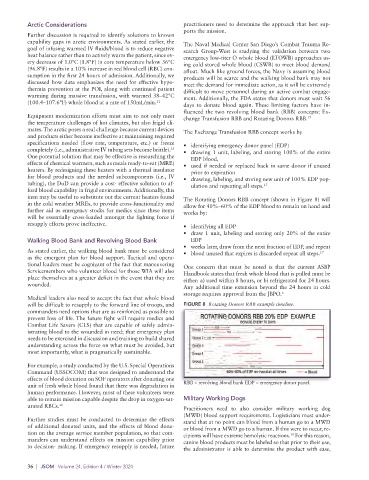
          item may be useful to substitute out the current heaters found   The Rotating Donors RBB concept (shown in Figure 8) will
          in the cold weather MREs, to provide cross-functionality and   allow for 40%–60% of the EDP blood to remain on hand and
          further aid as emergency stocks for medics since these items   works by:
          will be essentially cross-loaded amongst the fighting force if
          resupply efforts prove ineffective.                •  identifying all EDP
                                                             •  draw 1 unit, labeling and storing only 20% of the entire
          Walking Blood Bank and Revolving Blood Bank          EDP
                                                             •  weeks later, draw from the next fraction of EDP, and repeat
          As stated earlier, the walking blood bank must be considered   •  blood unused that expires is discarded repeat all steps. 17
          as the emergent plan for blood support. Tactical and opera-
          tional leaders must be cognizant of the fact that maneuvering   One concern that must be noted is that the current  ASBP
          Servicemembers who volunteer blood for those WIA will also   Handbook states that fresh whole blood that is pulled must be
          place themselves at a greater deficit in the event that they are   either: a) used within 8 hours, or b) refrigerated for 24 hours.
          wounded.                                           Any additional time extension beyond the 24 hours in cold
                                                             storage requires approval from the JBPO. 6
          Medical leaders also need to accept the fact that whole blood
          will be difficult to resupply to the forward line of troops, and   FIGURE 8  Rotating Donors RBB example timeline.
          commanders need options that are as reinforced as possible to
          prevent loss of life. The future fight will require medics and
          Combat Life Savers (CLS) that are capable of safely admin-
          istrating blood to the wounded in need; that emergency plan
          needs to be exercised in discussion and training to build shared
          understanding across the force on what must be avoided, but
          most importantly, what is pragmatically sustainable.

          For example, a study conducted by the U.S. Special Operations
          Command (USSOCOM) that was designed to understand the
          effects of blood donation on SOF operators after donating one
          unit of fresh whole blood found that there was degradation in   RBB = revolving blood bank EDP = emergency donor panel.
          human performance. However, most of these volunteers were
          able to remain mission capable despite the drop in oxygen-sat-  Military Working Dogs
          urated RBCs. 16                                    Practitioners need to also consider military working dog
                                                             (MWD) blood support requirements. Logisticians must under-
          Further studies must be conducted to determine the effects   stand that at no point can blood from a human go to a MWD
          of additional donated units, and the effects of blood dona-  or blood from a MWD go to a human. If this were to occur, re-
          tion on the average service member population, so that com-  cipients will have extreme hemolytic reactions.  For this reason,
                                                                                                18
          manders can understand effects on mission capability prior   canine blood products must be labeled so that prior to their use,
          to decision- making. If emergency resupply is needed, future   the administrator is able to determine the product with ease,

          36  |  JSOM   Volume 24, Edition 4 / Winter 2024

