


Page 34 - JSOM Winter 2024
P. 34
Planning Factors                                   platelets, and can also store 300 units.  Field Hospitals (Role
                                                                                           8
                                                             3) can hold up to 480 units of whole blood/WBE. Roles 1 and
          Before diving into blood planning support for an LSCO fight,   2 are currently ongoing materiel solution fielding.
          we must consider three factors: blood needed per patient,
          blood capacity starting from the ASWBPL and working down   What we can say so far is that the Role 1 requires capacity to
          to the maneuvering medics, and blood package considerations.  hold enough blood to support maneuvering medics (who, in-
          To remedy this, the Joint Staff Surgeon’s Office hosted an Op-  dividually, can carry 2 units each) within their battalion, while
          erational Planning Team in March 2022 to find a standard   the Brigade Support Medical Company (BSMC) will require
          planning factor needed for WIA casualties.
                                                             enough blood to support their Medical Treatment Platoon and
                                                             the Brigade Medical Supply Office (BMSO) team, so that they
          The OPT concluded with the recommendation to future GCCs   can meet the resupply demands of each supported unit within
          to plan for 8 units of whole blood or whole blood equivalent   the Brigade (BDE). If assigned, the Forward Resuscitative Sur-
          (WBE) per WIA casualty and that historically only 20% of   gical Detachment (FRSD) also has a 200-unit capacity and
                                 2
          casualties will require blood.  The assumption is that 2 units   may be positioned far forward in the fight. Although doctrine
          will be required at the POI, and the remaining 6 units will be   states BSUs can distribute blood to Role 2 assets like the FRSD,
          required at follow-on roles of care.
                                                             it may be worth advising against based on probability of sur-
                                                             vivability to conduct the blood resupply mission. Combatant
          Therefore, hypothetically, if a GCC estimates that 1,000 war-  commanders at each echelon will need to consider how far
          fighters will be wounded within 24 hours, 200 of them will   external support can maneuver, and at which point they will
          require 8 units of whole blood or WBE each. This totals to   need to sustain resupply efforts internally. This will require
          1,600 units needed within that 24-hr time span.
                                                             Sustainers to understand the packaging considerations needed
                                                             for blood to ensure supplies are not compromised.
          Next, we will explore the capacity of our known blood support
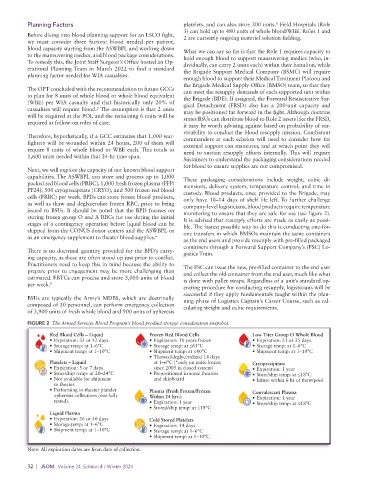
          capabilities. The ASWBPL can store and process up to 1,000   These  packaging  considerations  include  weight,  cubic  di-
          packed red blood cells (PRBC), 1,000 fresh frozen plasma (FFP/  mensions, delivery system, temperature control, and time in
          PF24), 500 cryoprecipitate (CRYO), and 500 frozen red blood   custody. Blood products, once provided to the Brigade, may
          cells (FRBC) per week. BPDs can store frozen blood products,   only have 10–14 days of shelf life left. To further challenge
          as well as thaw and deglycerolize frozen RBC, prior to being     company-level logisticians, blood products require temperature
          issued to BSUs. It should be noted that the BPD focuses on   monitoring to ensure that they are safe for use (see figure 2).
          storing frozen group O and A RBCs for use during the initial   It is advised that resupply efforts are made as easily as possi-
          stages of a contingency operation before liquid blood can be   ble. The fastest possible way to do this is conducting one-for-
          shipped from the CONUS donor centers and the ASWBPL or   one transfers in which BMSOs maintain the same containers
          as an emergency supplement to theater blood supplies. 6
                                                             as the end users and provide resupply with pre-filled packaged
                                                             containers through a Forward Support Company’s (FSC) Lo-
          There is no doctrinal quantity provided for the BPD’s carry-  gistics Train.
          ing capacity, as these are often stood up just prior to conflict.
          Practitioners need to keep this in mind because the ability to   The FSC can issue the new, pre-filled container to the end user
          prepare prior to engagement may be more challenging than   and collect the old container from the end user, much like what
          estimated. EBTCs can process and store 3,000 units of blood   is done with pallet swaps. Regardless of a unit’s standard op-
          per week. 6
                                                             erating procedure for conducting resupply, logisticians will be
                                                             successful if they apply fundamentals taught within the plan-
          BSUs are typically the Army’s MDBS, which are doctrinally   ning phase of Logistics Captain’s Career Course, such as cal-
          composed of 30 personnel, can perform emergency collection   culating weight and cubic requirements.
          of 3,900 units of fresh whole blood and 900 units of apheresis
          FIGURE 2  The Armed Services Blood Program’s blood product storage consideration snapshot.

                 Red Blood Cells – Liquid         Frozen Red Blood Cells            Low Titer Group O Whole Blood
                 • Expiration: 35 or 42 days      • Expiration: 10 years frozen     • Expiration: 21 or 35 days
                 • Storage temp: at 1–6°C         • Storage temp: at ≤65°C          • Storage temp: at 1–6°C
                 • Shipment temp: at 1–10°C       • Shipment temp: at ≤40°C         • Shipment temp: at 1–10°C
                                                  • Thawed/deglycerolized 14 days
                 Platelets – Liquid                at 1–6°C (*only on units frozen   Cryoprecipitate
                 • Expiration: 5 or 7 days         since 2005 in closed system)     • Expiration: 1 year
                 • Store/ship temp: at 20–24°C    • Prepositioned in some theaters   • Store/ship temp: at ≤18°C
                 • Not available for shipment      and shipboard                    • Infuse within 6 hr of thaw/pool
                   to theater.
                 • Performing in-theater platelet   Plasma (Fresh Frozen/Frozen     Convalescent Plasma
                   apheresis collections (not fully   Within 24 hrs.)               • Expiration: 1 year
                   tested).                       • Expiration: 1 year              • Store/ship temp: at ≤18°C
                                                  • Stored/ship temp: at ≤18°C
                 Liquid Plasma
                 • Expiration: 26 or 40 days      Cold Stored Platelets
                 • Storage temp: at 1–6°C         • Expiration: 14 days
                 • Shipment temp: at 1–10°C       • Storage temp: at 1–6°C
                                                  • Shipment temp: at 1–10°C

          Note: All expiration dates are from date of collection.

          32  |  JSOM   Volume 24, Edition 4 / Winter 2024

