


Page 35 - JSOM Winter 2024
P. 35
A typical package used to deliver blood is a reusable cardboard   weight, which would then require three CDS bundles instead
              and styrofoam standard container called a Collins box. Collins   of six.
              boxes require either wet or dry ice based on the products be-
              ing delivered. The capacity of one of these boxes is 20 units   As for GAC blood support planning, the medical logistician
              whole blood, 30 units PRBC, 15 units FFP/PF24, or 30 units   now needs to consider the amount of weight and capacity of
              of CRYO; one unit of whole blood (500mL) weighs approxi-  each AcuTemp. Each AcuTemp can hold 40 units of whole
              mately 1.42 pounds. These boxes have a cubic dimension of 18   blood, will weigh 201.8 pounds filled, and has a cubic dimen-
              inches (long) × 19 inches (wide) × 16 inches (high) and weigh   sion of 39.2 inches (long) × 23.2 inches (wide) × 22.8 inches
              9.5 pounds when empty. Necessary wet ice will weigh approx-  (high). One LMTV has the capacity to carry six wooden pal-
              imately 14 pounds, whereas necessary dry ice will weigh ap-  lets and a total weight of 5,000 pounds.¹  The dimensions of
                                                                                                 0
              proximately 20–30 pounds. The total approximate weight of   one wooden pallet are 48 inches (long) × 40 inches (wide). The
              one package will range from 44–54 pounds.  We recommend   FSC commander recommends that pallets should not exceed
                                                6
              future logisticians plan around the maximum weight number.  5 feet in height (with boxes secured using ratchet straps or
                                                                 cellophane packing wrap). Knowing these factors, the med-
                                                                 ical logistician can pack two AcuTemps horizontally and up
              Blood Planning Scenario Application
                                                                 to two AcuTemps vertically for a total of four AcuTemps per
              Understanding the various requirements of the supported unit,   pallet. To meet the one DOS demand, the medical logistician
              the commodity, and delivery system, logisticians will need to   has calculated that 12 AcuTemps will be needed, and so three
              meet capacity to the BDE’s supply demand. Consider the fol-  pallets would be required—half of the total allotted space on
              lowing scenario: a medical logistician in the 82nd Airborne   one LMTV, as shown in in Figure 3.
              Division receives notification that 2 days of supply (DOS) of
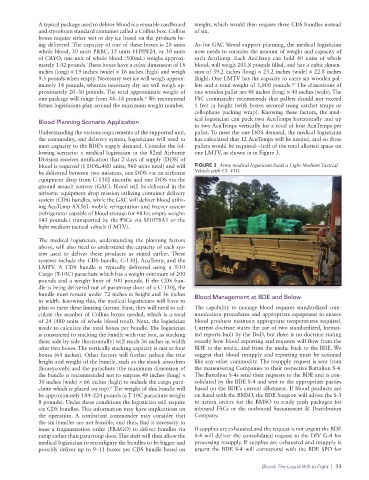
              blood is required (1 DOS=480 units; 960 units total) and will   FIGURE 3  Army medical logistician loads a Light Medium Tactical
              be delivered between two missions, one DOS via an airborne   Vehicle with CL VIII.
              equipment drop from C-130J aircrafts and one DOS via the
              ground assault convoy (GAC). Blood will be delivered in the
              airborne equipment drop mission utilizing container delivery
              system (CDS) bundles, while the GAC will deliver blood utiliz-
              ing AcuTemp AX56L mobile refrigeration and freezer system
              (refrigerator capable of blood storage for 48 hr; empty weight:
              145 pounds.) transported by the FSCs via M1078A1 or the
              light medium tactical vehicle (LMTV).
              The medical logistician, understanding the planning factors
              above, will also need to understand the capacity of each sys-
              tem used to deliver these products as stated earlier.  These
              systems include the CDS bundle, C-130J, AcuTemp, and the
              LMTV.  A CDS bundle is typically delivered using a  T-10
              Cargo (T-10C) parachute which has a weight minimum of 200
              pounds and a weight limit of 500 pounds. If the CDS bun-
              dle is being delivered out of paratroop door of a C-130J, the
              bundle must remain under 72 inches in height and 36 inches   Blood Management at BDE and Below
              in width. Knowing this, the medical logisticians will have to
              plan to meet these limiting factors. First, they will need to cal-  The capability to manage blood requires standardized com-
              culate the number of Collins boxes needed, which is a total   munication procedures and appropriate equipment to ensure
              of 24 (480 units of whole blood total). Next, the logistician   blood products maintain appropriate temperatures required.
              needs to calculate the total boxes per bundle. The logistician   Current doctrine states the use of two standardized, format-
              is constricted to stacking the bundle with one box, as stacking   ted reports built by the DoD, but there is no doctrine stating
              them side-by-side (horizontally) will reach 36 inches in width   exactly how blood reporting and requests will flow from the
              after two boxes. The vertically stacking capacity is met at four   BDE to the medic, and from the medic back to the BDE. We
              boxes (64 inches). Other factors will further reduce the true   suggest that blood resupply and reporting must be actioned
              height and weight of the bundle, such as the shock absorbers   like any other commodity. The resupply request is sent from
              (honeycomb) and the parachute (the maximum dimension of   the maneuvering Companies to their respective Battalion S-4.
              the bundle is recommended not to surpass 48 inches (long) ×   The Battalion S-4s send their requests to the BDE and is con-
              30 inches (wide) × 66 inches (high) to include the cargo para-  solidated by the BDE S-4 and sent to the appropriate parties
              chute which is placed on top).  The weight of this bundle will   based on the BDE’s current allotment. If blood products are
                                     9
              be approximately 184–224 pounds (a T-10C parachute weighs   on-hand with the BMSO, the BDE Surgeon will advise the S-3
              8 pounds). Under these conditions the logistician will require   to action orders for the BMSO to ready push packages for
              six CDS bundles. This information may have implications on   inbound FSCs or the outbound Sustainment & Distribution
              the operation.  A combatant commander may consider that   Company.
              the six bundles are not feasible, and thus, find it necessary to
              issue a fragmentation order (FRAGO) to deliver bundles via   If supplies are exhausted and the request is not urgent the BDE
              ramp rather than paratroop door. This shift will then allow the   S-4 will deliver the consolidated request to the DIV G-4 for
              medical logistician to reconfigure the bundles to be bigger and   processing resupply. If supplies are exhausted and resupply is
              possibly deliver up to 9–11 boxes per CDS bundle based on   urgent the BDE S-4 will correspond with the BDE SPO for

                                                                                       Blood: The Liquid Will to Fight  |  33

