


Page 33 - JSOM Winter 2024
P. 33
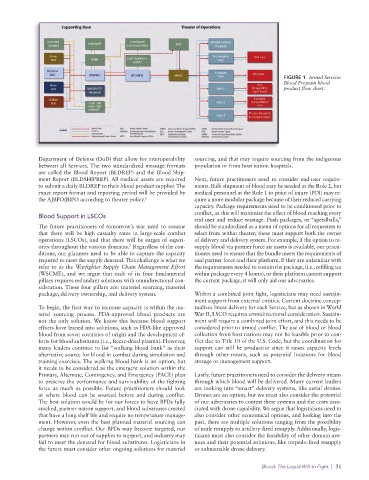
FIGURE 1  Armed Services
                                                                                              Blood Program blood
                                                                                              product flow chart.


              Department of Defense (DoD) that allow for interoperability   sourcing, and that may require sourcing from the indigenous
              between all Services. The two standardized message formats   population or from host nation hospitals.
              are called the Blood Report (BLDREP) and the Blood Ship-
              ment Report (BLDSHIPREP). All medical assets are required   Next, future practitioners need to consider end-user require-
              to submit a daily BLDREP to their blood product supplier. The   ments. Bulk shipment of blood may be needed at the Role 2, but
              exact report format and reporting period will be provided by   medical personnel at the Role 1 to point of injury (POI) may re-
              the AJBPO/JBPO according to theater policy. 6      quire a more modular package because of their reduced carrying
                                                                 capacity. Package requirements need to be conditioned prior to
                                                                 conflict, as this will maximize the effect of blood reaching every
              Blood Support in LSCOs
                                                                 end user and reduce wastage. Push packages, or “speedballs,”
              The future practitioners of tomorrow’s war need to assume   should be standardized as a menu of options for all requesters to
              that there will be high casualty rates in large-scale combat   select from within theater; these must support both the owner
              operations (LSCOs), and that there will be surges of superi-  of delivery and delivery system. For example, if the option to re-
              ority throughout the various domains.  Regardless of the con-  supply blood via partner force air assets is available, our practi-
                                           7
              ditions, our planners need to be able to capture the capacity   tioners need to ensure that the bundle meets the requirements of
              required to meet the supply demand. This challenge is what we   said partner force and their platform. If they are unfamiliar with
              refer to as the Warfighter Supply Chain Management Effort   the requirements needed to sustain the package, (i.e., refilling ice
              (WSCME), and we argue that each of its four fundamental   within package every 4 hours), or their platform cannot support
              pillars requires redundant solutions with omnidirectional con-  the current package, it will only aid our adversaries.
              sideration. These four pillars are: materiel sourcing, materiel
              package, delivery ownership, and delivery system.  Within a combined joint fight, logisticians may need sustain-
                                                                 ment support from external entities. Current doctrine concep-
              To begin, the first way to increase capacity is within the ma-  tualizes linear delivery for each Service, but as shown in World
              teriel sourcing process. FDA-approved blood products are   War II, LSCO requires omnidirectional consideration. Sustain-
              not the only solution. We know this because blood support   ment will require a combined joint effort, and this needs to be
              efforts have leaned into solutions, such as FDA-like approved   considered prior to armed conflict. The use of blood or blood
              blood from seven countries of origin and the development ef-  collection from host nations may not be feasible prior to con-
              forts for blood substitutes (i.e., freeze-dried plasma). However,   flict due to Title 10 of the U.S. Code, but the coordination for
              many leaders continue to list “walking blood bank” as their   support can still be productive since it raises capacity levels
              alternative source for blood in combat during simulation and   through other means, such as potential locations for blood
              training exercises. The walking blood bank is an option, but   storage or management support.
              it needs to be considered as the emergent solution within the
              Primary, Alternate, Contingency, and Emergency (PACE) plan   Lastly, future practitioners need to consider the delivery means
              to preserve the performance and survivability of the fighting   through which blood will be delivered. Many current leaders
              force as much as possible. Future practitioners should look   are looking into “smart” delivery systems, like aerial drones.
              at where blood can be sourced before and during conflict.   Drones are an option, but we must also consider the potential
              The best solution would be for our forces to have BPDs fully   of our adversaries to contest these systems and the costs asso-
              stocked, partner nation support, and blood substitutes created   ciated with drone capability. We argue that logisticians need to
              that have a long shelf life and require no temperature manage-  also consider other economical options, and looking into the
              ment. However, even the best planned materiel sourcing can   past, there are multiple solutions ranging from the possibility
              change within conflict. Our BPDs may become targeted, our   of mule resupply to artillery-fired resupply. Additionally, logis-
              partners may run out of supplies to support, and industry may   ticians must also consider the feasibility of other domain ave-
              fail to meet the demand for blood substitutes. Logisticians in   nues and their potential solutions, like torpedo-fired resupply
              the future must consider other ongoing solutions for materiel   or submersible drone delivery.

                                                                                       Blood: The Liquid Will to Fight  |  31

