


Page 28 - JSOM Winter 2024
P. 28
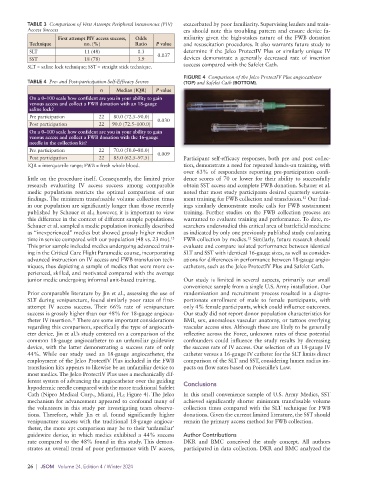
TABLE 3  Comparison of First Attempt Peripheral Intravenous (PIV)   exacerbated by poor familiarity. Supervising leaders and train-
          Access Success                                     ers should note this troubling pattern and ensure device fa-
                    First attempt PIV access success,    Odds   miliarity given the high-stakes nature of the FWB donation
           Technique         no. (%)         Ratio  P value  and resuscitation procedures. It also warrants future study to
           SLT               11 (48)          0.3    0.037   determine if the Jelco ProtectIV Plus or similarly unique IV
           SST               18 (78)          3.9            devices demonstrate a generally decreased rate of insertion
          SLT = saline lock technique; SST = straight stick technique.  success compared with the Safelet Cath.
                                                             FIGURE 4  Comparison of the Jelco ProtectIV Plus angiocatheter
          TABLE 4  Pre- and Post-participation Self-Efficacy Scores  (TOP) and Safelet Cath (BOTTOM).
                                  n    Median (IQR)  P value
           On a 0–100 scale how confident are you in your ability to gain
           venous access and collect a FWB donation with an 18-gauge
           saline lock?
           Pre participation     22   80.0 (72.5–90.0)  0.030
           Post participation    22   90.0 (72.5–100.0)
           On a 0–100 scale how confident are you in your ability to gain
           venous access and collect a FWB donation with the 16-gauge
           needle in the collection kit?
           Pre participation     22   70.0 (50.0–80.0)  0.009
           Post participation    22   85.0 (62.5–97.5)       Participant self-efficacy responses, both pre and post collec-
          IQR = interquartile range; FWB = fresh whole blood.  tion, demonstrate a need for repeated hands-on training, with
                                                             over  63%  of  respondents  reporting  pre-participation  confi-
          little on the procedure itself. Consequently, the limited prior   dence scores of 70 or lower for their ability to successfully
          research evaluating IV access success among comparable   obtain SST access and complete FWB donation. Schauer et al.
          medic populations restricts the optimal comparison of our   noted that most study participants desired quarterly sustain-
                                                                                                    12
          findings. The minimum transfusable volume collection times   ment training for FWB collection and transfusion.  Our find-
          in our population are significantly longer than those recently   ings similarly demonstrate medic calls for FWB sustainment
          published by Schauer et al.; however, it is important to view   training. Further studies on the FWB collection process are
          this difference in the context of different sample populations.   warranted to evaluate training and performance. To date, re-
          Schauer et al. sampled a medic population ironically described   searchers understudied this critical area of battlefield medicine
          as “inexperienced” medics but showed grossly higher median   as indicated by only one previously published study evaluating
                                                         12
                                                                                  12
          time in service compared with our population (48 vs. 23 mo).    FWB collection by medics.  Similarly, future research should
          This prior sample included medics undergoing advanced train-  evaluate and compare isolated performance between identical
          ing in the Critical Care Flight Paramedic course, incorporating   SLT and SST with identical 16-gauge sizes, as well as consider-
          advanced instruction on IV access and FWB transfusion tech-  ations for differences in performance between 18-gauge angio-
          niques, thus depicting a sample of medics that were more ex-  catheters, such as the Jelco ProtectIV Plus and Safelet Cath.
          perienced, skilled, and motivated compared with the average
          junior medic undergoing informal unit-based training.  Our  study is  limited  in  several  aspects,  primarily  our  small
                                                             convenience sample from a single U.S. Army installation. Our
          Prior comparable literature by Jin et al., assessing the use of   randomization and recruitment process resulted in a dispro-
          SLT during venipuncture, found similarly poor rates of first-   portionate  enrollment  of male  to female  participants, with
          attempt IV access success.  Their 66% rate of venipuncture   only 4% female participants, which could influence outcomes.
          success is grossly higher than our 48% for 18-gauge angioca-  Our study did not report donor population characteristics for
          theter IV insertion.  There are some important considerations   BMI, sex, anomalous vascular anatomy, or tattoos overlying
                         11
          regarding this comparison, specifically the type of angiocath-  vascular access sites. Although these are likely to be generally
          eter device. Jin et al.’s study centered on a comparison of the   reflective across the Force, unknown rates of these potential
          common 18-gauge angiocatheter to an unfamiliar guidewire   confounders could influence the study results by decreasing
          device,  with the  latter  demonstrating  a success  rate  of  only   the success rate of IV access. Our selection of an 18-gauge IV
          44%. While our study used an 18-gauge angiocatheter, the   catheter versus a 16-gauge IV catheter for the SLT limits direct
          employment of the Jelco ProtectIV Plus included in the FWB   comparison of the SLT and SST, considering lumen radius im-
          transfusion kits appears to likewise be an unfamiliar device to   pacts on flow rates based on Poiseuille’s Law.
          most medics. The Jelco ProtectIV Plus uses a mechanically dif-
          ferent system of advancing the angiocatheter over the guiding   Conclusions
          hypodermic needle compared with the more traditional Safelet
          Cath (Nipro Medical Corp., Miami, FL; Figure 4). The Jelco   In this small convenience sample of U.S. Army Medics, SST
          mechanism for advancement appeared to confound many of   achieved significantly shorter minimum transfusable volume
          the volunteers in this study per investigating team observa-  collection times compared with the SLT technique for FWB
          tions.  Therefore, while Jin et al. found significantly higher   donations. Given the current limited literature, the SST should
          venipuncture success with the traditional 18-gauge angioca-  remain the primary access method for FWB collection.
          theter, the more apt comparison may be to their ‘unfamiliar’
          guidewire device, in which medics exhibited a 44% success   Author Contributions
          rate compared to the 48% found in this study. This demon-  DKR and BMC conceived the study concept.  All authors
          strates an overall trend of poor performance with IV access,   participated in data collection. DKR and BMC analyzed the

          26  |  JSOM   Volume 24, Edition 4 / Winter 2024

