


Page 26 - JSOM Winter 2024
P. 26
13
          literature directly comparing SLT with SST.  Therefore,  we   FIGURE 2  Standardized set up for straight stick technique (UPPER
          sought to evaluate the use of the SLT for successful venipunc-  LEFT) and technique execution (BOTTOM LEFT); saline lock technique
          ture and time to FWB donation completion and compared it   (UPPER RIGHT) and technique execution (BOTTOM RIGHT).
          with the traditional SST.


          Methods
          The Regional Health Command–Pacific Institutional Review
          Board approved protocol #223050 after a full board review.
          We conducted a prospective, randomized, crossover study us-
          ing a convenience sample of active duty U.S. Army medics sta-
          tioned at Joint Base Lewis-McChord, Washington undergoing
          unit FWB transfusion training.  Volunteers were excluded if
          they self-reported any prior formal advanced medical training,
          such as Special Operations combat medic, licensed practice
          nurse, registered nurse, physician assistant training, or medical
          school, or if they had any physical limitations that would pre-
          vent them from participation.
                                                             Volunteers were afforded a total of 3 attempts per donor on ei-
          Volunteers received a brief introduction to the study and a   ther arm, and donors could withdraw if they felt uncomfortable
          standardized  briefing  on  FWB  collection  techniques. Volun-  with the procedure or if there were any complications, including
          teers received pre-randomized participation packets used to   presyncope symptoms or syncope. Investigators determined ve-
          assign collection technique sequences (SST or SLT). Volunteers   nipuncture unsuccessful if any of these circumstances occurred
          then completed a demographic survey, including prior FWB   or if the collection bag failed to increase in volume in over 1
          transfusion and IV access experience. Volunteer surveys used   minute. Time stopped once the FWB collection bag reached a
          a 0–100 Bandura scale for self-efficacy scores of procedural   minimum transfusable volume of 527g, based on continuous
          confidence. Additionally, all volunteers certified their eligibil-  reading from a commercial scale (Bonvoison Inc., New York;
          ity to donate in accordance with the Armed Services Blood   Figure 3).  While FWB donations target a collection bag fill
          Program guidelines. Following demographics completion and   of 585g, real-world fills must come within 10% to minimize
          verification, investigators randomly assigned participants into     transfusion-induced citrate toxicity or clotting within the collec-
          groups of three using a random number generator (Research   tion bag with underfilling or overfilling, respectively. Therefore,
                                                                                                       13
          Randomizer,  https://www.randomizer.org), creating a ‘donor   a minimum transfusable volume of 527g is required.  Upon
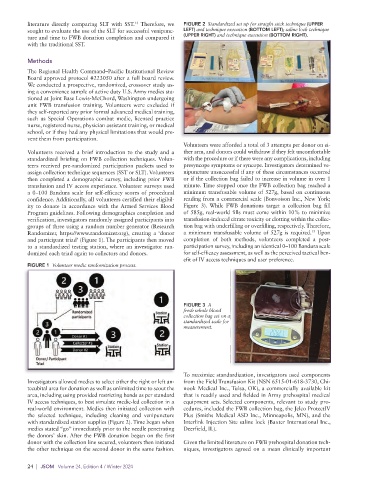
          and participant triad’ (Figure 1). The participants then moved   completion of both methods, volunteers completed a post-
          to a standardized testing station, where an investigator ran-  participation survey, including an identical 0–100 Bandura scale
          domized each triad again to collectors and donors.  for self-efficacy assessment, as well as the perceived tactical ben-
                                                             efit of IV access techniques and user preference.
          FIGURE 1  Volunteer medic randomization process.


                                                             FIGURE 3  A
                                                             fresh whole blood
                                                             collection bag set on a
                                                             standardized scale for
                                                             measurement.


                                                             To maximize standardization, investigators used components
          Investigators allowed medics to select either the right or left an-  from the Field Transfusion Kit (NSN 6515-01-618-3730, Chi-
          tecubital area for donation as well as unlimited time to scout the   nook Medical Inc., Tulsa, OK), a commercially available kit
          area, including using provided restricting bands as per standard   that is readily used and fielded in Army prehospital medical
          IV access techniques, to best simulate medic-led collection in a   equipment sets. Selected components, relevant to study pro-
          real-world environment. Medics then initiated collection with   cedures, included the FWB collection bag, the Jelco ProtectIV
          the selected technique, including cleaning and venipuncture   Plus (Smiths Medical ASD Inc., Minneapolis, MN), and the
          with standardized station supplies (Figure 2). Time began when   Interlink Injection Site saline lock (Baxter International Inc.,
          medics stated “go” immediately prior to the needle penetrating   Deerfield, IL).
          the donors’ skin. After the FWB donation began on the first
          donor with the collection line secured, volunteers then initiated   Given the limited literature on FWB prehospital donation tech-
          the other technique on the second donor in the same fashion.   niques, investigators agreed on a mean clinically important

          24  |  JSOM   Volume 24, Edition 4 / Winter 2024

