


Page 21 - JSOM Winter 2024
P. 21
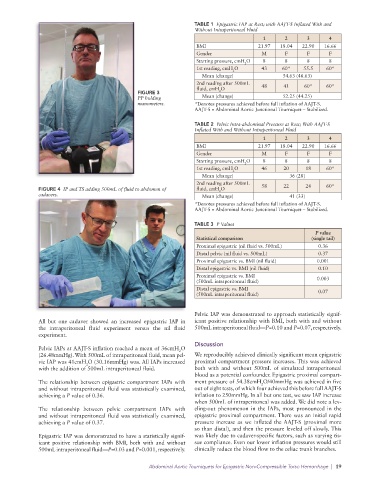
TABLE 1  Epigastric IAP at Rest; with AAJT-S Inflated With and
                                                                 Without Intraperitoneal Fluid
                                                                                       1      2      3       4
                                                                 BMI                 21.97   18.04  22.90  16.66
                                                                 Gender                M      F      F       F
                                                                 Starting pressure, cmH O  8  8      8       8
                                                                                 2
                                                                 1st reading, cmH O   43     60*    55.5    60*
                                                                             2
                                                                   Mean (change)             54.63 (46.63)
                                                                 2nd reading after 500mL   48  41   60*     60*
                                                                 fluid, cmH O
                                              FIGURE 3                   2
                                              PP holding           Mean (change)             52.25 (44.25)
                                              manometers.        *Denotes pressures achieved before full inflation of AAJT-S.
                                                                 AAJT-S = Abdominal Aortic Junctional Tourniquet – Stabilized.

                                                                 TABLE 2  Pelvic Intra-abdominal Pressure at Rest; With AAJT-S
                                                                 Inflated With and Without Intraperitoneal Fluid
                                                                                       1      2      3       4
                                                                 BMI                 21.97   18.04  22.90  16.66
                                                                 Gender                M      F      F       F
                                                                 Starting pressure, cmH O  8  8      8       8
                                                                                 2
                                                                 1st reading, cmH O   46      20     18     60*
                                                                             2
                                                                   Mean (change)                36 (28)
                                                                 2nd reading after 500mL   58  22    24     60*
              FIGURE 4  IP and TS adding 500mL of fluid to abdomen of   fluid, cmH O
                                                                         2
              cadavers.                                            Mean (change)                41 (33)
                                                                 *Denotes pressures achieved before full inflation of AAJT-S.
                                                                 AAJT-S = Abdominal Aortic Junctional Tourniquet – Stabilized.

                                                                 TABLE 3  P Values
                                                                                                        P value
                                                                 Statistical comparison                (single tail)
                                                                 Proximal epigastric (nil fluid vs. 500mL)  0.36
                                                                 Distal pelvic (nil fluid vs. 500mL)     0.37
                                                                 Proximal epigastric vs. BMI (nil fluid)  0.001
                                                                 Distal epigastric vs. BMI (nil fluid)   0.10
                                                                 Proximal epigastric vs. BMI             0.003
                                                                 (500mL intraperitoneal fluid)
                                                                 Distal epigastric vs. BMI
                                                                 (500mL intraperitoneal fluid)           0.07


                                                                 Pelvic IAP was demonstrated to approach statistically signif-
              All but one cadaver showed an increased epigastric IAP in   icant positive relationship with BMI, both with and without
              the intraperitoneal fluid experiment versus the nil fluid   500mL intraperitoneal fluid—P=0.10 and P=0.07, respectively.
              experiment.
                                                                 Discussion
              Pelvic IAPs at AAJT-S inflation reached a mean of 36cmH O
                                                            2
              (26.48mmHg). With 500mL of intraperitoneal fluid, mean pel-  We reproducibly achieved clinically significant mean epigastric
              vic IAP was 41cmH O (30.16mmHg) was. All IAPs increased   proximal compartment pressure increases. This was achieved
                             2
              with the addition of 500mL intraperitoneal fluid.  both with and without 500mL of simulated intraperitoneal
                                                                 blood as a potential confounder. Epigastric proximal compart-
              The relationship between epigastric compartment IAPs with   ment pressure of 54.38cmH O/40mmHg was achieved in five
                                                                                      2
              and without intraperitoneal fluid was statistically examined,   out of eight tests, of which four achieved this before full AAJT-S
              achieving a P value of 0.36.                       inflation to 250mmHg. In all but one test, we saw IAP increase
                                                                 when 500mL of intraperitoneal was added. We did note a lev-
              The relationship between pelvic compartment IAPs with   eling-out  phenomenon  in  the  IAPs,  most  pronounced  in  the
              and without intraperitoneal fluid was statistically examined,   epigastric proximal compartment. There was an initial rapid
              achieving a P value of 0.37.                       pressure increase as we inflated the AAJT-S (proximal more
                                                                 so than distal), and then the pressure leveled off slowly. This
              Epigastric IAP was demonstrated to have a statistically signif-  was likely due to cadaver-specific factors, such as varying tis-
              icant  positive  relationship  with  BMI,  both  with  and  without   sue compliance. Even our lower inflation pressures would still
              500mL intraperitoneal fluid—P=0.03 and P=0.001, respectively.  clinically reduce the blood flow to the celiac trunk branches.

                                                  Abdominal Aortic Tourniquets for Epigastric Non-Compressible Torso Hemorrhage  |  19

