


Page 20 - JSOM Winter 2024
P. 20
hemorrhage by 50%. However, these interventions are un-  anatomy lab records for the selected donors, as was photo-
          likely to ever fall within the practice scope of combat med-  graphic and scientific consent. Ethics board approval was not
          ics. Resuscitative endovascular balloon occlusion of the aorta   sought as this is not required for UK cadaver studies.
                                                  15
          (REBOA) is an invasive means of arresting NCTH,  but this
                                             6,9
          is not a combat medic–delivered intervention.  The American   A single pilot cadaver was used to test, re-test, validate, and
          College of Surgeons Committee on Trauma and the American   streamline the test process (This cadaver was pre-excluded
          College of Emergency Physicians have also stated that REBOA   from the research due to a prominent midline laparotomy
          should only be employed by a trained acute surgeon, or by an   scar). For each test cadaver, one 4-cm manometric water-filled
          emergency physician or interventionalist when an acute care   balloon was placed intraperitoneally in the epigastric space
          surgeon is immediately available.  A major recent randomized   and another in the retropubic space by two consultant trauma
                                   16
          trial has shown that REBOA use increased bleeding and mor-  surgeons. These were each connected to manometer tubing,
          tality at all time points.  A matched cohort trial on REBOA   a syringe, and three-way tap (Figure 2). Skin around the out-
                             17
          in pelvic trauma showed significantly increased mortality and   lets was clipped to form a seal. Baseline pressures of 8cmH O
                                                                                                           2
                       18
          worse outcomes.  We believe REBOA use may well now be   were set (equating to mean human intra-abdominal pressure
                                                                  29
          significantly curtailed, if not discontinued.      [IAP].)  The AAJT-S was then applied correctly: abdominally,
                                                             centered on the umbilicus, and inflated to 250mmHg as per
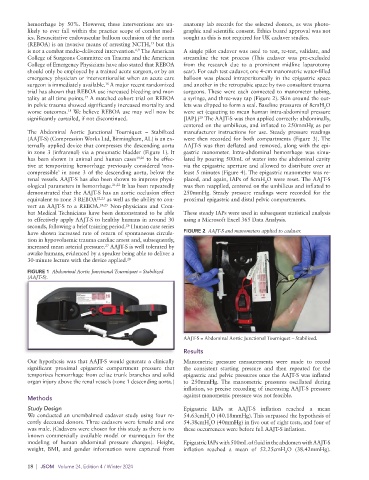
          The Abdominal Aortic  Junctional Tourniquet  –  Stabilized   manufacturer instructions for use. Steady pressure readings
          ( AAJT-S) (Compression Works Ltd, Birmingham, AL) is an ex-  were then recorded for both compartments (Figure 3). The
          ternally applied device that compresses the descending aorta   AAJT-S was then deflated and removed, along with the epi-
          in zone 3 (infrarenal) via a pneumatic bladder (Figure 1). It   gastric manometer. Intra-abdominal hemorrhage was simu-
          has been shown in animal and human cases 19,20  to be effec-  lated by pouring 500mL of water into the abdominal cavity
          tive at temporizing hemorrhage previously considered ‘non-   via the epigastric aperture and allowed to distribute over at
          compressible’ in zone 3 of the descending aorta, below the   least 5 minutes (Figure 4). The epigastric manometer was re-
          renal vessels. AAJT-S has also been shown to improve physi-  placed, and again, IAPs of 8cmH O were reset. The AAJT-S
                                                                                        2
          ological parameters in hemorrhage. 21,22  It has been repeatedly   was then reapplied, centered on the umbilicus and inflated to
          demonstrated that the AAJT-S has an aortic occlusion effect   250mmHg.  Steady pressure  readings  were  recorded  for the
          equivalent to zone 3 REBOA 22,23  as well as the ability to con-  proximal epigastric and distal pelvic compartments.
          vert an AAJT-S to a REBOA. 24,25  Non-physicians and Com-
          bat Medical Technicians have been demonstrated to be able   These steady IAPs were used in subsequent statistical analysis
          to effectively apply AAJT-S to healthy humans in around 30   using a Microsoft Excel 365 Data Analysis.
          seconds, following a brief training period.  Human case series
                                          26
          have shown increased rate of return of spontaneous circula-  FIGURE 2  AAJT-S and manometers applied to cadaver.
          tion in hypovolaemic trauma cardiac arrest and, subsequently,
          increased mean arterial pressure.  AAJT-S is well tolerated by
                                   27
          awake humans, evidenced by a speaker being able to deliver a
          30-minute lecture with the device applied. 28
          FIGURE 1  Abdominal Aortic Junctional Tourniquet – Stabilized
          (AAJT-S).


                                                             AAJT-S = Abdominal Aortic Junctional Tourniquet – Stabilized.

                                                             Results
          Our hypothesis was that AAJT-S would generate a clinically   Manometric pressure measurements were made to record
          significant proximal  epigastric compartment  pressure  that   the  consistent  starting  pressure  and  then  repeated  for  the
          temporizes hemorrhage from celiac trunk branches and solid   epigastric and pelvic pressures once the AAJT-S was inflated
          organ injury above the renal vessels (zone 1 descending aorta.)  to 250mmHg.  The manometric pressures oscillated during
                                                             inflation, so precise recording of increasing AAJT-S pressure
                                                             against manometric pressure was not feasible.
          Methods
          Study Design                                       Epigastric IAPs at  AAJT-S inflation reached a mean
          We conducted an unembalmed cadaver study using four re-  54.63cmH O (40.18mmHg). This surpassed the hypothesis of
                                                                     2
          cently deceased donors. Three cadavers were female and one   54.38cmH O (40mmHg) in five out of eight tests, and four of
                                                                     2
          was male. (Cadavers were chosen for this study as there is no   these occurrences were before full AAJT-S inflation.
          known commercially  available model  or  mannequin  for the
          modeling of human abdominal pressure changes). Height,   Epigastric IAPs with 500mL of fluid in the abdomen with  AAJT-S
          weight,  BMI, and  gender  information  were captured  from   inflation reached a mean of 52.25cmH O (38.42mmHg).
                                                                                              2
          18  |  JSOM   Volume 24, Edition 4 / Winter 2024

