


Page 16 - JSOM Winter 2024
P. 16
Methods                                            FIGURE 1  Temperature trend in trial 3 versus time.
          This study was determined to be basic science research and
          deemed exempt from institutional review board (IRB)-
          approval. All trials were completed on the Okinawa main is-
          land. The trials were completed in the same physical locations
          outdoors, with approximately 4 hours of direct sunlight daily.
          A commercially available 45-liter capacity  Yeti cooler (Yeti
          Holdings, Austin, TX) was used for each trial. Four 500-mL
          saline bags were precooled to 1–6°C and placed in the cooler.
          Bags of ice were purchased from the local economy via a con-
          venience store (Family Mart) and weighed before being placed
          in the cooler.  Two thermometers were placed in the cooler
          adjacent  to  each  saline  bag  to  measure  cooler  temperature
          throughout each trial. One thermometer allowed for commu-
          nication via Bluetooth connection and the other continuously
          recorded and stored the data, which we were able to download   large-scale combat operations in distributed maritime environ-
          after the trial. At t=0, the saline bags, thermometer, and ice   ments as well as when healthcare is employed in support of
          were placed into the cooler and closed.            irregular/unconventional warfare. As war has always been the
                                                             mother of invention, it follows that purely civilian humani-
          Each trial lasted until t=168 hours. Four separate trials, with   tarian applications abound throughout much of the inhabited
          14, 16.7, 15.7, and 7kg of ice, were completed. The ice was   world.
          held at a temperature of –20°C before commercial purchase.
          Approximately 20 minutes elapsed between the removal of the   Blood banking  requires  strict  environmental  control  to en-
          ice and its placement in the cooler. Temperature was recorded   sure safe transfusion in critically ill patients. One aspect of
          once per minute for the duration of each trial. The weight of   this study’s development was the method to continually mon-
          ice varied based on the amount that could be placed within   itor the temperature. Two separate off-the-shelf thermometers
          the cooler. Different shapes of ice were available commercially,   were used, with adequate battery life and one with the ability
          which allowed different maximum amounts of ice. Ice in trial   to transmit data to smartphones via Bluetooth connectivity. In
          4 was approximately half the weight of the ice in the full con-  this study, while a thermometer connected to a smartphone via
          tainer (7kg).                                      a wired connection was used to collect minute-by-minute tem-
                                                             perature data, a wireless temperature probe could likely have
          The  primary outcome  was  hours of  adequate  refrigeration.   been used as well and represents a potential area for future
          Adequate refrigeration is based on the FDA guidelines on   study. Toward the end of each trial, the Bluetooth thermometer
          blood storage temperature,  between 1 and 6°C.     would not always connect, and we suspected that this was due
                               6
                                                             to the influence of liquid water surrounding the thermometer
                                                             decreasing the transmission of electromagnetic waves. When
          Results
                                                             the thermometer would connect to Bluetooth, the authors
          All four trials were completed in 168 hours. Trial 3 was con-  were very satisfied with the ability to have recorded tempera-
          ducted during Typhoon (tropical cyclone) Khanun, and the ex-  tures and assess them via smartphones, in a way that could be
          posed coolers sustained category 4 winds. Besides the storm,   easily used in austere settings.
          there were no significant adverse events during the trial. Trials
          1–3 achieved the goal temperature in >142 hours, while trial   The comparatively low cost of the passive coolers (US$200–
          4, with 7 kg of ice, achieved it in 78 hours (Table 1). A repre-  300) compared with active coolers (US$1,000–10,000) allows
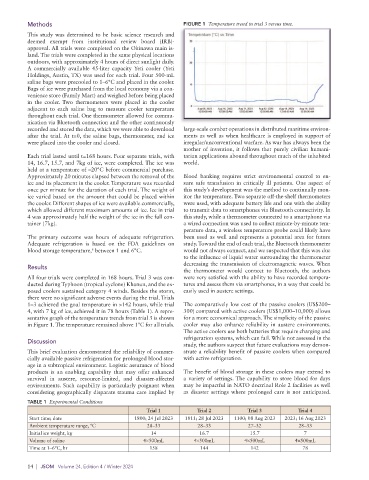
          sentative graph of the temperature trends from trial 3 is shown   for a more economical approach. The simplicity of the passive
          in Figure 1. The temperature remained above 1°C for all trials.  cooler may also enhance reliability in austere environments.
                                                             The active coolers use both batteries that require charging and
                                                             refrigeration systems, which can fail. While not assessed in the
          Discussion
                                                             study, the authors suspect that future evaluations may demon-
          This brief evaluation demonstrated the reliability of commer-  strate a reliability benefit of passive coolers when compared
          cially available passive refrigeration for prolonged blood stor-  with active refrigeration.
          age in a subtropical environment. Logistic assurance of blood
          products is an enabling capability that may offer enhanced   The benefit of blood storage in these coolers may extend to
          survival in austere, resource-limited, and disaster-affected   a variety of settings. The capability to store blood for days
          environments. Such capability is particularly poignant when   may be impactful in NATO doctrinal Role 2 facilities as well
          considering geographically disparate trauma care implied by   as disaster settings where prolonged care is not anticipated.
          TABLE 1  Experimental Conditions
                                                 Trial 1         Trial 2          Trial 3         Trial 4
           Start time; date                  1800; 24 Jul 2023  1811; 28 Jul 2023  1100; 08 Aug 2023  2023; 16 Aug 2023
           Ambient temperature range, °C         28–33            28–33           27–32            28–33
           Initial ice weight, kg                 14              16.7             15.7             7
           Volume of saline                     4×500mL         4×500mL          4×500mL         4×500mL
           Time at 1–6°C, hr                      158             144              142              78

          14  |  JSOM   Volume 24, Edition 4 / Winter 2024

