


Page 12 - JSOM Winter 2024
P. 12
FEATURE ARTICLES                                   An Analysis of Junctional Tourniquet Use Within the Depart-
          Rethinking the Operational Blood Bank Dilemma: Out of the   ment of Defense Trauma Registry: Reneau and colleagues ana-
          “Box” Blood Storage and Transportation Evaluation: Hughey   lyzed Department of Defense Trauma Registry data to determine
          and colleagues conducted 3 trials to determine whether commer-  the real-world efficacy of junctional tourniquet (JTQ) application.
          cially available coolers with ice could be used to store blood com-  They  found  that,  though  rare  in  the  combat  setting  (39  cases),
          ponents. Saline bags (500mL) in place of blood were precooled   JTQ applications in this cohort often involved polytrauma and
          and placed in the coolers next to thermometers that measured   survival was high.
          temperature throughout each trial. Their findings suggest that this   Airway Management in Tactical Combat Casualty Care: TCCC
          passive refrigeration technique presents a viable alternative to tra-  Change 24-1: Shaw and colleagues update the TCCC Guidelines
          ditional blood storage solutions in austere, disaster, and military   on airway management to include new guidance on patient posi-
          operational environments.                          tioning and monitoring as well as management of impaired venti-
          Abdominal Aortic Junctional Tourniquets – Clinically Im-  lation. The revised guidelines also remove the extraglottic airway
          portant Increases in Pressure in Aortic Zone 1 and Zone 3   as an airway adjunct and the Control-Cric as the preferred crico-
          in a Cadaveric Study Directly Relevant to Combat Medics   thyroidotomy device.
          Treating Non-Compressible Torso Hemorrhage:  In this ca-  Traumatic Tension Pneumothorax: A Tale of Two Patholo-
          daver study, Smith and colleagues tested whether the Abdominal   gies:  Thompson and colleagues discuss the etiology, incidence,
            Aortic Junctional Tourniquet – Stabilized (AAJT-S) would tam-  and clinical significance of simple and tension pneumothoraces.
          ponade  bleeding from vessels  of the celiac  trunk  in  descending   The authors then present their 16-point position statement on the
          aorta zone 1 by generating clinically significant proximal epigastric   identification and management of these conditions, which empha-
          compartment pressure. The researchers found that the  AAJT-S at   sizes a conservative approach in spontaneously breathing pneu-
          250mmHg achieves proximal epigastric compartment pressures of   mothorax and a more aggressive approach in positive pressure
          40mmHg, with or without 500mL simulated free blood in the ab-  ventilated tension pneumothorax.
          domen. Accordingly, AAJT-S may be a point-of-injury intervention
          for forward medics that contributes to non-surgical hemorrhage
          control and likely clot stabilization for zone 1 vascular and solid
          organ injuries.
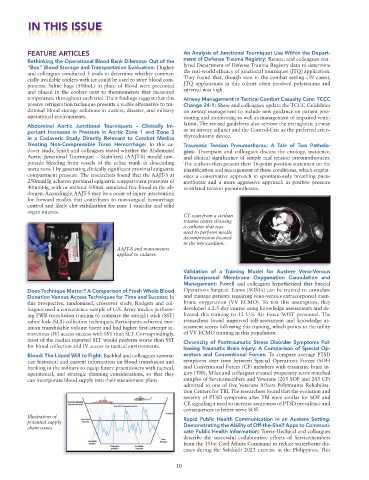
                                                             CT scan from a civilian
                                                             trauma center showing
                                                             a catheter that was
                                                             used to perform needle
                                                             decompression located
                                                             in the myocardium.
                                       AAJT-S and manometers
                                       applied to cadaver.


                                                             Validation of a Training Model for Austere Veno-Venous
                                                             Extracorporeal Membrane Oxygenation Cannulation and
                                                             Management: Powell and colleagues hypothesized that Special
          Does Technique Matter? A Comparison of Fresh Whole Blood   Operations Surgical Teams (SOSTs) can be trained to cannulate
          Donation Venous Access Techniques for Time and Success: In   and manage patients requiring veno-venous extracorporeal mem-
          this prospective, randomized, crossover study, Rodgers and col-  brane oxygenation (VV ECMO).  To test this assumption, they
          leagues used a convenience sample of U.S. Army medics perform-  developed a 2.5-day course using knowledge assessments and de-
          ing FWB transfusion training to compare the straight stick (SST)   livered this training to 12 U.S. Air Force SOST personnel. The
          saline lock (SLT) collection techniques. Participants achieved min-  researchers found improved self-assessment and knowledge as-
          imum transfusable volume faster and had higher first-attempt in-  sessment scores following this training, which points to the utility
          travenous (IV) access success with SST than SLT. Correspondingly,   of VV ECMO training in this population.
          most of the medics reported SLT would perform worse than SST   Chronicity of Posttraumatic Stress Disorder Symptoms Fol-
          for blood collection and IV access in tactical environments.  lowing Traumatic Brain Injury: A Comparison of Special Op-
          Blood: The Liquid Will to Fight: Bachhal and colleagues summa-  erators and Conventional Forces: To compare average PTSD
          rize historical and current information on blood transfusion and   symptoms over time between Special Operations Forces (SOF)
          banking in the military to equip future practitioners with tactical,   and Conventional Forces (CF) members with traumatic brain in-
          operational, and strategic planning considerations, so that they   jury (TBI), Miles and colleagues created propensity score matched
          can incorporate blood supply into their sustainment plans.  samples of Servicemembers and Veterans (205 SOF and 205 CF)
                                                             admitted to one of five Veterans Affairs Polytrauma Rehabilita-
                                                             tion Centers for TBI. The researchers found that the evolution and
                                                             severity of PTSD symptoms after TBI were similar for SOF and
                                                             CF, signaling a need to increase awareness of PTSD prevalence and
                                                             consequences to better serve SOF.
          Illustration of                                    Rapid Public Health Communication in an Austere Setting:
          potential supply                                   Demonstrating the Ability of Off-the-Shelf Apps to Communi-
          chain issues.
                                                             cate Public Health Information: Torris-Hedlund and colleagues
                                                             describe the successful collaborative efforts of Servicemembers
                                                             from the 351st Civil Affairs Command to reduce waterborne dis-
                                                             eases during the Salaknib 2023 exercise in the Philippines. This

                                                           10

