


Page 13 - JSOM Winter 2024
P. 13
initiative involved harnessing available cell phone applications to   sports-related traumatic hyphema complicated by commotio ret-
              deliver rapid and effective public health messaging, including spe-  inae in a Special Operations unmanned aircraft systems operator,
              cially created infographics.                       requiring teleconsultation and evacuation to specialty care. They
                                                                 additionally provide tailored prehospital strategies to manage
                                                                 these serious injuries.

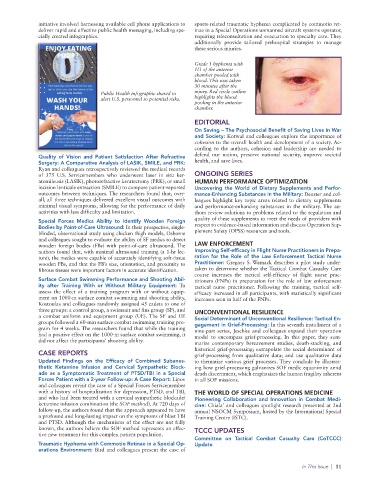
                                                                 Grade 1 hyphema with
                                                                 1/3 of the anterior
                                                                 chamber pooled with
                                                                 blood. This was taken
                                                                 30 minutes after the
                                  Public Health infographic shared to   injury. Red circle outline
                                  alert U.S. personnel to potential risks.  highlights the blood
                                                                 pooling in the anterior
                                                                 chamber.
                                                                 EDITORIAL
                                                                 On Saving – The Psychosocial Benefit of Saving Lives in War
                                                                 and Society: Kotwal and colleagues explore the importance of
                                                                 cohesion to the overall health and development of a society. Ac-
                                                                 cording to the authors, cohesion and leadership are needed to
              Quality of Vision and Patient Satisfaction After Refractive   defend  our  nation,  preserve  national  security, improve  societal
              Surgery: A Comparative Analysis of LASIK, SMILE, and PRK:   health, and save lives.
              Ryan and colleagues retrospectively reviewed the medical records
              of 375 U.S. Servicemembers who underwent laser in situ ker-  ONGOING SERIES
              atomileusis (LASIK), photorefractive keratectomy (PRK), or small   HUMAN PERFORMANCE OPTIMIZATION
              incision lenticule extraction (SMILE) to compare patient-reported   Uncovering the World of Dietary Supplements and Perfor-
              outcomes between techniques. The researchers found that, over-  mance-Enhancing Substances in the Military: Deuster and col-
              all, all three techniques delivered excellent visual outcomes with   leagues highlight key topic areas related to dietary supplements
              minimal visual symptoms, allowing for the performance of daily   and performance-enhancing substances in the military. The au-
              activities with less difficulty and limitation.    thors review solutions to problems related to the regulation and
              Special Forces Medics Ability to Identify Wooden Foreign   quality of these supplements to meet the needs of providers with
              Bodies by Point-of-Care Ultrasound: In their prospective,  single-   respect to evidence-based information and discuss Operation Sup-
              blinded, observational study using chicken thigh models, Osborne   plement Safety (OPSS) resources and tools.
              and colleagues sought to evaluate the ability of SF medics to detect
              wooden foreign bodies (FBs) with point-of-care ultrasound.  The   LAW ENFORCEMENT
              authors found that, with minimal ultrasound training (a 1-hr lec-  Improving Self-efficacy in Flight Nurse Practitioners in Prepa-
              ture), the medics were capable of accurately identifying soft-tissue   ration for the Role of the Law Enforcement Tactical Nurse
              wooden FBs, and that the FB’s size, orientation, and proximity to   Practitioner: Gregory S. Wamack describes a pilot study under-
              fibrous tissues were important factors in accurate identification.  taken to determine whether the Tactical Combat Casualty Care
                                                                 course increases the tactical self-efficacy of flight nurse prac-
              Surface Combat Swimming Performance and Shooting Abil-  titioners (FNPs) in preparation for the role of law enforcement
              ity after Training  With or Without Military Equipment:  To   tactical nurse practitioner. Following the training, tactical self-
              assess the effect of a training program with or without equip-  efficacy increased in all participants, with statistically significant
              ment on 1000-m surface combat swimming and shooting ability,   increases seen in half of the FNPs.
              Kostoulas and colleagues randomly assigned 45 cadets to one of
              three groups: a control group, a swimsuit and fins group (SF), and   UNCONVENTIONAL RESILIENCE
              a combat uniform and equipment group (UE). The SF and UE   Social Determinant of Unconventional Resilience: Tactical En-
              groups followed a 60-min surface combat swimming training pro-  gagement in Grief-Processing: In this seventh installment of a
              gram for 4 weeks. The researchers found that while the training   nine-part series, Jeschke and colleagues expand their operation
              had a positive effect on the 1000-m surface combat swimming, it   model to encompass grief-processing. In this paper, they sum-
              did not affect the participants’ shooting ability.  marize contemporary bereavement studies, death-stacking, and
                                                                 historical grief-processing; extrapolate the social determinant of
              CASE REPORTS                                       grief-processing from qualitative data; and use qualitative data
              Updated Findings on the Efficacy of Combined Subanes-  to thematize various grief processes. They conclude by illustrat-
              thetic Ketamine Infusion and Cervical Sympathetic Block-  ing how grief-processing galvanizes SOF medic equanimity amid
              ade as a Symptomatic Treatment of PTSD/TBI in a Special   death discernment, which emphasizes the human fragility inherent
              Forces Patient with a 2-year Follow-up: A Case Report: Lipov   in all SOF missions.
              and colleagues revisit the case of a Special Forces Servicemember
              with a history of hospitalization for depression, PTSD, and TBI,   THE WORLD OF SPECIAL OPERATIONS MEDICINE
              and who had been treated with a cervical sympathetic blockade/   Pioneering Collaboration and Innovation in Combat Medi-
              ketamine infusion combination (the SOF method). At 720 days of   cine: Chiala’ and colleagues spotlight research presented at 2nd
              follow-up, the authors found that the approach appeared to have   annual NSOCM Symposium, hosted by the International Special
              a profound and long-lasting impact on the symptoms of blast TBI   Training Centre (ISTC).
              and PTSD. Although the mechanisms of the effect are not fully
              known, the authors believe the SOF method represents an effec-  TCCC UPDATES
              tive new treatment for this complex patient population.
                                                                 Committee on Tactical Combat Casualty Care (CoTCCC)
              Traumatic Hyphema with Commotio Retinae in a Special Op-  Update
              erations Environment: Bird and colleagues present the case of

                                                                                                    In This Issue  |  11

