


Page 27 - JSOM Winter 2024
P. 27
difference of 60 seconds between techniques for FWB collec-  TABLE 1  Volunteer Demographics
              tion times. This represents approximately 10% of the upper                        PIV access technique
              limit for FWB collection times described by the American Red        Total, no. (%);    performed first, no. (%)
              Cross as well as prior medic-based IV literature. 11,12  Using a        n=23     SLT; n=10  SST; n=13
              crossover design, a power analysis established a required sam-  Sex
              ple size of 15 medics to complete both arms of the study.
                                                                 Male                21 (92)    8 (80)   13 (100)
              Continuous variables, including time, rate accuracy, volume ac-  Female  1 (4)    1 (10)    0 (0)
              curacy, and user confidence, were analyzed using a Mann-Whit-  Preferred no answer  1 (4)  1 (10)  0 (0)
              ney U test, while ordinal data of user appraisal was analyzed   Age, yr           5 (50)    7 (54)
              using a  Wilcoxon Signed-Rank test. Demographic data was   18–22       12 (52)    4 (40)    5 (38)
              evaluated  using  Microsoft  Excel  (Microsoft  Corp.,  Seattle,   23–30  9 (39)  1 (10)    1 (8)
              WA), while all other data was analyzed with DATAtab: Online   >31       2 (9)
              Statistics Calculator (DATAtab e.U., Graz, Austria).
                                                                 Grade
                                                                 E2–E3               8 (35)     3 (30)    5 (39)
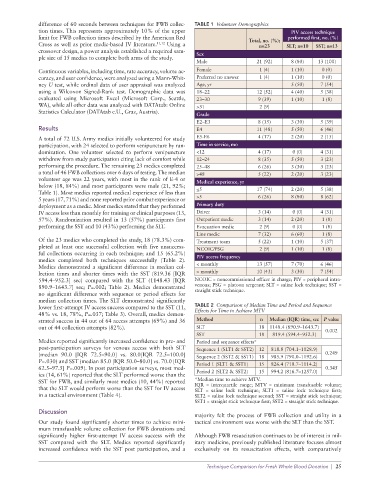
              Results                                            E4                  11 (48)    5 (50)    6 (46)
              A total of 72 U.S. Army medics initially volunteered for study   E5-E6  4 (17)    2 (20)    2 (15)
              participation, with 24 selected to perform venipuncture by ran-  Time in service, mo
              domization. One volunteer selected to perform venipuncture   <12       4 (17)      0 (0)    4 (31)
              withdrew from study participation citing lack of comfort while   12–24   8 (35)   5 (50)    3 (23)
              performing the procedure. The remaining 23 medics completed   25–48    6 (26)     3 (30)    3 (23)
              a total of 46 FWB collections over 6 days of testing. The median   >48   5 (22)   2 (20)    3 (23)
              volunteer age was 22 years, with most in the rank of E-4 or   Medical experience, yr
              below (18, 84%) and most participants were male (21, 92%;
                Table 1). Most medics reported medical experience of less than   <5   17 (74)   2 (20)    5 (38)
              5 years (17, 71%) and none reported prior combat experience or   >5    6 (26)     8 (80)    8 (62)
              deployment as a medic. Most medics stated that they performed   Primary duty
              IV access less than monthly for training or clinical purposes (13,   Driver  3 (14)  0 (0)  4 (31)
              57%). Randomization resulted in 13 (57%) participants first   Outpatient medic  3 (14)  2 (20)  1 (8)
              performing the SST and 10 (43%) performing the SLT.  Evacuation medic   2 (9)      0 (0)    1 (8)
                                                                 Line medic          7 (32)     6 (60)    1 (8)
              Of the 23 medics who completed the study, 18 (78.3%) com-  Treatment team  5 (22)  1 (10)   5 (37)
              pleted at least one successful collection with five unsuccess-  NCOIC/PSG  2 (9)  1 (10)    1 (8)
              ful collections occurring in each technique; and 15 (65.2%)
              medics  completed  both  techniques  successfully  (Table  2).   PIV access frequency
              Medics demonstrated a significant difference in median col-  < monthly  13 (57)   7 (70)    6 (46)
              lection times and shorter times with the SST (819.36 [IQR   > monthly  10 (43)    3 (30)    7 (54)
              594.4–952.3] sec) compared with the SLT (1148.43 [IQR   NCOIC = noncommissioned officer in charge; PIV = peripheral intra-
              890.9–1643.7] sec;  P=.002;  Table 2). Medics demonstrated   venous; PSG = platoon sergeant; SLT = saline lock technique; SST =
              no significant difference with sequence or period effects for   straight stick technique.
              median collection times. The SLT demonstrated significantly
              lower first-attempt IV access success compared to the SST (11,   TABLE 2  Comparison of Median Time and Period and Sequence
              48% vs. 18, 78%, P=.037; Table 3). Overall, medics demon-  Effects for Time to Achieve MTV
              strated success in 44 out of 64 access attempts (69%) and 36   Method   n  Median (IQR) time, sec P value
              out of 44 collection attempts (82%).               SLT                  18  1148.4 (890.9–1643.7)  0.002
                                                                 SST                  18  819.4 (594.4–952.3)
              Medics reported significantly increased confidence in pre- and   Period and sequence effects*
              post-participation surveys for venous access with both SLT   Sequence 1 (SLT1 & SST2)  12  818.8 (704.1–1028.9)
              (median 90.0 [IQR 72.5–90.0] vs. 80.0[IQR  72.5–100.0]   Sequence 2 (SST2 & SST1)  18  985.9 (790.0–1192.6)  0.249
              P=.030) and SST (median 85.0 [IQR 50.0–80.0] vs. 70.0 [IQR   Period 1 (SLT1 & SST1)  15  826.4 (718.7–1114.2)
              62.5–97.5] P=.009). In post participation surveys, most med-                                 0.345
              ics (14, 61%) reported that the SLT performed worse than the   Period 2 (SLT2 & SST2)  15  994.2 (816.7–1257.0)
              SST for FWB, and similarly most medics (10, 44%) reported   *Median time to achieve MTV.
              that the SLT would perform worse than the SST for IV access   IQR  =  interquartile  range;  MTV  =  minimum  transfusable  volume;
                                                                 SLT = saline lock technique; SLT1 = saline lock technique first;
              in a tactical environment (Table 4).               SLT2 = saline lock technique second; SST = straight stick technique;
                                                                 SST1 = straight stick technique first; SST2 = straight stick technique.
              Discussion
                                                                 majority felt the process of FWB collection and utility in a
              Our study found significantly shorter times to achieve mini-  tactical environment was worse with the SLT than the SST.
              mum transfusable volume collection for FWB donations and
              significantly higher first-attempt IV access success with the   Although FWB resuscitation continues to be of interest in mil-
              SST  compared with  the  SLT. Medics  reported  significantly   itary medicine, previously published literature focuses almost
              increased confidence with the SST post participation, and a   exclusively on its resuscitation effects, with comparatively

                                                                    Technique Comparison for Fresh Whole Blood Donation  |  25

